Tampa Bay Lightning general manager Julien BriseBois continues to be active with deals again at the 2025 NHL Trade Deadline. The Lightning’s forward core had some gaping holes, and the team has gotten away with cheap, defensive-specialist forwards in their bottom six up to this point in the season.
Related: Grading the Lightning’s Trade for Oliver Bjorkstrand & Yanni Gourde
However, with the recent hot streak of winning nine of their last 10 contests, BriseBois and Tampa Bay believe they have a chance at a third Stanley Cup this decade. Therefore, the Lightning went out and acquired Oliver Bjorkstrand and Yanni Gourde from the Seattle Kraken. The cost was plenty, including first-round picks in 2026 and 2027, a second-round pick in 2025, and depth winger Michael Eyssimont.
Teams continue to move away from “pure-rental” acquisitions at the deadline, meaning they want to find players with at least an additional year of term. Bjorkstrand is signed at $5.4 million through the 2025-26 season. How will the 29-year-old winger impact the Lightning forward core, and was he the right fit to fill the missing void?
About Oliver Bjorkstrand
A prolific goal-scorer in his junior days with the Portland Winterhawks in the Western Hockey League, Bjorkstrand slowly worked his way up through the Columbus Blue Jackets system to crack the NHL roster. Columbus selected the native of Denmark in the third round of the 2013 NHL Entry Draft at 89th overall. After scoring 28 goals and recording 57 points in 2021-22 with the Blue Jackets, the Seattle Kraken saw Bjorkstrand as an effective player to add to their uprising core and traded for him in the 2022 offseason. Last season, Bjorkstrand set a new career-high in points, registering 20 goals and 39 assists in 82 games.
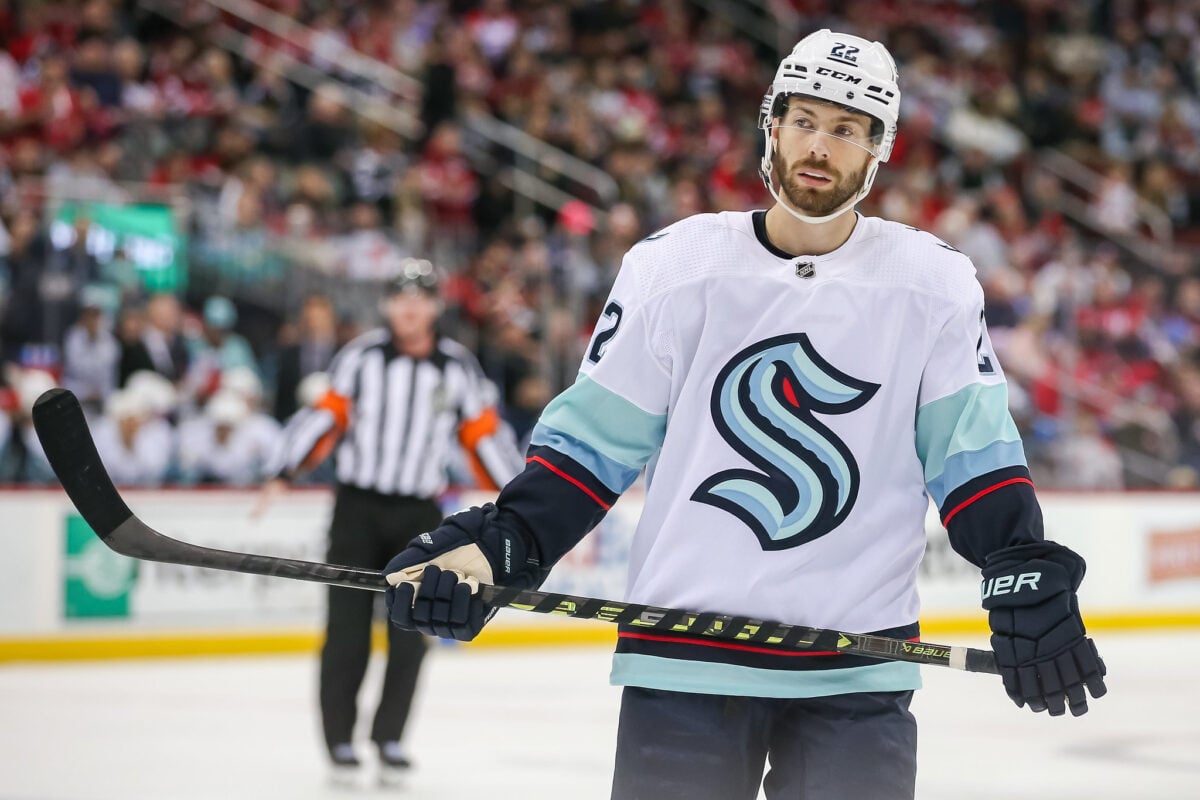
Bjorkstrand is best known for his quick and powerful shot who is able to surprise goaltenders with his heavy and accurate release. He’s a methodical player on the ice and doesn’t rely on foot speed to create and set up scoring chances. He’s ranked in the 55th percentile or lower in Speed Bursts Over 20 mph via NHL Edge. Does this play style align with Tampa Bay’s current roster construction?
Bjorkstrand’s Defensive Skillset and Hidden Tool
Another attribute that stands out in Bjorkstrand’s game is his defensive ability. While he has reached nearly 60 points in a season, his contributions on defense don’t drop off. In other words, Bjorkstrand can sustain solid offensive production while providing a well-above-average defensive impact relative to his position. After all, hockey has always been what you create minus what you give up.
His goal plus/minus per 60 relative to his teammates at five-on-five ranks fourth amongst Kraken skaters this season. That statistic comes from Evolving Hockey, and the goal is to calculate a player’s goal differential (plus or minus) per 60 minutes of ice time, compared to the average goal differential of their teammates. Furthermore, Bjorkstrand has the underlying metrics to back up his steady goal differential. His expected goal plus/minus relative to his teammates ranks third on Seattle behind his Lightning teammates Gourde and Matty Beniers.
Bjorkstrand has another hidden tool in his game that will considerably aid the Lightning forward core beyond this season. The Lightning rank in the 86th percentile of shots off defensive zone exits per 60 via Corey Sznajder at All Three Zones. The hidden tool in Bjorkstrand’s game is his consistently good breakout microstats from Sznajder’s stat cards. He ranks in the 91st percentile of defensive zone exits per 60 this season, in the 88th percentile last season, and in the 94th percentile in 2022-23. With his ability to transition from defense to offense, Bjorkstrand is a potential glove-like fit for the Lightning forward core due to their style of turning defensive zone exits into shot attempts.
Where Bjorkstrand Fits in the Lineup
The Lightning have a few options with Bjorkstrand in the lineup because he’s such a versatile player. The lack of a second-line scoring winger was temporarily fixed when Nick Paul jumped up from his third-line center role. In 112 minutes, a line of Paul, Anthony Cirelli, and Brandon Hagel controlled 58.9% of the on-ice expected goal share at five-on-five via MoneyPuck. The issue with this move is that the bottom six became very weak once Paul was off the third line. However, that’s where Tampa Bay’s two newest trade acquisitions come into play.
Therefore, the first option would be keeping the Kraken combination of Bjorkstrand and Gourde on Tampa Bay’s third line since the two played together regularly in Seattle. The instant chemistry and familiarity might be a good way to ease Bjorkstrand into the Lightning’s systems while also helping Gourde get a feel for his old team again.
Another option is to play Bjorkstrand on the second-line right wing and stack the top-six forward group. With his defensive ability aligning with Cirelli and Hagel, Bjorkstrand would help add a third threat off the cycle and the rush for this dynamic duo. The Lightning could then stack their third line with defensive specialists who are also able to provide a secondary scoring punch like Paul and Gourde.
Despite the hefty price tag, there’s no question Bjorkstrand will help the Lightning for this season and beyond. His methodical pace, finishing ability, and steady defensive play make him a well-rounded piece for the forward core.
