- Four Preseason Games Turn Camp Into a Speed Round
- Koivunen and McGroarty Cannot Afford Slow Starts
- Pittsburgh’s Final Forward Spots Could Be Decided by Tiny Samples
- Goaltending May Be the Hardest Competition to Evaluate
- Pittsburgh’s Blue Line Has the Same Problem
- Muse Has to Treat Practice Differently This September
- Sept. 30 Will Arrive Before Pittsburgh Has Perfect Answers
The Pittsburgh Penguins have four games in six days. That is their entire preseason dress rehearsal before the results start counting.
Pittsburgh’s four-game preseason schedule begins Sept. 21 against the Buffalo Sabres, continues the following night against the Detroit Red Wings, then shifts to road games in Columbus on Sept. 24 and Buffalo on Sept. 26. Four days later, the Penguins will open the regular season in Philadelphia on Sept. 30, which will be the first September regular-season game in franchise history.
That would be a tight turnaround for a settled team. Pittsburgh is anything but settled.
Head coach Dan Muse enters his second training camp with 17 legitimate forward candidates, three young goaltenders with reasonable NHL cases and multiple defensemen fighting for places on the blue line. The Penguins wanted competition when they assembled this roster. The NHL’s new schedule has given them very little time to sort through it.
Four Preseason Games Turn Camp Into a Speed Round
The condensed preseason is not unique to Pittsburgh. The NHL’s new collective bargaining agreement expands the regular season from 82 to 84 games beginning in 2026-27 while reducing the preseason to a maximum of four games per club. The Penguins will feel that change more than teams with established depth charts.
A recent look at Pittsburgh’s forward depth counted 17 candidates for a group that can realistically carry only 13 or 14 forwards. Nine appear positioned for top-nine roles, Blake Lizotte and Connor Dewar give Pittsburgh two established fourth-line options, and six more forwards are competing for what may ultimately be one lineup opening and a couple of extra roster spots.
In a traditional six-game preseason, Muse could separate those players into different groups and still provide several of them with multiple meaningful auditions. Four games make that considerably harder, especially when established veterans also need enough work to prepare for Sept. 30.
Every lineup becomes a resource allocation decision. Giving one bubble player a second exhibition game could mean another receives only one.
That makes practice performance more important, but practice cannot replicate an NHL exhibition game. A player can look excellent during drills and controlled scrimmages without showing how his decisions hold up when an opponent is forechecking, finishing checks and trying to win a roster job of his own. Pittsburgh has to make those projections anyway.
Koivunen and McGroarty Cannot Afford Slow Starts
The shortened evaluation window could be particularly unforgiving for Ville Koivunen and Rutger McGroarty. Koivunen’s new eight-year, $32 million contract makes him one of the most fascinating players in camp, but Kyle Dubas has already made clear that the term does not guarantee an NHL job. When discussing the contract, Dubas said Koivunen would still need to earn his opportunity through training camp and exhibition games. That last part becomes more significant when there are only four of them.
Koivunen might receive two preseason appearances. If Pittsburgh wants its established forwards together for the final tuneup in Buffalo, he could receive even less time in the type of game environment Dubas specifically identified as part of his evaluation.
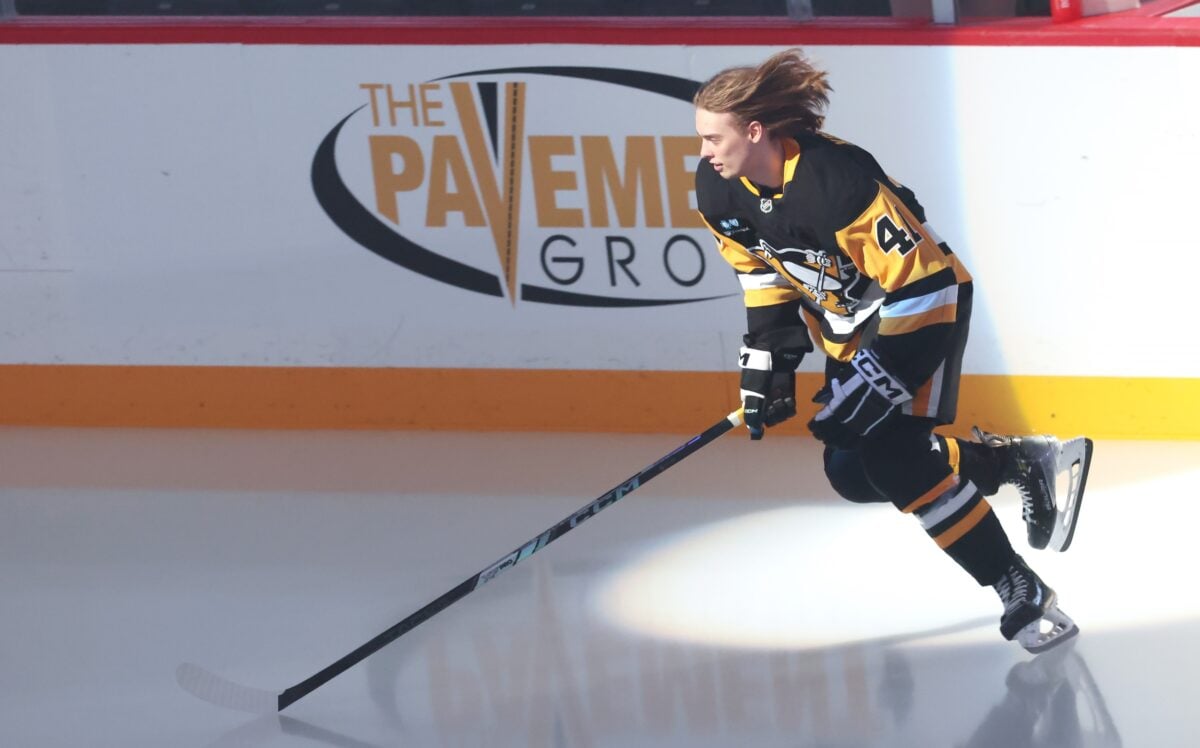
McGroarty faces similar pressure without Koivunen’s contractual security. Pittsburgh’s five biggest roster battles entering camp already included McGroarty competing with Nicholas Robertson and Koivunen for positioning on the wing. The Penguins could easily send McGroarty to Wilkes-Barre/Scranton if he does not force their hand, which makes each exhibition appearance disproportionately important.
Neither player can spend two games finding his timing. In this preseason, the audition could nearly be over by then.
Pittsburgh’s Final Forward Spots Could Be Decided by Tiny Samples
The squeeze extends beyond Pittsburgh’s two most prominent young forwards. Justin Brazeau scored 17 goals last season. Elmer Söderblom offers size and produced enough after arriving in Pittsburgh to remain a legitimate lineup candidate. Hendrix Lapierre cost the Penguins two draft picks to acquire and gives Muse another young center option. Avery Hayes also remains close enough to the NHL to deserve consideration.
PensBurgh grouped Brazeau, Söderblom, Lapierre, Koivunen, McGroarty and Hayes together as six players competing around the bottom of Pittsburgh’s forward roster. Four preseason games make clean comparisons almost impossible.
One player might face Buffalo’s prospect-heavy lineup while another receives minutes against a roster filled with NHL regulars. One could play beside Sidney Crosby or Evgeni Malkin while another gets bottom-six linemates. Special-teams opportunities will vary, and a single mistake could occupy an outsized place in an evaluation simply because there is not enough time for the player to create a larger sample.
That should make Muse cautious about overreacting to preseason statistics. Two goals in two exhibition games should not erase months of organizational evaluation, just as a scoreless week should not automatically send a prospect to Wilkes-Barre/Scranton.
Pittsburgh’s post-free-agency roster projection showed how many reasonable combinations exist before camp even begins. The shortened preseason means Muse may have to trust the larger body of work more than the four games directly in front of him.
Goaltending May Be the Hardest Competition to Evaluate
Forwards are not the only problem. Goaltending may actually be more difficult to solve in four games.
Artūrs Šilovs, Sergei Murashov and Joel Blomqvist enter camp as Pittsburgh’s primary NHL options, with Murashov and Blomqvist trying to turn strong developmental stretches into permanent NHL work. The Penguins’ current goaltending competition carries enough uncertainty that a normal preseason would have been useful for testing each goalie against NHL shooters.
Four games provide only 12 periods of goaltending. Even if Muse divided those periods evenly, each goalie would receive four. Pittsburgh will probably want at least one candidate to play a full game, making the distribution even less convenient.
Goaltending is already volatile in small samples. A prospect can surrender three goals because of defensive breakdowns and look worse statistically than another goalie who faces 15 harmless shots. Making an NHL roster decision from one or two preseason appearances creates obvious risk.
The Penguins will have to lean heavily on what Murashov and Blomqvist have already shown in Wilkes-Barre/Scranton, what Šilovs has shown in the NHL and what the coaching staff sees every day in practice.
Pittsburgh’s Blue Line Has the Same Problem
The defense provides another crowded evaluation. Samuel Girard and Erik Karlsson have established roles, while Trevor van Riemsdyk gives Pittsburgh another veteran option. The uncertainty arrives further down the depth chart, particularly on the left side, where Ryan Graves, Owen Pickering, Declan Carlile and Ilya Solovyov could all factor into the conversation.
Pittsburgh’s left-side uncertainty remains unresolved, and Pickering enters camp needing to show that his improved AHL season can translate into a permanent NHL role. Four exhibition games reduce the amount of evidence Muse can gather before making that decision.
Defensemen can be especially difficult to judge through isolated preseason moments. A clean game may simply mean a player avoided risk, while one glaring turnover can overshadow 20 otherwise responsible minutes.
Pairings will matter too. Pittsburgh has to decide which defensemen deserve jobs while simultaneously testing which combinations actually work together. There simply are not enough preseason games to explore every possibility.
Muse Has to Treat Practice Differently This September
The compressed calendar could change the purpose of training camp itself. Practices cannot merely prepare players for the exhibition schedule. They have to become part of the roster evaluation in a much more serious way, with Muse and his staff creating drills and scrimmages that force players into the situations Pittsburgh needs to judge.
Young forwards competing for scoring roles need repetitions with skilled linemates, not only bottom-of-the-roster practice groups. Centers need defensive-zone work and faceoff responsibilities. Defensemen need difficult retrievals under pressure. Goaltenders need sequences that test rebound control and traffic rather than routine shooting drills.
Muse also has to resist spending too much of the preseason experimenting with combinations that have already proved they work. Pittsburgh knows what Sidney Crosby and Bryan Rust look like together. It has evidence that Evgeni Malkin, Tommy Novak and Egor Chinakhov can create offense as a unit.
September minutes should be spent answering questions the Penguins do not already understand. That is the strange benefit hidden inside the shortened preseason. Pittsburgh does not have enough time to experiment casually, so every decision has to have a purpose.
Sept. 30 Will Arrive Before Pittsburgh Has Perfect Answers
There will probably still be legitimate roster debates when the Penguins leave Buffalo after their final preseason game on Sept. 26. They will have less than four full days before the puck drops against Philadelphia.
There is no extra exhibition at the end of the schedule to settle a tie. There is no week of practice between the final preseason game and opening night.
The new 84-game season was designed to create more meaningful hockey, but Pittsburgh pays for those extra games with a shortened evaluation period. For a roster containing 17 forward candidates, a three-way goaltending competition and an unsettled defensive depth chart, the timing could hardly be less convenient.
That is what makes this camp different from an ordinary September competition. Koivunen, McGroarty, Brazeau, Lapierre, Söderblom, Pickering, Murashov and the rest of Pittsburgh’s bubble players are not competing across a long exhibition schedule where one poor night can disappear into the larger picture.
They have four games. By the time everyone begins to settle in, the Penguins may already have to decide who stays.
Free Newsletter
Get Pittsburgh Penguins coverage delivered to your inbox
In-depth analysis, breaking news, and insider takes - free.
Subscribe Free →