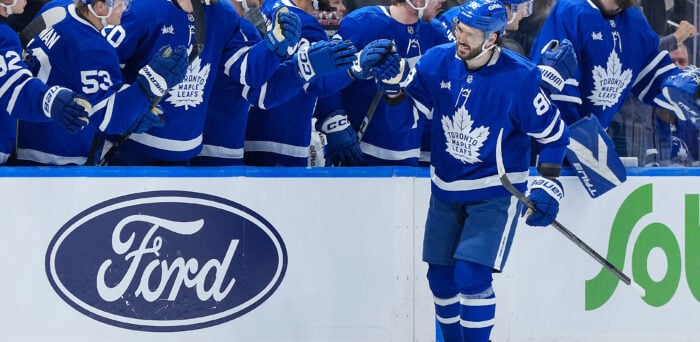
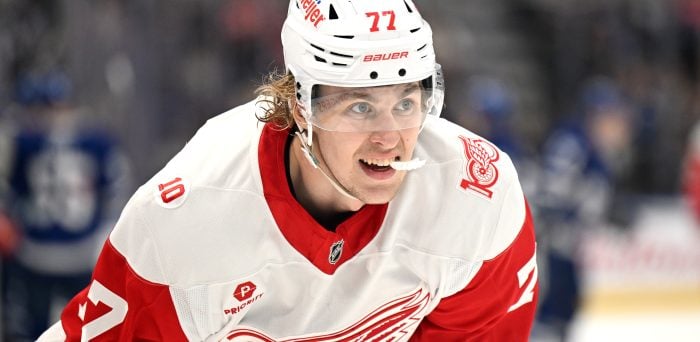
The Detroit Red Wings never wanted to find themselves in this position. Franchise-altering decisions made this offseason were supposed to be about adding, not subtracting. Yet, here they are.
Suddenly, the Red Wings face one of the most consequential decisions of Steve Yzerman’s tenure. Mishandle the situation, and Detroit risks diminishing the return on one of its most valuable assets while setting the franchise back even further. Approach it strategically, however, and the organization could accelerate the transition toward a new core led by Moritz Seider and Lucas Raymond.
With the 2026 NHL Draft rapidly approaching, here’s how the Red Wings should navigate the Dylan Larkin trade talks.
Red Wings’ Strategy for Facilitating the Larkin Trade Talks
Below is a step-by-step process the Red Wings should follow to ensure they maximize their return for Larkin:
- Trade List – Larkin submits a list of teams he’s willing to accept a trade to, which, according to multiple reports, has already happened.
- Notify Teams – Reach out to said teams—plus other interested teams—and give them until the 2026 NHL Draft to negotiate their best offer; non-list teams would need to pitch Larkin on their viability.
- Evaluate & Negotiate – Review offers from interested teams and negotiate if the offers don’t meet asking price; ideal return would need to build toward the Seider/Raymond-led core.
- Make a Decision – If fair offers are presented, then choose the best one ahead of the draft; if no reasonable offers are made, then hold out until one materializes – Yzerman’s goal is to improve the Red Wings, not appease Larkin.
- Determine the Downstream Impact – Chart a path forward based on the decision/return, starting with Detroit’s competitiveness heading into the 2026-27 season.
- Should the Red Wings sell further and move Alex DeBrincat, Justin Faulk, and John Gibson?
- Do the Red Wings get back to business with improving the team via trade/free agency and compete for a playoff spot?
- Does Larkin’s trade request impact the likelihood of Patrick Kane re-signing or Simon Edvinsson’s willingness to sign a long-term extension?
In theory, all of this needs to be done in less than three weeks. Not ideal, but certainly feasible.

The real question is what kind of a return the Red Wings can get for Larkin. His no-movement clause/trade list limits the size of the trade market, which could drive down the acquisition cost. That said, Yzerman has a track record of only committing to deals that make sense and backing away from negotiations that won’t satisfy his preferences.
The truth/result is likely somewhere in the middle. Detroit won’t get fleeced, and Larkin gets his wish.
What the Red Wings Need
With Larkin on his way out, the Red Wings would be left with only two bonafide top-six forwards: DeBrincat and Raymond.
Marco Kasper, Nate Danielson, Michael Brandsegg-Nygard, and Carter Bear may eventually develop into impact players, but projecting prospects is an inexact science. Potential is not certainty.
Given that reality, Detroit’s priority must be adding young talent up front. Ideally, the return includes some of the following:
- A young center under team control who projects as a future top-six contributor
- An NHL-ready forward with legitimate offensive upside
- A premium first-round pick, preferably in the top 10 of the 2026 draft
- Additional assets that complement a centerpiece capable of becoming part of Detroit’s next core
It should be noted, though, that first-round picks vary significantly in value depending on the trade partner involved. Teams such as the Florida Panthers or Seattle Kraken possess picks that are in the top 10, creating an opportunity for Detroit to draft a true difference-maker.
Future first-round picks from established contenders are a different story. Those selections are more likely to come near the end of the opening round, reducing the odds of finding a star.
If Detroit walks away from these negotiations without acquiring at least one piece capable of becoming part of the Seider-Raymond era, the organization likely failed to maximize Larkin’s value
Final Word
Larkin deserved better than another decade of missed expectations, and the Red Wings undoubtedly envisioned him helping lead their return to contention. But once a trade request becomes reality, nostalgia and emotion have to give way to pragmatism.
Again, Yzerman’s responsibility isn’t to facilitate a graceful exit. It’s to maximize the value of one of the organization’s premier assets and position Detroit for long-term success. That means leveraging every interested team, refusing to compromise on the return, and allowing the outcome of these negotiations to shape the next phase of the rebuild.
If the right offer arrives before the draft, the Red Wings should pull the trigger without hesitation. If it doesn’t, they should wait.
The captain’s future may no longer be in Detroit. The franchise’s future, however, still depends on getting this decision right.
Free Newsletter
Get Detroit Red Wings coverage delivered to your inbox
In-depth analysis, breaking news, and insider takes - free.
Subscribe Free →