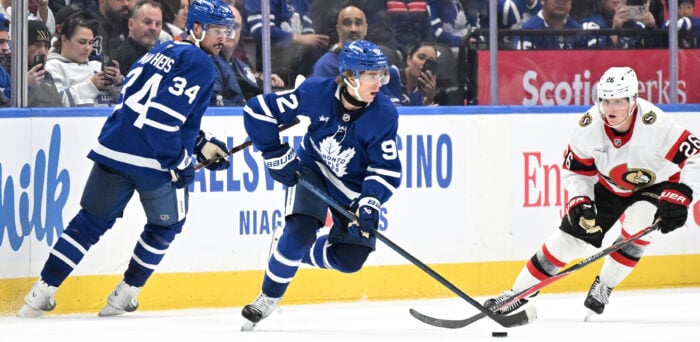
If the Toronto Maple Leafs looked tired against the Minnesota Wild and lost the game 6-3, it’s probably because they were. Sometimes the simplest explanation is the right one, and this schedule hasn’t exactly been gentle.
The media noticed it, as did anyone who watched the game. In fact, Craig Berube was asked after the Minnesota loss whether fatigue was a factor. He didn’t deflect it. He didn’t spin it. He simply acknowledged what the team already knew — and had talked about before puck drop. That conversation matters because it clearly answers the question. The team is tired.
Coaches don’t like to give the idea of fatigue any oxygen. It sounds like excuse-making, and excuses have a way of becoming habits. But Berube didn’t deny reality either. The Maple Leafs felt it coming. And if you take even a quick look at the schedule, it’s hard to argue with them.
Eight Games, 14 Days, 9,000 Kilometres
From Jan. 6 through Jan. 19, the Maple Leafs played eight games in 14 days. They bounced from home to the road and back again, crossed time zones, and logged roughly 9,000 kilometres along the way.
Here’s the travel list, excluding Toronto. Florida. Philadelphia. Vancouver. Colorado. Utah. Las Vegas. Winnipeg. Minnesota.

That’s not a gentle stretch. And while the record looks respectable on paper, the wear doesn’t show up neatly in the standings. It shows up in missed coverage, half-steps, late sticks, and the kind of goals against that feel preventable — until you realize legs are heavy and brains are tired.
How could they not be fatigued?
What’s Coming Isn’t Easier — Just Different
If the last two weeks felt like a grind, the next two won’t offer much relief. Another eight games in 14 days, this time leading into the Olympic break.
The good news? Five of those games are at home, and the travel load drops to about 4,400 kilometres. That helps. Familiar beds, fewer flights, and less disruption matter more than fans often realize.
The bad news? The competition ramps up. Detroit, Vegas, Colorado, then a Western road swing through Seattle, Vancouver, Calgary, and Edmonton. That’s not maintenance hockey. That’s work.

Over four weeks, the Maple Leafs will play 16 games in 29 days and crisscross North America four times. That’s not bad luck. That’s the calendar doing what it does when things are moving quickly.
The Olympic Layer Nobody Likes Talking About
Then there’s the part nobody really wants to confront. After the back-to-back games in Alberta, Auston Matthews, William Nylander, and — if healthy — Oliver Ekman-Larsson will fly back to Toronto, then immediately head to Italy. From Feb. 11 to Feb. 22, they’ll train, practice, and potentially play up to seven high-intensity games in 11 days.
Then they’ll fly back. And Toronto will jump right into another seven games in 11 days.
Matthews has a history of nagging injuries. Nylander is already dealing with something. OEL is 34. That’s a lot of wear over a short span, followed by the expectation that they’ll be fresh enough to carry a playoff push. That’s not criticism. It’s just physics.
The Break — and the Bet
There is a silver lining. Most of the roster will get a much-needed three-week break. That matters too. Legs will recover. Bruises will fade. Minds will reset.
Berube will need those rested players to shoulder more than their usual share when play resumes. And the medical staff will be working overtime to manage Matthews, Nylander, and Ekman-Larsson through a stretch where caution and competitiveness will collide.

(John E. Sokolowski-Imagn Images)
Nobody’s making excuses here. But the schedule is telling a story. The Maple Leafs are tired because the work has been heavy. What comes next will test not just their depth — but their judgment. And that, as always, is where seasons might turn.
Maple Leafs fans should probably give the team a mulligan on the Wild game. There might be real reasons why the team looked tired.
[Note: I want to thank long-time Maple Leafs fan Stan Smith for collaborating with me on this post. Stan’s Facebook profile can be found here.]
Free Newsletter
Get Toronto Maple Leafs coverage delivered to your inbox
In-depth analysis, breaking news, and insider takes - free.
Subscribe Free →