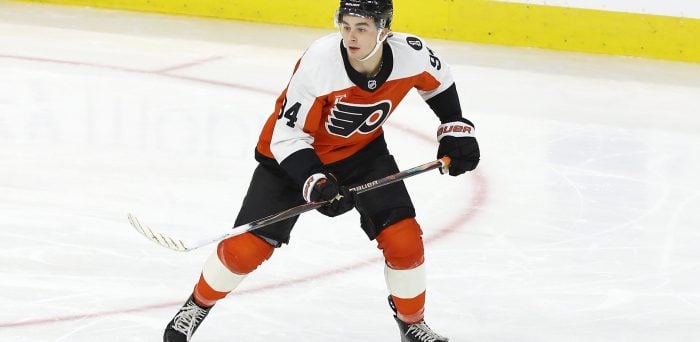
The Los Angeles Kings have spent the last decade building one of the NHL’s most interesting development systems, but what was once supposed to be a clean, simple rebuild has instead turned into a cluttered organization with one of the weakest prospect pools after years of trades and stalled development. During the early stages of their rebuild, the organization built one of hockey’s deepest prospect pools, filled with names like Quinton Byfield, Brandt Clarke, Alex Turcotte, Arthur Kaliyev, and Jordan Spence.
Looking at it now, that pipeline has almost completely collapsed. According to The Hockey Writers’ latest farm system rankings, the Kings currently possess a not-so-good prospect pool in the NHL, ranked 24th out of 32 teams. What was once viewed as a potential successful rebuild has instead become an example of how quickly a prospect system can vanish when development stalls, important assets are traded away, and the organization loses a clear direction of where the team is supposed to be headed.
What Went Wrong?
Every successful team eventually sees its top young players move to the main roster in the NHL from the American Hockey League (AHL). The issue is that the Kings failed to replace their top prospects with enough new young talent. Los Angeles may have spent years accumulating prospects and draft picks during their rebuild, but much of that depth either failed to develop into impact NHL players or was traded away.
Players once viewed as core foundational pieces hit a ceiling offensively or were moved elsewhere before reaching their potential. Players like Liam Greentree (traded from the Los Angeles Kings to the New York Rangers on Feb. 4, 2026), Arthur Kaliyev, who just couldn’t break through and have a dominant season, and Brock Faber, traded to the Minnesota Wild on June 29, 2022, for Kevin Fiala. Since then, Faber has been an absolute rock star for the Wild. In giving away these players that just needed a little bit of room to breathe and grow, the organization slowly lost the depth that once set it apart from the rest of the league.

The timing makes the situation worse. The Kings are not a Stanley Cup contender, yet they also no longer possess the top prospect pipeline that rebuilding teams rely on for long-term growth. Instead, the organization sits in the middle ground between being competitive enough to keep the team afloat, but lacking the young talent necessary to truly improve the roster.
A Look at the Prospect Development Pipeline
A major criticism of the Kings’ development system is that their current players show limited offensive growth. Many prospects entered the system with skill and scoring potential but steadily shifted into more conservative roles, focusing on reliable shift play rather than creating offense. The Kings’ AHL affiliate, the Ontario Reign, reflects that issue. While the organization has long praised its developmental structure and professionalism, the results have become difficult to defend.
Although the Reign have helped many players reach the NHL, such as Byfield and Turcotte, they have rarely produced high-end offensive talent. Their system tends to favor safe, defensively reliable forwards over elite scorers, which translates to depth rather than a top-tier offensive impact.
Good Enough Prospects, Not Great Ones
It becomes even more obvious when examining the organization’s current top prospects. Names including Henry Brzustewicz, Vojtech Cihar, Koehn Ziemmer, Francesco Pinelli, and Jack Hughes are the Kings’ top skater prospects. While there is some intriguing talent among them, none are seen as elite prospects in the broader league view. Cihar and Jared Woolley are participating in the 2026 Memorial Cup, but they remain long-term developmental players rather than guaranteed NHL contributors.
Following another not-so-good 2025-26 season, the organization entered yet another coaching search, with general manager Ken Holland openly discussing the need for changes throughout the roster. Frequent coaching changes create instability for young players. Prospects are forced to adapt to new systems and expectations instead of developing within a stable environment. That instability becomes especially challenging for younger talent still trying to establish confidence at the professional level.
With Anze Kopitar gone and no clear replacement in the system, it further emphasizes how much their prospect pool has weakened. The Kings still have some young talent in the system, and prospects can always exceed expectations; there’s no doubt regarding that. But heading slowly into the 2026-27 season, it’s becoming clear that an organization once known for having one of the deepest prospect pipelines in hockey now sits near the bottom of the league. Until Los Angeles shows it can consistently develop elite NHL players again, questions about its development system are likely to keep growing.
Free Newsletter
Get Los Angeles Kings coverage delivered to your inbox
In-depth analysis, breaking news, and insider takes - free.
Subscribe Free →