It feels like a yearly conversation analyzing how the Ottawa Senators’ special teams aren’t clicking, yet here we are again. Their penalty kill sits at 74.6%, but that is not surprising, given Ottawa’s penalty kill hasn’t been above 80% since the 2022/23 season.
Despite their struggles while shorthanded, the Senators can at least make up for it with their five-on-five defence, which has been among the best in hockey for several seasons now. Their power play, however, is a different story.
How much of a story? It’s second-last in the league at a 13.2% conversion rate and is nine-for-69 on the young season; that’s far worse than anyone could have expected, even with the forward core Ottawa carries. This might not be much of an issue either if the Senators could score more frequently overall, and right now, they can’t.
How Did We Get Here?
Everyone who follows the Senators might have expected some changes to this side of the offence after Daniel Alfredsson left the bench to coach the Toronto Maple Leafs’ power play in a shocking twist this past summer. It also hurts that the Leafs are fifth-best on the man-advantage. Even though fourth-year assistant coach Ben Sexton was promoted to run the power play, there haven’t been that many tweaks in the formats or execution.
Compared to last season when Alfredsson ran it, Ottawa’s power play ranked eighth in the league at a 24.0% conversion rate. That seems like an average stat, but they were also fourth in total goals on the man-advantage with 62, as well as third in shot-attempt percentage (Corsi) at 89.72%.

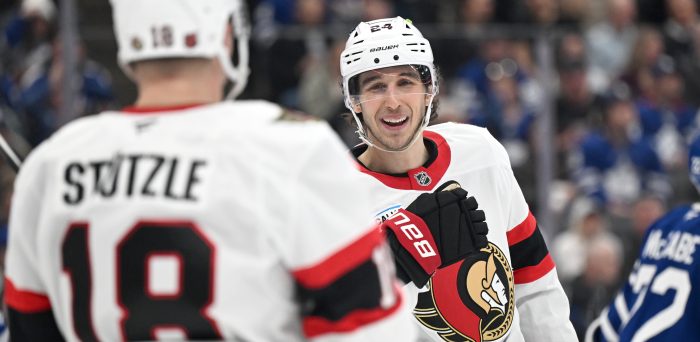
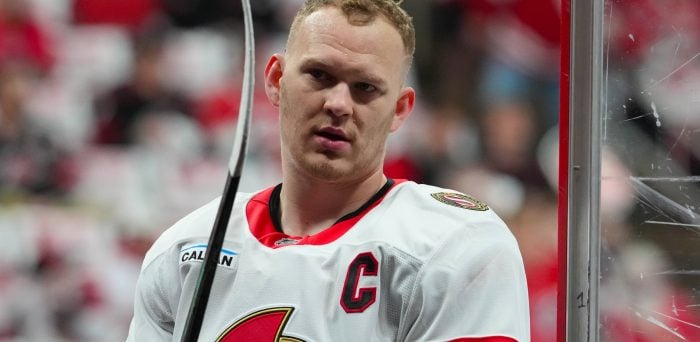
Last season’s structure that led to such successful numbers consisted of a 1-3-1 umbrella setup. Looking at their top unit’s work, two forwards, mainly Tim Stutzle and Drake Batherson, directed the setup along the half-walls on both sides. Another forward would rotate between the mid-and-high-danger lanes as a quick trigger option, mainly being Dylan Cozens. Brady Tkachuk occupied the netfront, and Jake Sanderson manned the point as the quarterback.
This setup especially saw success for Stutzle, Cozens, and Batherson, who weren’t just top-three in team scoring during the last campaign, but combined for 85 points at five-on-four. Claude Giroux, who usually led the second unit along with Thomas Chabot, Shane Pinto and rotating forwards, put up 12 five-on-four points to lead that group.
As smooth as things ran last regular season, it all fell apart once the playoffs rolled around, with the power play going just one-for-21 against a suffocating Carolina Hurricanes penalty kill. While that same Carolina squad went on to win it all, the Senators had their hands tied with the Alfredsson departure and were still forced to find a quick fix in Sexton.
Based on last season’s success, many can understand Ottawa’s thought process in what to do with their manpower advantage for this campaign. They have stuck to the same umbrella structure, as well as some of the same options as last season. Stutzle and Batherson still create plays on each side of the ice, but Cozens has now shifted to the front of the net while Giroux or other rotating forwards are near the slot.
As well, though he doesn’t have all the strengths of an elite power-play quarterback defenseman, Sanderson still mans the top unit up high while Chabot does so for the second. Of Sanderson’s 54 points last season, just 19 of them came at five-on-four, whereas the top defencemen around the league like Cale Makar and Quinn Hughes averaged between 25 and 30.
Short-Term Improvement Solutions
So, what’s really holding this power play back? It’s not like they aren’t shooting enough, as the Sens are 11th in shots at five-on-four with 79. The problem is that they’re shooting from the least effective areas. Ottawa has only generated five – yes, five – high-danger shots on their power play, leaving them 26th amongst all teams. They have 50-plus shots in both-mid-and-low danger territory. For reference, they had 65 high-danger shots at five-on-four last season, good for eighth-best, but also took 380 of them from low-danger territory.
Stacking up one power-play line could make Ottawa more dangerous and generate more chances, but they are already doing so. Outside of Tkachuk, the Senators’ top-five scorers last season were Batherson, Giroux, Cozens, Stutzle, and Sanderson, making them their ‘big guys.’ Almost every team in the league, including the Senators, tends to stack up one power-play line with their best weapons, play them for the majority of the man advantage, and end off with their role players on the second unit. It’s pretty much become the norm of how power plays operate.
Unfortunately for Ottawa, as great as Stutzle’s and Batherson’s playmaking abilities are, they don’t quite have the remaining star power to stack up one line and meet other needs. Who has the hard shot to finish passes on this top unit? Stutzle’s improved on his, but he only has 11 power-play goals in the last two seasons. Cozens and Batherson both led the team in five-on-four goals last season with 13, but they have differing roles and aren’t pure goal scorers.
Alas, this is what the Senators must stick to: a system with their forwards that doesn’t include a heavy shot, but relies on generating offence in all areas of the ice. Shots for deflections, quick plays in the bumper spot, frustrating defenders, and opposing goalies at the top of the crease are Ottawa’s biggest power-play strengths, but they have to change up the options on each unit, especially with Andre Burakovsky and Warren Foegele out of action.
Granted, the Senators have tried this in the past few games, and it’s worked so far. Giroux was moved to the top unit in place of the injured William Eklund, and it’s been needed given how good he is on faceoffs. Also, because of injuries, Philip Tomasino’s getting a chance on the second unit. The power play has shown signs of improvement since, but Ottawa has to keep going with shakeups.
Fabian Zetterlund’s been looking better recently, with three points in his last five games, and he just scored a power-play goal with a beautiful shot upstairs this past Saturday. With his shot, he could give more offence if he had the right playmaker giving him the puck. Stephen Halliday is tied for the team lead in power-play points with four. He could drive the offence on the second unit, but how about getting him in front of the net with his 6-foot-4 frame?

The biggest shakeup, however, must come from the back end. Sanderson can’t take that booming slap shot from beyond the circles, one of his flaws as a power-play quarterback, yet he’s still on the top unit. He and Chabot could easily flip units since Batherson and Stutzle are already the big guns on the first. Let Sanderson grow into his own on unit two, or even put Carter Yakemchuk with him for that extra relief of two defenders.
The Senators have many options for changing who represents their power play, but if things don’t continue to turn around, they have to go deeper and change their structure. They can’t afford to be held back by their own offensive obstacles for much longer, and their defence can’t hold the fort forever – much like they learned against Carolina in last year’s first-round exit.
Free Newsletter
Get Ottawa Senators coverage delivered to your inbox
In-depth analysis, breaking news, and insider takes - free.
Subscribe Free →