The Ottawa Senators have played three games. That is it. Three games is nowhere near enough of a sample to make sweeping conclusions about a team that has legitimate playoff aspirations. A couple of games can be influenced by goaltending, shooting percentages, matchups, special teams or simply the randomness that comes with such a small sample size.
So, consider this exactly what the title says: way too early thoughts. That does not mean there is nothing worth discussing. Three games can still provide some early clues about how a team is shaping up, particularly when viewed alongside what we already know from last season. Some of these trends will almost certainly change as the sample grows, but there are a few things that have stood out through Ottawa’s first three games.
Sanderson’s Injury Is Concerning
The biggest concern coming out of Ottawa’s opening three games has nothing to do with the standings or the team’s play. It is the health of Jake Sanderson.
After Sanderson missed a significant portion of training camp with a lower-body injury, the hope was that he had put the issue behind him by the time the regular season arrived. Unfortunately for Ottawa, that has not been the case.
Sanderson returned to practice Friday and suited up for the season opener against the Toronto Maple Leafs, but he played just six shifts before leaving the game with the injury. He subsequently missed Ottawa’s second game against the Boston Bruins and will not travel with the team for the remainder of the road trip. Travis Green said the injury is “not as serious as it could be,” which should provide some relief for a Senators team that simply cannot afford to lose its top defenceman for an extended period.

Still, it is not an ideal way to begin the season. Sanderson is not just another defenceman on Ottawa’s roster. He is the most important piece of its defensive core and a legitimate No. 1 defenceman.
Last season, Sanderson recorded 14 goals and 40 assists for 52 points in 67 games. He provides Ottawa with virtually everything you want from a modern top-pairing defenceman: he can generate offence, transition the puck himself, create entries and exits, and defend at a high level against tough competition.
The Senators should be encouraged that the injury does not appear to be as serious as initially feared. But the fact that the same issue has followed Sanderson from training camp into the regular season is something worth monitoring closely.
The D-Core Has the Potential to Be Elite
One of the most intriguing aspects of this Senators team is the potential of its defence. If everything breaks right, Ottawa could have a defensive core capable of being among the better groups in the league. Sanderson is the obvious centrepiece. Thomas Chabot remains a legitimate high-end defenceman, while Jordan Spence took another step forward last season and consistently produced strong underlying numbers, particularly with his ability to move the puck.
Then there is Carter Yakemchuk. The 2024 seventh-overall pick had an impressive first American Hockey League (AHL) season last year, recording 40 points as a defenceman. That is a significant accomplishment for a young defenseman in his first year at that level, and there were flashes of what makes Yakemchuk such an intriguing prospect when he played in Ottawa. In particular, his offensive-zone play and ability to make slick transition plays stood out.
The early results this season, however, have not been quite as encouraging. Yakemchuk has been getting caved in territorially when playing with Tyler Kleven, his most common defensive partner. The pair has posted an xGF% of just 16.65% so far this season.
That number obviously comes with an enormous asterisk because of the tiny sample size. Three games is nowhere near enough to make a judgment on a defensive pairing.
There have also been encouraging signs. Yakemchuk has looked considerably better when paired with Chabot, with that duo posting an 73.76% xGF%. Again, though, that number comes from 11:55 of playing time, so it would be irresponsible to treat it as anything more than an early glimpse.
The ideal configuration for Ottawa is likely Sanderson alongside Artem Zub. That pairing was excellent last season. Sanderson and Zub handled the toughest competition, played the most difficult minutes and consistently won those matchups.
Behind them, Chabot and Spence were fantastic together. To illustrate just how dominant that pairing was, they finished last season with 128 scoring chances for compared to just 69 against, the largest margin on the Senators. Their 61.90% High-Danger CF percentage was also outstanding.
That is what makes the potential of Ottawa’s defence so exciting. If Sanderson-Zub can continue to handle the toughest minutes when the boys return, while Chabot-Spence tilt the ice in Ottawa’s favour, the Senators could potentially have a third pairing that does something most teams simply cannot get from their bottom four: consistently push play in the other direction.
For that to happen, Yakemchuk needs to establish himself.
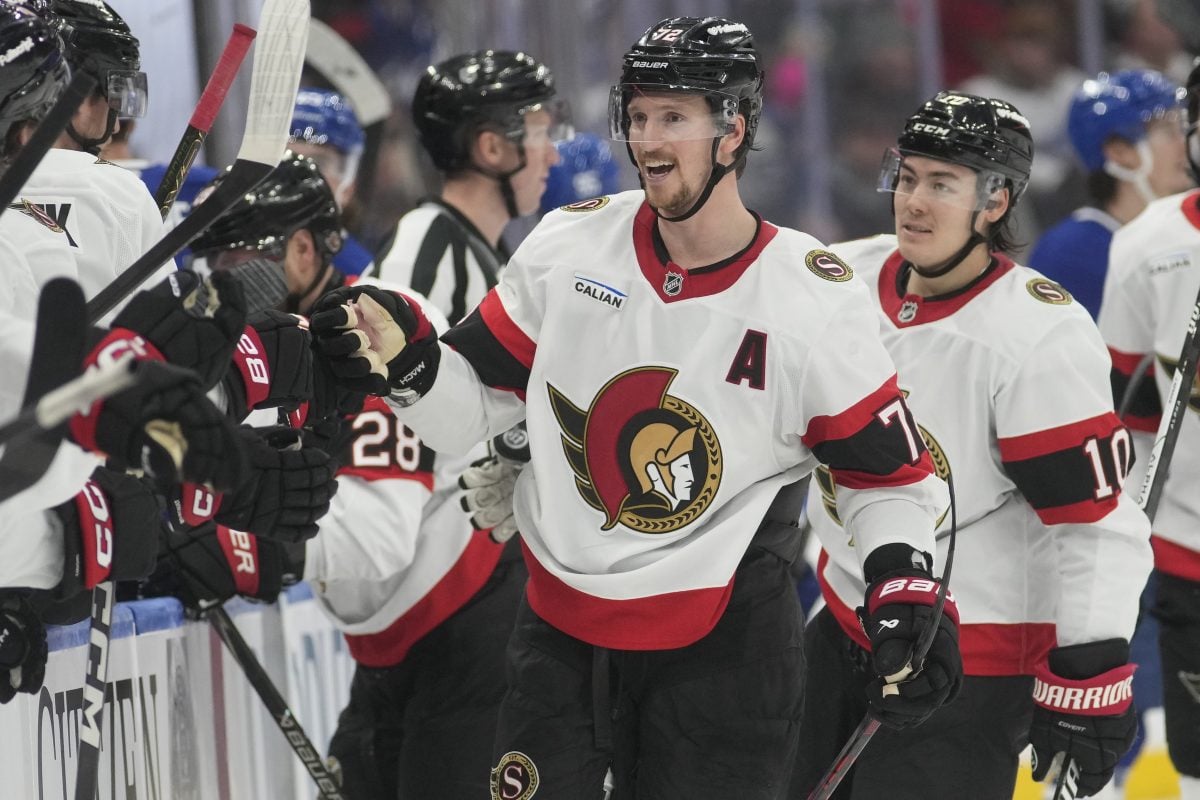
So far, the Yakemchuk-Kleven pairing has not been able to tilt the ice in Ottawa’s favour. It is far too early to make any definitive judgment, but it is certainly something worth watching as the season progresses. Because if Yakemchuk can become that third-pairing anchor, Ottawa’s defence could become a significant advantage.
Stützle Is Off to a Strong Start, But His Line Needs to Be Better
Tim Stützle has the potential to become a top-10 centre in the NHL, and through three games, he has already started the season on a strong note.
Stützle has six points through three games, which is exactly the kind of offensive production Ottawa needs from its top centre. He is an electrifying offensive player who can create chances off the rush, carry the puck through the neutral zone and generate offence in ways few players on the Senators’ roster can.
After putting up 83 points last season, Stützle has the offensive ability to eventually reach the 100-point mark. At just 24 years old, there is still plenty of room for his game to develop.
His work on the penalty kill has also been particularly noticeable early in the season. Stützle has been active in those minutes, using his speed and ability to pressure opposing puck carriers to make an impact. It is another part of his game that has continued to develop, and his ability to contribute in all situations only adds to his value.
The concern, at least this early, is not Stützle himself. It is the performance of his line at five-on-five. Stützle has been playing alongside Drake Batherson and Warren Foegele, and the trio has struggled to control play through the first three games. The line has posted an xGF% of just 19.74%, which is not the type of territorial performance you want to see from your first line.
The actual results have been better, with the trio holding a 1-0 goal differential, but the underlying play suggests they have spent far too much time defending rather than dictating the game.
The first line needs to control play better. That does not mean there is reason to panic. Three games is an extremely small sample, and line combinations can take time to develop. It is also worth remembering that during the preseason, Batherson and Stützle were playing alongside Andre Burakovsky, who brings strong puck skills and could potentially be a better complementary connector for the two.
There is also reason to believe the line can improve. Last season, Batherson and Stützle played together with Claude Giroux and were excellent at controlling play, posting a 59.15% Corsi for percentage.
Stützle’s line with Brady Tkachuk also produced elite underlying numbers in expected goals and high-danger chances last season. While the actual production did not always match those underlying results, Stützle still finished with 83 points.
So, the early takeaway is not that Stützle is struggling. Quite the opposite. Six points in three games is an excellent start, and his penalty killing has been one of the more encouraging aspects of his all-around game.
But if Ottawa wants its top line to drive the team this season, Stützle, Batherson and Foegele will need to spend considerably more time controlling play at five-on-five. The production is there early. Now the territorial game needs to catch up.
The Senators Are Playing a Lower-Event Game
One other early trend worth watching is the overall style of play. Through their first three games, the Senators have played a relatively lower-event game, with fewer chances and less back-and-forth action than we might typically expect from an Ottawa team built around its offensive talent.
With the number of injuries Ottawa is already dealing with, it is fair to wonder whether some of that lower-event style is simply out of necessity. When a team is missing important pieces, there may be less appetite to trade chances and play an overly aggressive game, particularly while the lineup is still finding its footing.
It will be interesting to see whether that trend continues. With Sanderson, Zub, Burakovsky, Kurtis MacDermid, and now Linus Ullmark already dealing with injuries, the circumstances may have forced the team to adjust. Losing key players can change how a team manages the puck, how aggressively its defencemen join the rush and how much offensive risk it is willing to take.
For now, though, the Senators have played three relatively lower-event games. We will see if that trend continues as the sample grows and the team navigates the injuries it is dealing with.
And that, ultimately, is the theme of these first three games: there are plenty of things to watch, but it is far too early to know what any of them really mean.
Three games can give us clues. They cannot give us conclusions.
Free Newsletter
Get Ottawa Senators coverage delivered to your inbox
In-depth analysis, breaking news, and insider takes - free.
Subscribe Free →