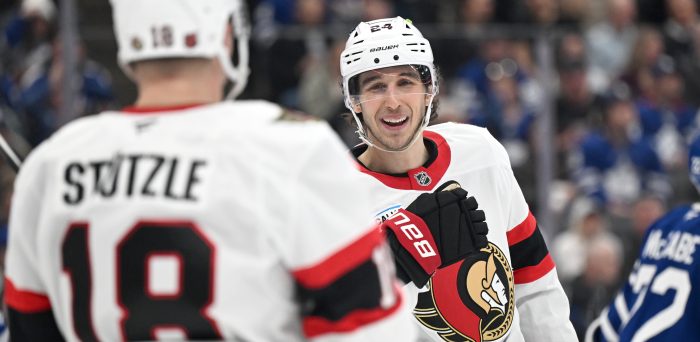
After some steady offensive production in his first season with the club last season – including a career-high 31 points and a plus-15 rating – the Ottawa Senators rewarded Jordan Spence with a five-year, $20 million extension before the offseason began.
With just four points in Ottawa’s 23 games to start this campaign, Spence is on pace for 15 total. Yet, is the contract living up to what general manager Steve Staios hoped it would? Absolutely, just in a different area for the Australian-born defender – his defensive game.
Spence is currently second on the team in goal differential at plus-13, third in shot blocks with 32, as well as third in five-on-five on-ice goals percentage at 70%. To date, he and Thomas Chabot have been one of the most consistent pairings in the league.
We saw how he improved defensively throughout the second half of last season, and for Spence to be starting this strong on the other side of the puck fills a great need for the Senators, further proving they can rely on him.
Spence Has Historically Been a Slow Starter
On both sides of the puck, Spence hasn’t always been the fastest to get going right off the bat. This includes last season, when throughout October and early November, he was a healthy scratch on most occasions by head coach Travis Green.
At the time, Spence was still leading the Senators in goals-for percentage at five-on-five while averaging 19 minutes on the third pair, but his defence seemed to be desired. He had to nearly overhaul his defensive game in order to be a regular on Ottawa’s back end, and he was able to do it to gain a full-time role.

While he did have seven points in as many games to start his previous campaign, offence in the first month or so had been hard to come by before gaining confidence and rhythm when Spence was with the Los Angeles Kings.
At the start of the 2024-25 campaign, he had five points in his first 25 games while generating 27 shots on goal. Not bad shot totals, but he didn’t record any in his first three games before contributing more offensively.
In 2023-24, he started a little better points-wise with nine in that same 25-game stretch, but with 26 shots generated – including just three in his opening nine games.
The point is, while Spence takes a while to get started, he has found ways to eventually find his place in any lineup since becoming a full-time regular. Not only does he recover and get his point totals better every season, but this time, he has a defensive mindset to make up for scoring.
Spence and Chabot Have Been an Outstanding Pair
When the Senators’ line combinations and defensive pairings were being projected at the start of the season, it was always going to be Chabot and Spence paired together.
It was the most logical outcome since there was no separating Jake Sanderson and Artem Zub, and it made sense to put Carter Yakemchuk with Tyler Kleven, who is turning into one of the league’s best third-pairing defencemen.
Because of both Spence’s and Chabot’s offensive abilities and playing styles, the duo wasn’t expected to be all that great defensively. So far, that is far from the case, as they carry the top two plus/minus ratings on the club, Chabot being a plus-16, slightly above Spence’s aforementioned plus-13 rating.

If you look deeper into it, though, their two-way style has been phenomenal. A team-leading goals-against per 60 of 1.66 and 25th amongst all defensive pairs in goals-for per 60 at 4.03. They have accounted for just seven goals against at five-on-five while both are getting offensive chances, averaging over 46 shot attempts a game.
Granted, the two are familiar with one another, having played the fifth-most defensive minutes on the team last season. But their offensive and defensive numbers were nowhere near what they have produced in these first 23 games. They set up 12 goals last season compared to the 17 they have already been involved in.
So why has this worked so well? You can argue Chabot’s experience driving an offence comes into play, and it certainly does. His 12 points in 19 games have him on pace for 53, which would be the second-highest total of his career – he had 55 in his sophomore season in 2018-19.
Spence has shown he can provide the same 30-40-point seasons Chabot has, but he’s also shown an upward trend on the other side of the puck. He allows the fifth-fewest five-on-five high-danger shots against on the team (1.01), and he leads Ottawa in on-ice expected goals per 60 at even strength (3.32).
That means the Senators are on pace for over three goals a game whenever Spence is on the ice for five-on-five play. True, he’s not a defensive specialist like Kleven or Zub, who’s going to be out defending leads at the end of games. But it shows how much of a two-way style Spence brings to this team now compared to the start of last season.
On top of that, he’s disciplined and gets pucks to the net, some of the most important assets a player can bring to a team. Last season, he was third on the team in Wins Above Replacement (WAR) at 2.77. WAR in hockey is determined by goals above replacement (GAR) around offence, defence, shooting and penalties.
We won’t know what that adds up to for Spence until the end of this season, but he consistently posts high shooting percentages, has steady defensive numbers, and takes few penalties. It’s safe to say he should contribute to plenty more Senators wins – unless something changes drastically.
Maybe the points do come for Spence, but Ottawa would want Chabot to continue driving offence on this second pair. After all, if it ain’t broke, don’t fix it.
Free Newsletter
Get Ottawa Senators coverage delivered to your inbox
In-depth analysis, breaking news, and insider takes - free.
Subscribe Free →