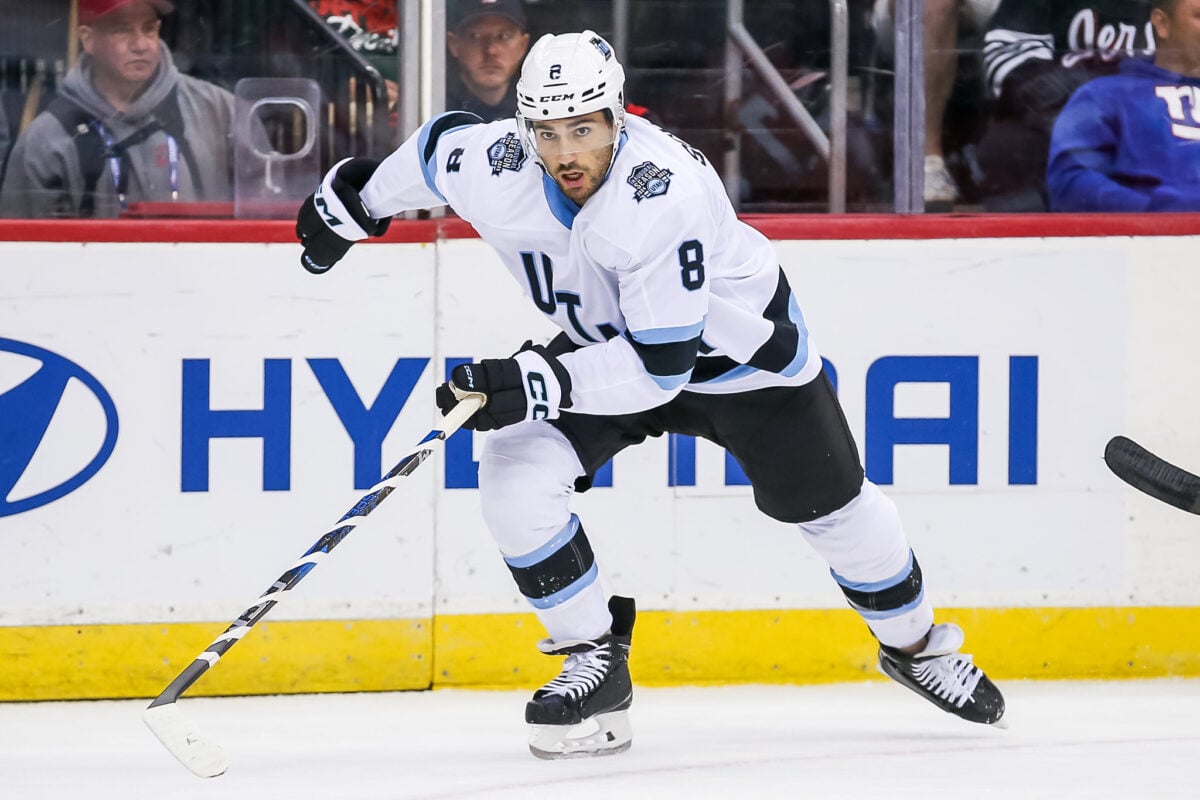
Nick Schmaltz of the Utah Hockey Club scored on the power play against the Nashville Predators on April 14 to get his 20th goal of the season. With the goal, he solidified a new career high in points with 62, before assisting on Utah’s lone goal in their final game of the season to finish with 63 points.
Schmaltz achieved this despite not scoring a goal for the first 23 games (28%) and having two other stretches throughout the season that were seven games or longer without a goal. Despite seemingly fighting the puck at times throughout the season, Schmaltz still managed to achieve his fourth straight 20-goal season and also set a career high in assists.
However, with Utah’s inaugural season in Salt Lake City over and Schmaltz’s contract expiring at the end of next season, it is time to start having the conversation about what Utah should do with the 29-year-old as the offseason approaches.
Schmaltz’s Impact With the Utah Hockey Club
For much of the season, Schmaltz played on Utah’s top line with Clayton Keller and Barrett Hayton or Logan Cooley. This combination of Schmatlz, Keller and Hayton took the opposition’s toughest matchup night in and night out and walked away from the season with an impressive 57.8% expected goal share, averaging 3.4 expected goals while only allowing 2.4 per 60 minutes in their 363 minutes played together at five-on-five.
Even when Utah experimented with Cooley on the top line alongside Keller and Schmaltz, this line still had a significant impact, averaging 4.2 goals per 60 minutes and a 65.5% goal share in the 271 minutes this trio played together at even strength (via Money Puck).
While Schmaltz fit in well with these three players at different points throughout the season, he was not the one driving these lines offensively, only averaging 0.40 primary scoring chance contributions per 60 minutes above the league average, compared to Keller, who averaged 1.63, and Cooley, who averaged 1.24. Even Hayton, who is known as a reliable two-way center, averaged more than Schmaltz at 0.45 (Player Cards, All Three Zones, April 18, 2025).
This lack of primary contributions led to Schmaltz having the highest rate of secondary assists per 60 minutes on Utah, the 23rd highest rate in the NHL among players who played 100 minutes or more at five-on-five. These would have been excellent numbers if it were not for Schmaltz ranking 255th in the NHL in primary assists per 60 minutes (via Natural Stat Trick).
Schmatlz is a unique player who is a highly skilled passer and excels at controlling the puck. However, he does not venture into high-risk areas of the ice and often relies on multiple teammates to finish plays for him. He is a player that almost every team in the NHL would want on one of their middle-six lines, but not someone a Stanley Cup-contending team would want on their top line.
Should Utah Trade Schmaltz This Offseason?
Utah’s willingness to move Schmaltz will likely hinge on whether they can connect on the big swing they have been talking about taking. Schmaltz, now 29 years old, feels slightly disconnected from Utah’s young core. After four straight seasons with just over 20 goals and 58 or more points, it seems he has peaked, and his value is as high as it will ever be.
Branch Rickey, a former Major League Baseball player and executive, once said, “Trade a player a year too early rather than a year too late”, and with Schmaltz setting a career high in points in Utah’s inaugural season in Salt Lake City, this line might be crossing general manager Bill Armstrong’s mind when he knows he may get the chance to offer contracts to pending free agents such as Mitch Marner of the Toronto Maple Leafs or Nikolaj Ehlers of the Winnipeg Jets, who had much more impactful seasons than Schmaltz and are both the same age or younger (NHL Player Cards, The Athletic, April 18, 2025).
If Armstrong were able to convince one of these two players to come to Salt Lake City or trade for someone of similar calibre, Utah should move Schmaltz after closing on a home run acquisition. Say, Utah signs either Marner or Ehlers, either move would likely push Schmaltz into the bottom six forwards—a spot where he would likely thrive and provide depth scoring at a reasonable rate.
However, this would diminish much of the value Schmaltz has built in Arizona and Utah, as he would likely no longer receive the significant minutes at five-on-five and would lose a substantial portion of his power-play minutes, which would drastically affect his production. In addition to that, sliding a veteran player down the lineup in Utah would only hinder the development of numerous up-and-coming, high-ranked prospects, such as Danil But and Tij Iginla, who will be looking to crack the NHL roster next season.
While Schmaltz’s situation is not urgent, it is one that likely depends on the success of other moves this offseason. It is an interesting situation to keep an eye on over the offseason to see if Utah will stay committed to developing their young prospects and give them a shot, and move on from a key piece that has been with this team throughout the entire rebuild process.
Suppose Armstrong can put together another phenomenal offseason, as he did last summer. In that case, I think there’s a good chance we’ll see Schmaltz’s name linked to many different trade conversations.
Free Newsletter
Get Advanced Stats coverage delivered to your inbox
In-depth analysis, breaking news, and insider takes - free.
Subscribe Free →