If you’ve been tracking the Anaheim Ducks’ rebuild, you know patience isn’t just a virtue; it’s a requirement for season ticket holders. But every so often, a prospect arrives who doesn’t just knock on the door of the NHL—he kicks it open.
Beckett Sennecke has been that player this season. He’s in the Calder Trophy conversation.
The Numbers Game
Let’s look at the production, because the stat sheet is usually the first casualty when a teenager jumps straight to the big league. Usually, you expect a talented kid to tread water, maybe putting up a point every other game while they figure out the speed.
Sennecke didn’t get that memo.

He is sitting on 20 points (seven goals, 13 assists) through 26 games. For those keeping track, that’s first among all NHL rookies. That isn’t just a hot week; that is sustained production. He is on an eight-game point streak.
A Big Body with Soft Hands
What makes Sennecke fascinating to watch isn’t just that he scores, but how he scores. Scouts often used the phrase “small player in a big player’s body” during his draft year, implying he had the skill set of a dangler but hadn’t quite figured out how to use his size.
Related – Ducks News & Rumors: Goalie Changes and Young Players Stay Hot
That has changed. At 19 years old, he is learning that his frame is a weapon. Earlier in his development, he might have been shoved off the puck along the wall. Now, he’s using that leverage to muscle off defenders and sustain possession in the offensive zone.
But the finesse is still the headline. His play recognition is arguably already at an elite level. If you caught the game against the Utah Mammoth recently, you saw the overtime winner. Sennecke didn’t just pass the puck; he froze three skaters and the goaltender with a pause that lasted an eternity, waiting for the lane to open before setting up the winner. That is patience you can’t teach. Most rookies panic and throw the puck at the net; Sennecke waits for the picture to develop.
Life on the “Kid Line”
Context matters in the Calder race. Sennecke is doing this heavy lifting in the top six.

He has found immediate chemistry on what Anaheim fans are affectionately calling the “Kid Line,” skating alongside Mason McTavish and Cutter Gauthier. The coaching staff is trusting him with nearly 17 minutes of ice time per night. That is a significant workload for a teenager.
This trio works because they complement one another. McTavish brings the grit and two-way responsibility, Gauthier has the shot, and Sennecke has become the connector—the playmaker who finds the soft ice. He’s also drawing penalties at a high rate (tied for second among rookies), which provides value even when the puck isn’t going in the net.
Growing Pains and the “Dangle” Tax
Now, let’s not paint a picture of perfection. The transition to the NHL is rarely a straight line, and Sennecke has had his “welcome to the show” moments.
The biggest issue right now is risk management. In junior hockey, you can dangle a defenseman at your own blue line and get away with it. In the NHL, that ends up in the back of your net. We saw this against the Dallas Stars, where a failed high-risk move by Sennecke led directly to a goal against.
Related – 3 Things the Ducks Should Be Thankful For
That mistake earned him a brief demotion to the third line, but what is telling is how the coaching staff responded. They didn’t bury him. They are allowing him to play through the errors. They want him to keep those offensive instincts sharp while he learns to eliminate turnovers in the “danger zones.” It’s a delicate balance, but one the Ducks seem committed to navigating.
The “Manchild” Off the Ice
For all the maturity he shows with the puck, it is refreshing to remember that Sennecke is still very much a kid. He’s living on his own, navigating adulthood, but he doesn’t even have a car yet. He relies on teammates for rides to the rink and rooms with fellow young star Leo Carlsson on the road.
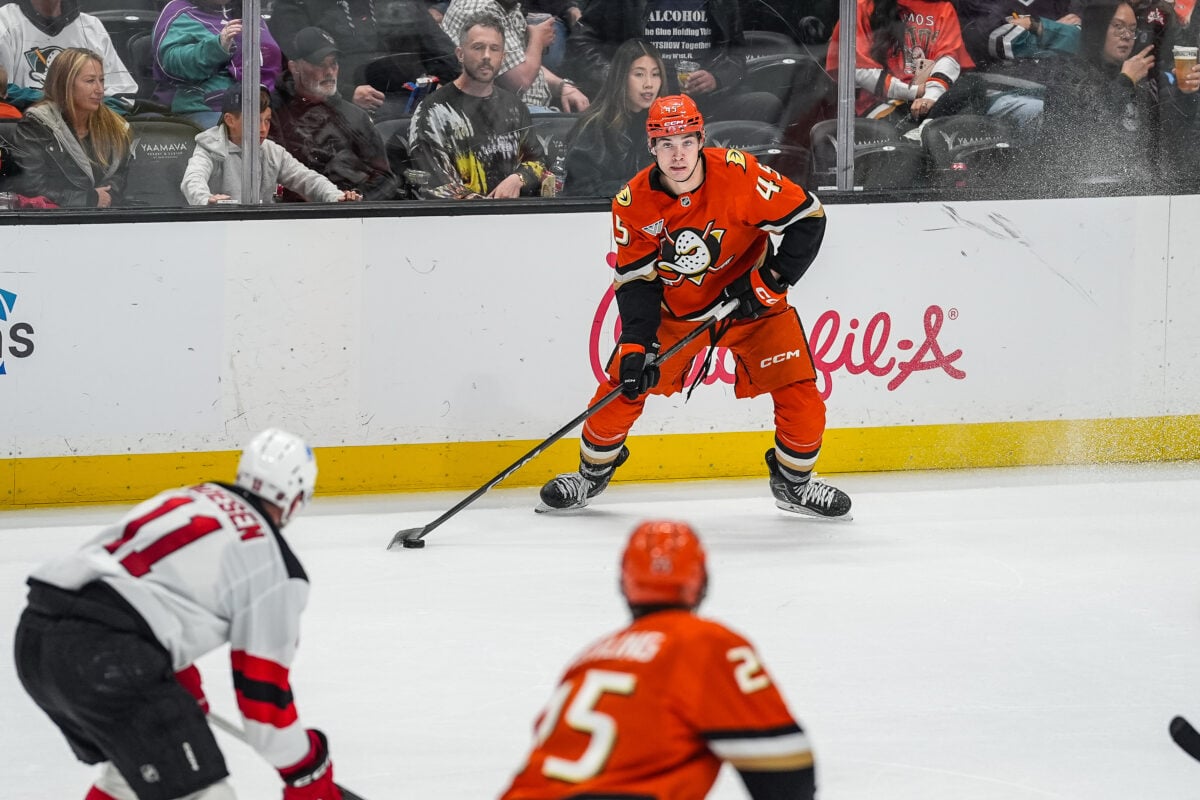
The team has embraced his youth, perhaps best encapsulated by his choice of goal song at the Honda Center: “Manchild” by Sabrina Carpenter. It’s a bit of self-deprecating humor that has endeared him to the fanbase. He knows he’s a work in progress.
The Competition
So, can he actually win the Calder Trophy? He has a legitimate shot, but the field is crowded this season.
- Matthew Schaefer (New York Islanders): It is rare for an 18-year-old defenseman to step right in, but Schaefer made the roster out of camp and hasn’t looked back. Voters often love the degree of difficulty associated with playing defense as a teenager, and he is the current favorite.
- Ivan Demidov (Montreal Canadiens): The buzz out of Montreal is deafening. Demidov plays in a high-pressure market and is delivering.
- Yaroslav Askarov (San Jose Sharks): Never discount a goaltender, especially one putting up these numbers. Askarov leads all rookie goalies in wins and is sporting a .910 save percentage. If he drags the Sharks into relevance, voters will take notice.
The Verdict
Sennecke is currently like a high-performance sports car being driven by a student driver. The engine power and sleek design are undeniable, and he is already winning races. But, he is still learning when to shift gears and when to avoid risky maneuvers in heavy traffic.
If he can smooth out the handling and shore up the two-way aspects of his game while keeping his foot on the gas offensively, he won’t just be a finalist. He has a very real chance to bring the hardware home to Anaheim.
The race is far from over, but the Ducks have a horse in it.
AI tools were used to support the creation or distribution of this content, however, it has been carefully edited and fact-checked by a member of The Hockey Writers editorial team. For more information on our use of AI, please visit our Editorial Standards page.

Free Newsletter
Get Anaheim Ducks coverage delivered to your inbox
In-depth analysis, breaking news, and insider takes - free.
Subscribe Free →