Benjamin Rautiainen just posted the best offensive season a Finnish forward has produced in the Liiga in nearly two decades, and the Tampa Bay Lightning still have to decide in October whether he plays for them. He currently is on loan to Tappara and scored in the 2026-27 season opener.
Rautiainen is a deception-first playmaker whose record-breaking season was built by a first-line creative role Tampa Bay will not hand a rookie, which turns his next step into a test of the skill underneath the numbers rather than the numbers themselves.
Rautiainen’s Game
Watch Rautiainen and the first thing that registers is that he plays a step ahead of everyone on the ice. He is often described as a constant deception, a first touch that becomes a pass before defenders react, and the patience to slow a rush, survey, and pick the seam instead of forcing the outside lane. He wants the puck, pops open for it, and orchestrates once it’s on his stick.
The calling card is his playmaking. On the half-wall he threads saucer passes over sticks, and off the rush he curls back to buy time rather than die on a checked lane, then hits a teammate arriving with speed. He can finish too, with a clever, disguised release, but the projectable skill is the passing and the sense.
The knock has been the same for three years, and it’s fair. His skating mechanics are ordinary, his explosiveness is average, and at 6-foot, 174 pounds, he isn’t winning by force. He answered part of it last season, adding pace and getting craftier on his edges with cutbacks that shake pressure, and he battles along the wall harder than his frame suggests. The question is whether the skill is high enough to make him a top-nine forward and power-play piece, or whether he settles a level below that as a periphery passer. That’s the NHL projection in one line.
Rautiainen’s Deployment Arc
His point total needs a bit of context, because his year-to-year leap is enormous, but real. Rautiainen went from 33 points in 50 games as a 19-year-old to 25 goals and 77 points in 59 games and a plus-24 a year later, the first Liiga player past 70 points since 2007-08 and the league’s best player. Numbers that big invite a regression argument. I would say the better argument is about role.
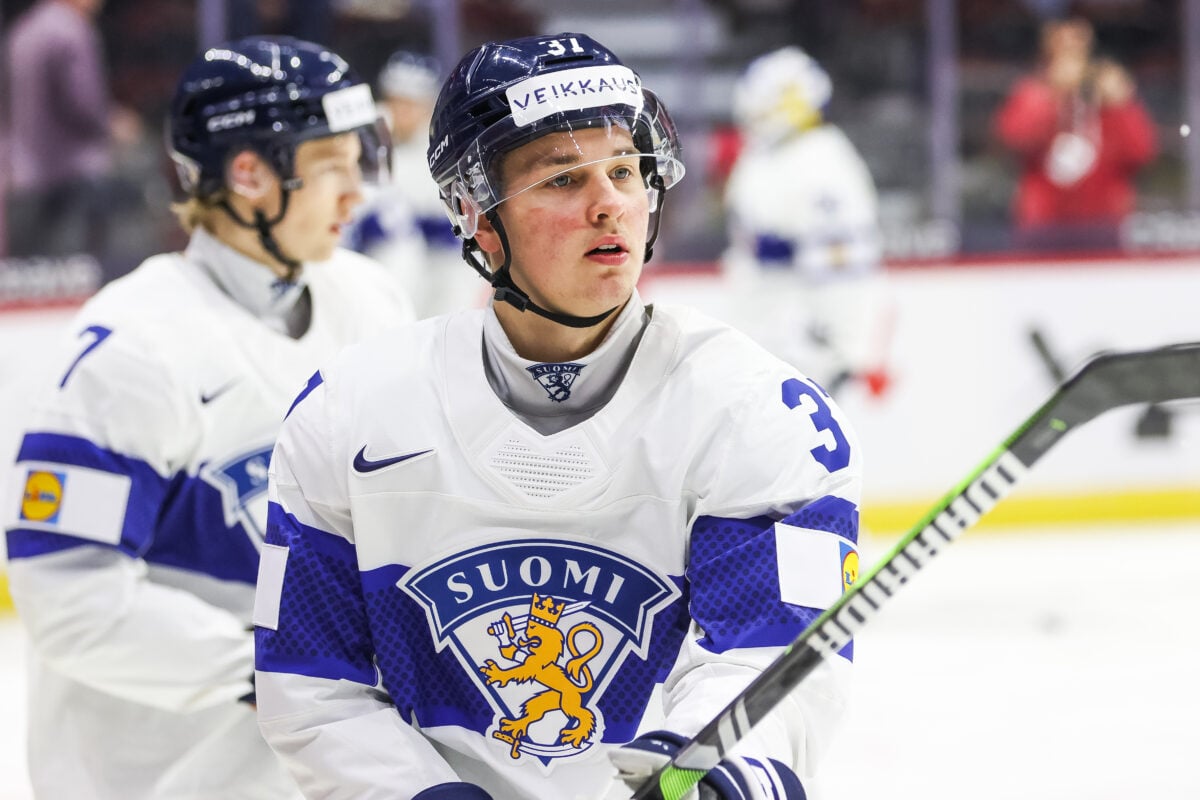
Rautiainen has said as much himself. He told Tappara’s site that his role changed completely and that the jump flattered him, that “maybe the numbers distort it,” because he doesn’t believe he developed as much as 77 points suggests.
His head coach, Rikard Grönborg, framed it the same way to Yle, saying that even the year before, Rautiainen was “the force that started our five-on-five game” when it came to creating chances, and that the staff expected the breakout. The production accelerated once Joachim Blichfeld, who finished second in Liiga scoring, settled onto his line. He was the primary creator on the best team in the country, in the biggest offensive role, next to a linemate who buried what he set up.
Two facts sit underneath the total and pull in opposite directions. The encouraging one: only five of his 25 goals came on the power play, so the season was overwhelmingly even strength, and even-strength production travels better than power-play production. The cautioning one: he is a 20-year-old who broke out in his third year of draft eligibility, in a field where the next-closest scorer, Blichfeld, was seven years older. I believe this is a late bloomer whose skill jump is genuine and whose counting stats were amplified by the best situation on the board.
The Tappara-to-Tampa Fit
Here the fit is real, and the ceiling problem is real, and they come from the same place. Tampa Bay’s identity under Jon Cooper is offensive-zone possession, one of the league’s best teams at holding the puck below the dots and scoring off sustained pressure rather than the rush, with a breakout built to move the puck before a forecheck can pin it. That is Rautiainen’s game translated into a system: extend the possession, beat the first pressure, find the seam. He was built in Grönborg’s aggressive, retrieval-under-pressure Tappara, the same system that shaped Juho Piiparinen, and it asks for exactly those habits.
The catch sits in the same offense. Tampa Bay’s top power play runs through Nikita Kucherov, and the most dangerous creative touches at five-on-five belong to Kucherov and Brayden Point, not a depth forward. The puck-dominant creative role that produced Rautiainen’s 77 points is, in Tampa Bay, already occupied by one of the best players alive. A rookie does not get it, and the power-play time that would pad a rookie’s totals is spoken for.
Which is why the fit is roster math before it is a scoring fit. Tampa Bay is cap-strapped and top-heavy, built around Kucherov, Point, Jake Guentzel, Brandon Hagel, Anthony Cirelli, and Victor Hedman, and it has drafted without a first-round pick for four straight years. The organization stays a contender by finding cheap contributors in the middle rounds and growing them into roles. A fourth-round MVP on a three-year entry-level deal with a cap hit just over $1 million is that bet exactly: secondary offense at a price that buys flexibility everywhere else.
The Two Honest Complications
Rautiainen’s game runs on time and space, the extra half-second to survey and manipulate, and the North American sheet takes some of that away. The tell is already in his record. His regular-season rate of 1.31 points per game fell to 0.39 across 18 playoff games, against tighter, more physical checking on a championship run. Playoff hockey is the closest thing the Liiga offers to the compression he will meet in the NHL, and his production dropped hard. Add a 6-foot, 174-pound frame and average explosiveness, and there is a real gap between the skill and the body.
In Tampa Bay, he projects, at best, as a 12th or 13th forward out of camp, which strips away the first-line creative job that built the totals. And the goal number carries regression risk: his shooting percentage jumped from 6.5 to 11.0 in a single season, so the 52 assists are the stable, translatable core, not the 25 goals. Bet on the passing and the sense to survive the jump. Do not bet on 25 goals as a baseline.
So the honest expectation is patience. Rautiainen told Jatkoaika that if he does not make the NHL roster, “I’ll play in Tappara,” which the transfer agreement turns into a full season back home before the NHL or the American Hockey League (AHL) opens up. The Liiga site already lists him as Tappara’s No. 78 for 2026-27, which is exactly what that default looks like. The thing worth watching if he goes back is simple and revealing: whether Rautiainen can carry a top role without Blichfeld beside him. That, more than another 77-point stat line, is the real answer to how much of this was the player.
Free Newsletter
Get Lightning Prospects coverage delivered to your inbox
In-depth analysis, breaking news, and insider takes - free.
Subscribe Free →