An influx of young talent defined the Chicago Blackhawks this season. From Frank Nazar joining the team in December to Ryan Greene debuting at the end of the season, fans tasted the fruit of the seeds that have been sown for several years now. One player in that crop who garnered significant praise was Sam Rinzel. The 20-year-old defenseman suited up for the Blackhawks’ final nine games after the University of Minnesota lost in the NCAA tournament in late March.
Those games were the first Rinzel ever played professionally, but you’d be hard pressed to find any blatant errors revealing that fact. Of course, there’s plenty for him to improve, but his transition to the NHL looked surprisingly—and excitingly—seamless. Whether it be the ice time he logged, the breakouts created, or the numbers he produced, he gave the impression that he felt confident playing at the highest level of hockey. Rinzel’s quiet, humble confidence, alongside this small sample size of play, not so sublty hints that his role in the rebuild will be more significant than many anticipated.
Evaluating Rinzel’s Nine NHL Games
Rinzel’s numbers through nine games begin to tell the story. He registered five assists, a plus-1 rating, and an average of 23:22 of ice time per game. His plus/minus and ice time particularly stand out. The Blackhawks finished the season with a minus-68 goal differential after allowing 292 goals against (second worst in the league). Only two players finished with a plus rating: Ilya Mikheyev (plus-4) and Rinzel.
Finishing any stint in the NHL as a plus player at the age of 20 is not merely an accomplishment but an indication of enormous potential. What’s more, Rinzel’s impressive play spanned even-strength, short-handed, and power-play scenarios. He logged just over 175 minutes of even-strength ice time, just under 27 minutes of power-play time, and about 14 minutes of short-handed time. You wouldn’t be justified calling his nine games “dipping his toes in the water” as a rookie. Interim head coach Anders Sorenson dropped him into the ocean, and Rinzel swam without a life jacket.
Sam Rinzel is such a smooth skater. #Blackhawks pic.twitter.com/xLyiHbaSXh
— Charlie Roumeliotis (@CRoumeliotis) April 15, 2025
Numbers tell one side of the story, but the eye test tells the other. Rinzel’s skating and ability to make plays with his head up showed inklings of a veteran defenseman. We know these skills are crucial to thriving in the NHL, but they’re also highly valued within the Blackhawks organization. In Episode 5 of Every Shift, assistant coach Kevin Dean worked with 19-year-old defenseman Artyom Levshunov after he joined the squad in March. While on the ice practicing neutral zone regroups, Dean told Levshunov:
There’s a time and a place for it, but I don’t love defenseman grabbing the puck in the neutral zone and skating backwards. Get around it, and go. You’re a big guy that can skate. Get around it, and go. You’ll be a load to handle in the neutral zone. Now you’ve got a forehand option over there, you’ve got options over here. And you’re skating full speed, right?
This clip provided insight into how the Blackhawks are developing their defensemen, and every word of Dean’s could be applied to Rinzel. He’s 6-foot-4 (a big guy) who can skate. He wielded that size and speed to break pucks out and drive plays through the neutral zone (like in the X clip above). He knew when to take the puck himself and when to dish it to a forward with more speed, capitalizing on those options Dean mentioned to Levshunov.
Related: Chicago Blackhawks 2024-25 Player Grades: Defense
Rinzel demonstrated these talents at the collegiate level. If you watch his highlights, you’ll see plays practically identical to the one above. He tallied many points after sending a forward in on the rush or joining the play himself with his strong skating. Translating those abilities to the NHL is not a given, so watching Rinzel create and dissect plays at this level proves his head is in sync with his body.
Exuding Confidence in the Media
Many younger players entering the NHL either struggle to find confidence or are overconfident. It’s less common for a player to strike the balance between the two. Rinzel communicated during his end-of-season media scrum that he’s walking that line.
When asked how important it was to have nine games of NHL experience heading into next season, Rinzel responded that it was “a nice cup of coffee”—a joke that elicited a smile he couldn’t quite contain and a chuckle from teammate Greene. Even that lighthearted moment showed he didn’t take himself too seriously and felt comfortable enough to have a laugh. A reporter asked if taking on more responsibility on the ice felt overwhelming, to which Rinzel answered:
No. I mean I had kind of the same responsibility at Minnesota so I wouldn’t say it was anything new. So I was comfortable in it. I knew I just had to do my job.
Pressed further about his confidence playing over 27 minutes a game so quickly, Rinzel said stoically, “It’s obviously pretty cool whenever you can jump in and do that and receive those minutes.”
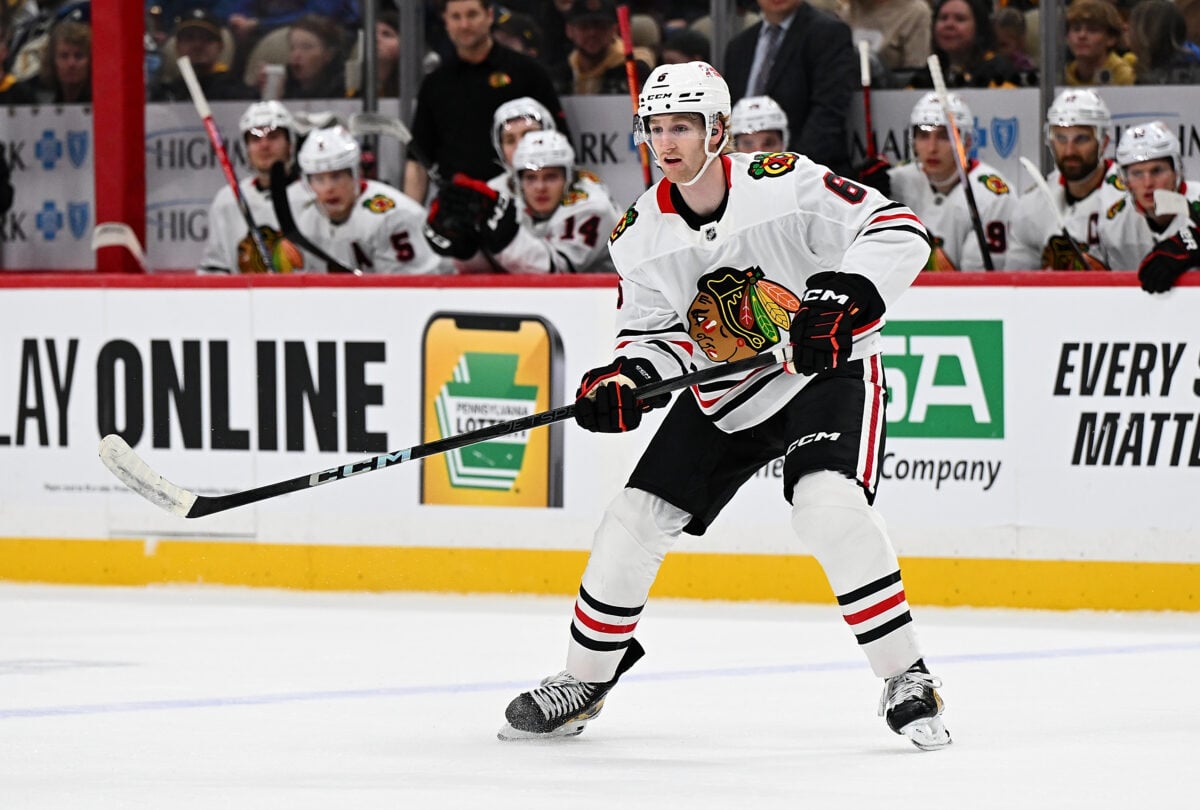
Rinzel’s confidence shone through most prominently when asked how he felt defending against the league’s most talented players.
Obviously, every game was new for me, whether it was [Alex Ovechkin], [Sidney Crosby], or having to go against [Nathan MacKinnon]. My first shift against MacKinnon was a little awakening. But you quickly learn how to play and how they like to play and how you’re able to defend them. You learn their tendencies, which is important to understand when you get in the league. You understand how to play different players better. It’s just part of growing.
You read that correctly. Rinzel said, “you quickly learn” how to play against some of the best players ever. He wasn’t diminishing their talents or overstating his. He simply showed that he’s confident and will continue to learn how to succeed in the NHL. Again, his mind and approach to the game exude a seemingly unflappable confidence.
So often, coaches and front offices must practice patience while players mature and cultivate the correct attitude. These players have the physical capabilities but lack the confidence that respects the process needed to succeed. Their brains need to catch up to their bodies.
Rinzel is the opposite. His brain is there. He’s waiting for his body to catch up.
Foundational Player Moving Forward
Connor Bedard is the name most attached to the Blackhawks’ rebuild. And while Levshunov and Alex Vlasic have primarily garnered attention as the pieces around which the defense will be built, Rinzel made a compelling opening statement in this metaphorical court case concerning the path forward. Fortunately, the team has the luxury of leveraging all three players as they develop. But Rinzel’s stock has undeniably risen.
