


Thursday night is hockey night in Arlington, Virginia. These days, every night feels like hockey night—but it wasn’t always this way.
The Washington, D.C.-Maryland-Virginia metropolitan area—colloquially known as the “DMV”—now has more in common with Northeast cities like New York, Philadelphia, and Boston. However, the Capital Region, which sits south of the Mason-Dixon line–historically the dividing line between the American North and South––is not a natural hockey market, and the game does not have deep roots here.
The DMV received its first exposure to hockey when the Washington Capitals first hit the ice in 1974. However, overshadowed by the then-Washington Redskins and Washington Bullets––both dominant in the 1970s and ’80s––the Capitals were largely an afterthought in the local sports landscape.
Everything changed on June 26, 2004, when the Capitals selected Alexander Ovechkin with the first-overall pick.
Related: Capitals Reveal 2025-26 to Be Alexander Ovechkin’s Final Season
Washington’s transformation into a hockey town is best illustrated by the explosion of youth hockey in the Capital Region. Ovechkin’s arrival in the District of Columbia has not only ignited a new generation of players but has also put the region on the global hockey map, making it a destination for international talent.
New Fans Produce New Players
Capitals Academy players practice at the MedStar Capitals Iceplex in Arlington, Va. (The Hockey Writers/Serge Rousskikh)
As the sun sets on a Thursday night, the MedStar Capitals Iceplex parking lot is packed. SUVs and minivans circle, searching for an empty spot. Youngsters, sticks in hand and flanked by their parents, file into the arena for practice. Inside, the barn is buzzing. On the ice, aspiring hockey stars are put through their paces, working on quick feet drills, breakouts, and stickhandling through props. Behind the glass, proud parents, coffee or book in hand, mingle, read, or quietly observe their offspring in action.

One parent is Nicholas Ortiz, whose relationship with hockey is a whirlwind romance that has stood the test of time.
“Ovi came to town. The Capitals became good. I got hooked and started playing myself,” Ortiz says with a huge smile. His love for the game was sealed when he met his future wife, Nadina Kezel, a proud native of Cape Breton, Nova Scotia, where hockey is ingrained in the culture. Naturally, when it came time to choose a sport for their sons, Landon and Jaxon, the decision was easy.
“They were going to play hockey,” Kezel says, highlighting how the Caps have opened their doors to non-traditional hockey families, including women and first-generation fans, who Ortiz estimates account for approximately half of the Caps Hockey Academy players’ parents.
The development of youth hockey in the DMV isn’t just anecdotal—it’s backed by numbers. Between the 2005-06 and 2023-24 seasons, the number of registered youth hockey players in the Potomac Valley region—USA Hockey’s designation for the DMV—rose by 43 percent from 8,975 to 12,801. Washington, D.C., saw an even more dramatic surge, with youth hockey participation skyrocketing 187%, marking the third-largest growth rate in the country.

For comparison, the total number of registered youth players across the U.S. grew by just 10% during the same period. Furthermore, Maryland, Virginia, and Washington, D.C., all rank in the top half of U.S. states in youth hockey enrolment growth––Maryland saw a 27% increase, Virginia 53%, and D.C. led the way with its 187% spike between the 2005-06 and 2023-24 seasons.
The DMV’s hockey boom has outpaced other emerging markets like Texas and Idaho and has far exceeded the modest growth seen in traditional hockey powerhouses such as New York (4%), Minnesota (16%), and Massachusetts (a 5.5% decline). Notably, Virginia has surpassed historically strong hockey states like Alaska, New Hampshire, and Maine in total youth hockey enrollment.
As a result, the DMV’s share of the nation’s youth hockey players has risen from 2.6% in 2005-06 to 3.3% in 2023-24, reflecting the region’s growing presence in the sport.
DMV Youth Hockey Stakes Its Place on the Global Hockey Map
The DMV’s surge in youth hockey development is gaining broader recognition, with players from across the world increasingly considering it as a destination.
Three such players are Prokhor Pankratov, Gleb Semenko, and Konstantin Yurkov, who traded their elite Russian development programs for Team Maryland, one of two Tier 1 hockey programs in the DMV.
“We wanted to test our skills in the US,” Pankratov says. While the trio notes that there is room for improvement in comparison with their Russian squads, they have been pleasantly surprised by the speed and physicality of play. In fact, their very presence at the Piney Orchard Arena in Odenton, Maryland is an acknowledgment of the region’s growing quantity of players being translated into quality.
“We don’t want to be good for the DMV, we want to be objectively good,” Robbie Murden, Hockey Director of Team Maryland, says.
The Capitals and their captain make the job easier.
While Team Maryland and the Washington Little Capitals––the second Tier 1 program in the DMV––already attract top hockey talent in the area, Murden says the goal now is to recruit more elite players from outside the region while encouraging the best local young athletes to choose hockey as their primary sport.
And Murden’s aspirations are coming to fruition. The Ontario Junior Hockey League (OJHL) alum says he’s seeing more and more kids––often from non-hockey families––select hockey as their sport of choice often inspired by the Capitals and Ovechkin’s success, with each Capitals’ milestone having a cycle effect. He explains that the generation of 11- and 12-year-olds that entered the program following the Capitals’ 2018 Stanley Cup triumph now make up the core of the U18 team, while others have progressed to major junior hockey leagues.
The Georgetown, Ontario native adds that Ovechkin’s international stature elevates DMV hockey’s credibility, attracting global talent like Pankratov, Semenko, and Yurkov and raising the overall level of play.
“If Ovechkin never played for the Washington Capitals, perceptional-wise––exact same coaches, exact same program, exact same billet setup––it would be a lot more difficult to get Russian players to want to live in DC,” Murden says.
Caps’ Personable Outreach Efforts Pay Dividends
While DMV had all the ingredients for an explosion of youth hockey development––most notably their megastar captain––it was made possible by painstaking and strategic efforts by multiple stakeholders, including local clubs, USA Hockey, and the Capitals themselves.
“When you get a generational player like Ovi, certainly the awareness is there, and people want to be a part of it… but if they don’t have an enjoyable experience with it, they’re not going to stay in it. I think that’s a credit to both the Capitals and the youth hockey leaders in the DMV that have been able to capture what Alexander has been able to do and the buzz that he’s been able to create,” Scott Paluch, a American Development Model regional manager for the DMV, says.
The former U.S. world junior player lauds the growth of youth hockey in the region and says the Capitals have been a good partner in their efforts, pointing to initiatives like the Coaches Day and Learn to Play program.
This partnership has clearly paid off.
According to a team statement, the Caps’ Learn to Play program, which provides first-time players with full sets of hockey gear, has introduced more than 9,000 players to the game since its launch in 2016, including more than 700 in the past six months. In all, the team says a total of 25,424 individual youth hockey players have taken part in a Caps youth hockey event since 2019.
And while the overall growth of youth hockey in the region has been impressive, the Capitals have also worked to advance girls’ hockey. In fact, the number of registered girls’ hockey players (ages 19 and under) in the Potomac Valley region has soared by 173%, while Maryland alone has seen a staggering 326% increase.
“[The Capitals] really put a lot of thought into how to encourage girls to play, how to get women to watch hockey, how to get them involved in playing hockey. That’s helped a lot,” says Kush Sidhu, founder of the Washington Pride, the region’s only Tier 1 girls’ hockey program.
But, ultimately, what has captured the hearts and minds of the DMV’s hockey community cannot be measured in financial terms or statistical metrics. At its core, the Capitals’ connection with the community is rooted in their personal touch. Every interview subject had personal anecdotes to share about Capitals’ players and staff presence in the local hockey community—small moments that have helped cultivate a genuine hockey culture.
One such story comes from Christian Bisetti, a first-generation fan, who enroled his son Adriel in hockey during the Capitals’ 2018 Stanley Cup run. Bisetti recalls how Adriel, a goalie with the Capitals Hockey Academy U14 team, had the opportunity to take a photo with his hero, former Capitals goalie Braden Holtby, during the Cup run. Just a few weeks ago, Bisetti ran into Holtby at the MedStar Capitals Iceplex and showed him the photo of Adriel from years past. Holtby, with a smile, gladly took the time to recreate that moment for them.
Others like Nadina Kezel point out the emphasis Caps players and personnel place on connecting with young players, often setting aside time to sign autographs and interacting with the next generation. Sidhu, a co-founder of the Junior Women’s Hockey League (JWHL), meanwhile, highlights the Capitals’ support in organizing free clinics for female players and facilitating visits by NCAA teams.
The Ovi Factor
While the DMV’s youth hockey boom is a collective achievement, the conversation inevitably circles back to Ovechkin.
When asked to describe Ovechkin’s impact on youth hockey, nearly everyone had one word in common: “huge.”
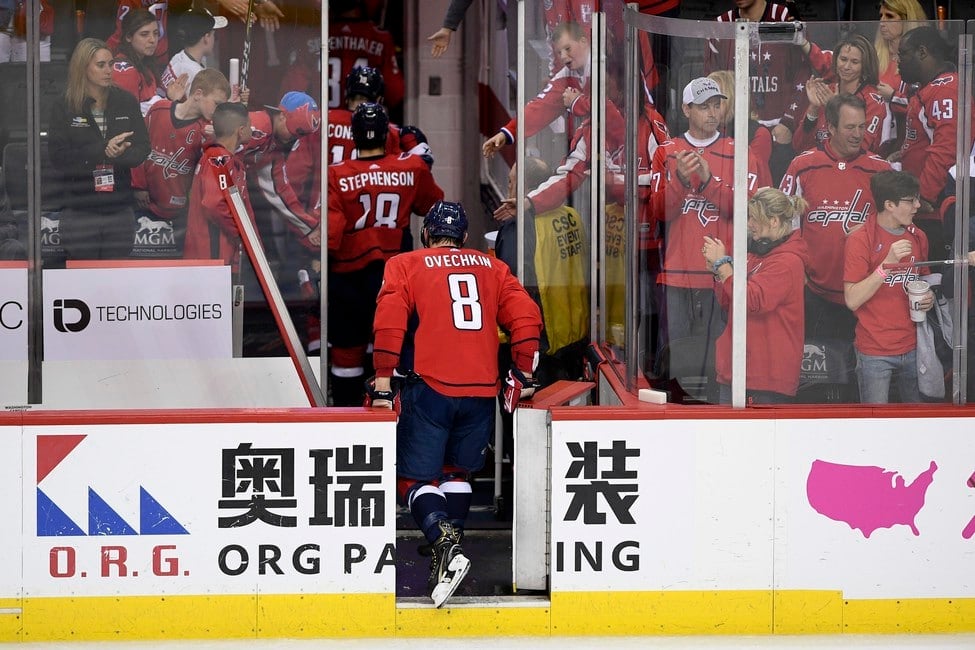
Despite his larger-than-life presence in the hockey world, those who have met the Capitals’ captain describe him as a “normal guy,” a family man, and highly approachable.
Kezel, whose family has an Ovechkin goal counter at home, recalls almost convincing the man who beat Wayne Gretzky’s goal record this season to play in the annual Caps Hockey Academy parents-vs-kids game. Meanwhile, Bisetti notes that he often sees “Ovi” and his wife, Anastasia, play the role of hockey parents themselves watching their six-year-old son Sergei play for his youth team from the stands at MedStar.
And while the Ovechkin factor may not have played a defining role in their decision to join Team Maryland, Yurkov says that having the opportunity to practice on the same ice the Capitals captain once played on at Piney Orchard puts the opportunity to play for Team Maryland into perspective.
Such perspective is important and a reminder that it is easy to take the future Hall of Famer for granted.
“His accomplishments, I wouldn’t say we take him for granted, but we’re just so used to it now. We’re just so used to everything that he does that I guess there’s an expectation for him to do great things,” says Sidhu.
However, Ovechkin won’t be on the ice forever, and the question becomes: What happens to hockey in the DMV after he’s gone? If the exhausted youngsters leaving MedStar under the watchful gaze of his banner are any indication, the generation the Great Eight grew is ready to carry his mantle long after he takes his final shift.

