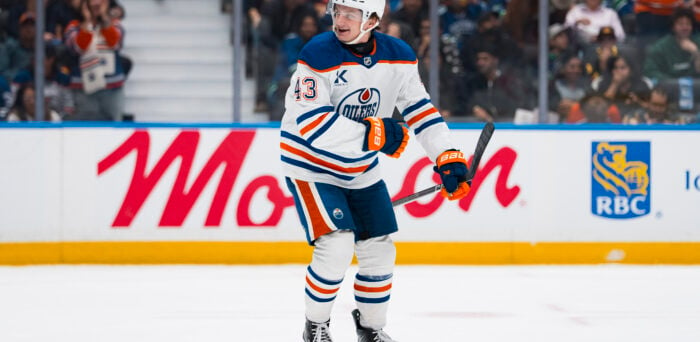
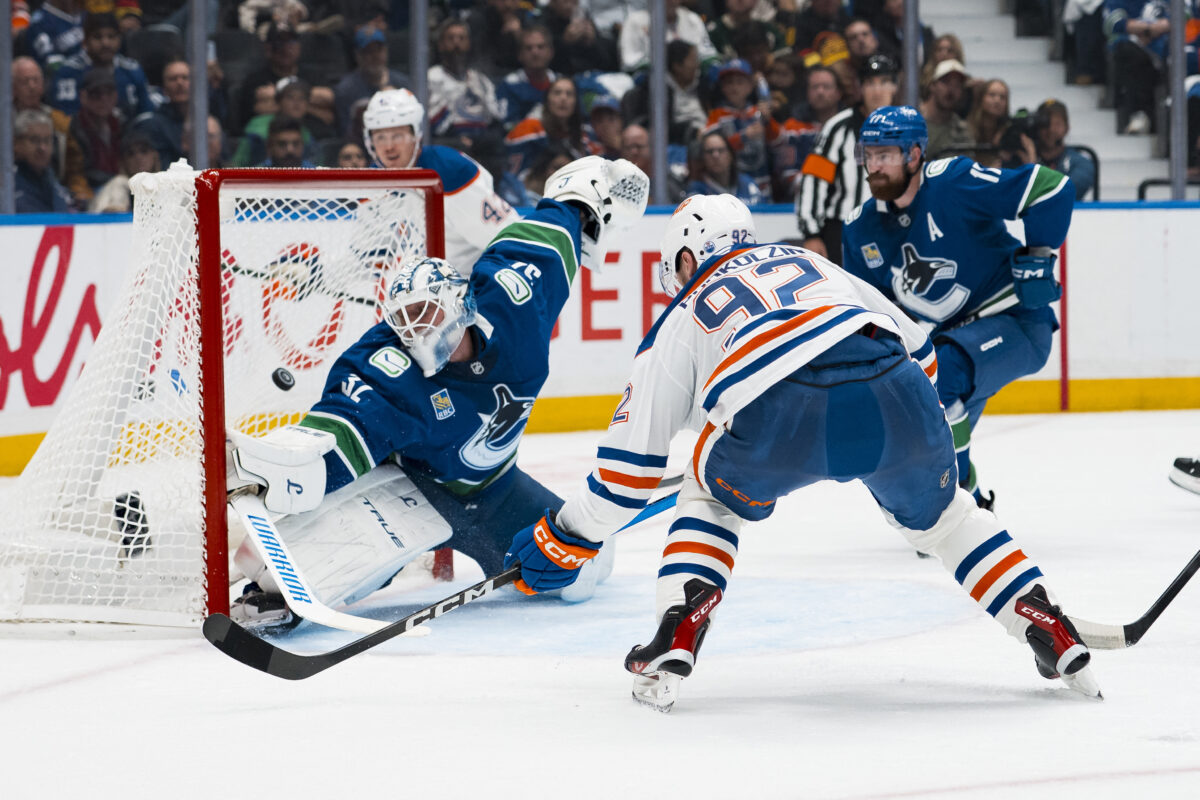
The Edmonton Oilers left Vancouver with their first win of the season on Thursday night. However, a 9-7 victory in a rematch with the Canucks hardly provided the reassurance normally associated with putting nine goals on the board.
For roughly 40 minutes, Edmonton looked like the team new head coach Mike Babcock has been trying to build since taking over this summer. The Oilers played fast, tracked back through the neutral zone, controlled possession, and overwhelmed Vancouver en route to an 8-2 lead before the halfway mark of the second period.
Then everything unravelled. Vancouver scored five of the final six goals and turned a blowout into a game Edmonton suddenly had to survive. Combined with Tuesday’s 6-5 overtime loss, the Oilers have surrendered 12 regulation goals through their first two games.
Some patience is warranted. Edmonton is learning a new system under a new coaching staff, and two games is not enough time to determine whether it will work. The bigger question is how long the Oilers can afford to wait for everything to click.
Babcock Knew There Would Be Growing Pains
The struggles shouldn’t come as a surprise. During the preseason, Babcock acknowledged that implementing his system wouldn’t happen overnight. “Yeah, it’s going to take some time. You know, I’m not another coach. I’m just me. I just know what I know,” he told reporters.
Babcock explained that Edmonton’s staff had studied analytics and video to determine how they wanted the team to play, resulting in plenty of changes for the players to process. He even admitted the approach may have been “almost too detailed” early in camp.
That context matters. Babcock isn’t simply tweaking a forecheck or changing a couple of line combinations. He has emphasized structure, speed, responsibility and attention to detail throughout training camp. Zach Hyman described practices as fast and low-event, with very little space available to players.
Those habits require repetition before they become instinctive. Right now, there are moments when Edmonton’s players appear to be thinking about where they’re supposed to be rather than simply reacting. That’s understandable in October. It can’t remain understandable indefinitely.
The First 40 Minutes Showed the Potential
The encouraging part of Thursday’s win was that the team demonstrated the system can work. Vancouver had only five shots halfway through the game, while Edmonton had already built an enormous advantage. Late in the second period, the Oilers had scored eight times while the Canucks had directed only seven shots at goaltender Devon Levi.
That wasn’t simply Connor McDavid and Leon Draisaitl exchanging chances with Vancouver. Edmonton controlled the game. “The first 40 is what it could look like a lot of the time, and what it should look like a lot of the time,” McDavid acknowledged post-game. He specifically pointed to his team working hard, tracking back and being responsible with the puck, adding that the Oilers have to replicate that performance consistently. That might be the most important takeaway from Thursday’s contest.
There is a difference between a system that isn’t working and a team that isn’t consistently executing its system. For 40 minutes, Edmonton provided evidence that Babcock’s approach can work. The problem was what happened when they stopped doing those things.
Edmonton Can’t Keep Falling Back Into Old Habits
An 8-2 lead should be game over. Instead, Vancouver scored with 0.1 seconds remaining in the second period and then scored three more times in the opening 7:37 of the third. Suddenly it was 8-6. Draisaitl’s second goal restored some breathing room before Vancouver scored again late. Babcock summed up the night perfectly: “What I saw tonight was a group that could play right and knew what they were doing, and then I saw a group that didn’t do it.”
His solution was equally straightforward: Edmonton has to “repeat, repeat, rinse, repeat.” That’s where the concern lies. The Oilers have enough offensive firepower to survive games like Thursday’s during the regular season. McDavid had five points, Draisaitl had three, and Evan Bouchard added another three after recording five in the opener.
But asking the offence to repeatedly erase defensive mistakes isn’t sustainable. Babcock wasn’t brought to Edmonton because the Oilers needed help scoring goals. He was brought in, in part, to establish a more structured and responsible team. Two games into the season, that transformation remains a work in progress.
Not Everything Can Be Blamed on the System
There’s another important distinction here. Some mistakes are inevitable when learning new assignments. Others have very little to do with coaching systems. Bouchard made that point following the opener, saying, “There are little things that aren’t the system’s fault.” He referenced bad pinches leading to odd-man rushes. That’s important when evaluating the team’s defensive performance.
Babcock can teach players where to position themselves, how aggressively to pressure opponents and what their responsibilities are without the puck. He can’t prevent every individual decision that leaves Edmonton exposed.
Thursday presented additional concerns on the blue line. Sportsnet’s Mark Spector highlighted Jake Walman and Shakir Mukhamadullin after they finished minus-3 and minus-4, respectively, while noting that Ty Emberson and Spencer Stastney remain available. If individual execution continues to undermine the structure, Babcock may eventually have to change personnel rather than simply waiting for players to adjust.
Goaltending and Defence Are Feeding Into Each Other
Edmonton’s defensive problems also can’t be discussed without acknowledging the goaltending. Through two games, the Oilers had a team save percentage of just .727. Tristan Jarry had a .739 after his first start, while Levi emerged on Thursday with a .682 save percentage and 7.02 goals-against average. But the goaltenders aren’t operating independently from the five players in front of them.

Jarry faced breakaways, odd-man rushes and uncovered attackers in the opener. He acknowledged he needed to make additional saves, but Edmonton’s defensive breakdowns repeatedly put him in difficult situations. Levi should have stopped more against Vancouver, too.
Both things can be true. Edmonton needs better goaltending, and its goaltenders need better protection. That’s why determining whether Babcock’s defensive system is actually improving the quality of chances Edmonton allows will eventually matter more than simply looking at goals against.
Patience Is Necessary, But There Has to Be a Deadline
Two games shouldn’t cause Edmonton to abandon what it spent training camp building. There was always going to be an adjustment period, particularly with a shortened camp and preseason limiting how much time Babcock had to install his system.
Thursday’s first 40 minutes provided legitimate reason for optimism. But the Oilers are also trying to contend for a Stanley Cup. They don’t have the luxury of treating the first quarter of the season as an extended training camp. The standard shouldn’t be perfection in October. It should be progress.
Are the odd-man rushes decreasing? Are Edmonton’s defencemen making better decisions at the offensive blue line? Are forwards consistently tracking back? Are opponents getting fewer uncontested opportunities from dangerous areas? Can Edmonton protect a multi-goal lead without needing another McDavid or Draisaitl goal?
Those are the measurements that will tell us whether the system is taking hold. For now, Edmonton deserves some patience. But patience can’t become an excuse. Thursday’s rematch showed signs of what Babcock’s Oilers could become. The final 20 showed exactly how much work remains before they get there.
AI tools were used to support the creation or distribution of this content, however, it has been carefully edited and fact-checked by a member of The Hockey Writers editorial team. For more information on our use of AI, please visit our Editorial Standards page.
Free Newsletter
Get Edmonton Oilers coverage delivered to your inbox
In-depth analysis, breaking news, and insider takes - free.
Subscribe Free →