On a night that felt inevitable yet still profound, Sidney Crosby officially claimed the top spot in Pittsburgh Penguins history. With a goal and an assist in a 4–3 shootout win over the Montreal Canadiens at PPG Paints Arena, Crosby passed Mario Lemieux to become the franchise’s all-time points leader — a milestone that cements his place not only in Penguins lore, but also in NHL history.
Related: Sidney Crosby Becomes Penguins All-Time Points Leader in Shootout Win Over Canadiens
The moment itself was fittingly understated. Crosby tied Lemieux with an early goal, then moved ahead with a power-play assist later in the game. The crowd reaction told the real story. When Lemieux’s tribute message appeared on the video board, the arena fell into a respectful silence — a shared recognition that one era had seamlessly passed into another.
“It’s really special,” Crosby said afterward. “You’re trying to stay in the game, but also just trying to enjoy the moment too.”
Passing a Standard That Once Felt Untouchable
For decades, Lemieux’s place atop the Penguins’ record books felt immovable. He didn’t just produce points — he defined what offensive dominance looked like in Pittsburgh. His totals were accumulated across a shorter career, interrupted by illness and early retirement, making his numbers feel almost mythical.
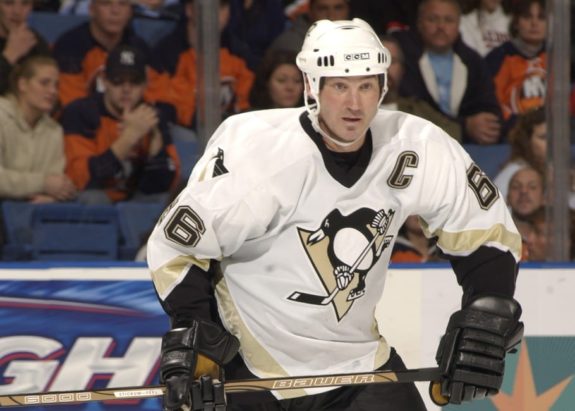
Crosby now stands alone with 1,724 points in a Penguins uniform, surpassing Lemieux’s 1,723. The contrast between the two resumes highlights the uniqueness of the achievement. Lemieux’s production was explosive and condensed; Crosby’s has been built on consistency, durability, and elite play across more than 20 seasons.
That longevity is what ultimately separated Crosby from history. He has averaged at least a point per game in each of his first 20 NHL seasons — a standard no one else in league history has matched.
A Franchise Built Around One Player, Twice
The Penguins are one of the rare franchises that can say they were shaped by two generational players — and that the second somehow lived up to the first.
Crosby arrived in Pittsburgh as the No. 1 pick in 2005, stepping into a locker room still defined by Lemieux’s shadow. As an 18-year-old rookie, Crosby played alongside Lemieux before the icon’s final retirement, even living with the Lemieux family for several years.
That mentorship left a permanent imprint.
“It didn’t seem like he was playing in the same league,” Crosby once said of Lemieux. “Just the way that he saw the game, the way he could make plays — his presence.”
Over time, Crosby didn’t just honor that legacy — he expanded it. Three Stanley Cups, countless franchise records, and a standard of professionalism that reshaped expectations for what a Penguins captain should be.
What Crosby Means to the Penguins Organization
Statistics alone don’t explain Crosby’s significance in Pittsburgh. He stabilized a franchise that once flirted with relocation, became the face of the organization for two decades, and helped define its modern identity.
Under Crosby’s leadership, the Penguins transitioned from rebuilding curiosity to perennial contender. He became the connective tissue between eras — bridging Lemieux’s influence to the next generation of Penguins hockey.
Penguins head coach Dan Muse summed it up best, noting that Crosby’s impact goes far beyond production. His daily habits, competitiveness, and humility have influenced nearly every player who has passed through the organization.
“You see the drive that he has, how that rubs off on probably every other player he’s ever played with,” Muse said. “And then you see a day like today, where he has that moment — it’s incredible and well-deserved.”
Where This Puts Crosby Among the All-Time Greats
Passing Lemieux at the franchise level naturally raises a bigger question: where does Crosby sit in the NHL’s all-time hierarchy?
With 1,925 total points across the regular season and playoffs, Crosby now ranks seventh all-time, trailing only Wayne Gretzky, Mark Messier, Jaromir Jagr, Gordie Howe, Ron Francis, and Steve Yzerman.
He also owns 505 career multi-point games, the sixth-most in NHL history, and continues to add to totals that already place him firmly in the sport’s inner circle.
Even as milestones stack up, Crosby remains reluctant to frame his career in numerical terms.
“I don’t look at it the same way,” he said. “The points for a game don’t change the way I think about what those guys did.”
A Record Set the Crosby Way
Crosby’s pass to Lemieux felt right. It wasn’t just an empty-netter or a big show. He tied the score by tipping the puck in front of the net. Then, he broke the record with an assist on a power play, fighting hard and making the smart, easy play.
That’s what Crosby’s always been about. He changed as the game did, going from just a scorer to one of the best all-around centers ever. He got better as he got older, staying a top player even in his late 30s.
Because he can change his game, he keeps hitting new milestones even though many other players have slowed down.
Still Standing in Lemieux’s Shadow — By Choice
Despite holding the record outright, Crosby has been adamant about where he believes Lemieux still stands.
“He’s still No. 1 in my books,” Crosby said. “I don’t think you can put a stat line or a number on what he means to this team and to hockey.”
That perspective speaks volumes. Crosby never chased Lemieux’s records for validation. Instead, he focused on honoring the standard that was set before him — a standard of excellence, leadership, and respect for the game.
In that sense, the record feels less like a passing of the torch and more like a shared legacy.
A Moment That Defines an Era
History doesn’t always shout; sometimes, it just shows up quietly. Like in a regular February game, with a little help from a deflection and a rebound. But trust me, this is a moment we’ll remember.
Crosby now has the most points ever for the Penguins. He’s played through different times, changed with the rules, and stayed awesome for 20 years. He didn’t just match what Lemieux did—he made it even better for a whole generation after him.
“You’re watching history,” Muse said. And for Penguins fans, it’s history they’ve been privileged to witness firsthand.
Crosby didn’t replace Lemieux. He stood beside him — and now, in the record books, just slightly ahead.

Free Newsletter
Get Penguins History coverage delivered to your inbox
In-depth analysis, breaking news, and insider takes - free.
Subscribe Free →