Change is coming for the Detroit Red Wings. There’s no doubt about that. But before Steve Yzerman makes any decisions on how to adjust the roster, it’s important that a thorough assessment of Detroit’s organizational depth takes place.
In addition to 2025-26 team and player evaluations, a comprehensive analysis of Detroit’s depth will illuminate both the franchise’ strengths and areas of need from a positional and role-based standpoint.
Today, we’re going to do just that. Let’s dive in.
More Red Wings Offseason Analysis:
- Red Wings Team Evaluation: Year-Over-Year Analysis
- Red Wings 2025-26 Player Grades
- 360-Degree Audit of the Red Wings Franchise
Red Wings’ Current Depth Chart
First, we’ll look at Detroit’s depth in the North American professional ranks. The chart below ranks the players based on a full view of their abilities heading into the 2026-27 season. For clarity, wingers and defensemen are organized by handedness – left shot and right shot.
| LW | C | RW |
| Emmitt Finnie | Dylan Larkin | Lucas Raymond |
| John Leonard | Andrew Copp | Alex DeBrincat |
| Carter Bear | Marco Kasper | Michael Brandsegg-Nygard |
| Dylan James | Nate Danielson | Carter Mazur |
| Jakub Rychlovsky | J.T. Compher | Mason Appleton |
| Noah Dower Nilsson | Michael Rasmussen | Dominik Shine |
| Alexandre Doucet | Amadeus Lombardi | Jesse Kiiskinen |
| Wojciech Stachowiak | Sheldon Dries | |
| Michael Milne | Ondrej Becher |
| LD | RD | G |
| Simon Edvinsson | Moritz Seider | John Gibson |
| Ben Chiarot | Justin Faulk | Sebastian Cossa |
| Albert Johansson | Axel Sandin-Pellikka | Michal Postava |
| William Wallinder | Jacob Bernard-Docker | Trey Augustine |
| William Lagesson | Anton Johansson | Carter Gylander |
| Shai Buium |
Italics denotes 2026 restricted free agent.
Let’s start with the good news. And yes, there is some.
For starters, Detroit’s defense is pretty much set for 2026-27 and looks solid. The right side, in particular, slots in nicely. The same goes for the left, with the exception of Ben Chiarot, who could be displaced by Albert Johansson sometime next season.
In fact, all of Detroit’s defensemen—minus Chiarot and Justin Faulk—will be better next year if we use the NHL age curve averages as a guide. In addition, Faulk’s age-related decline could be offset by the fact that he’s entering a contract year, too.
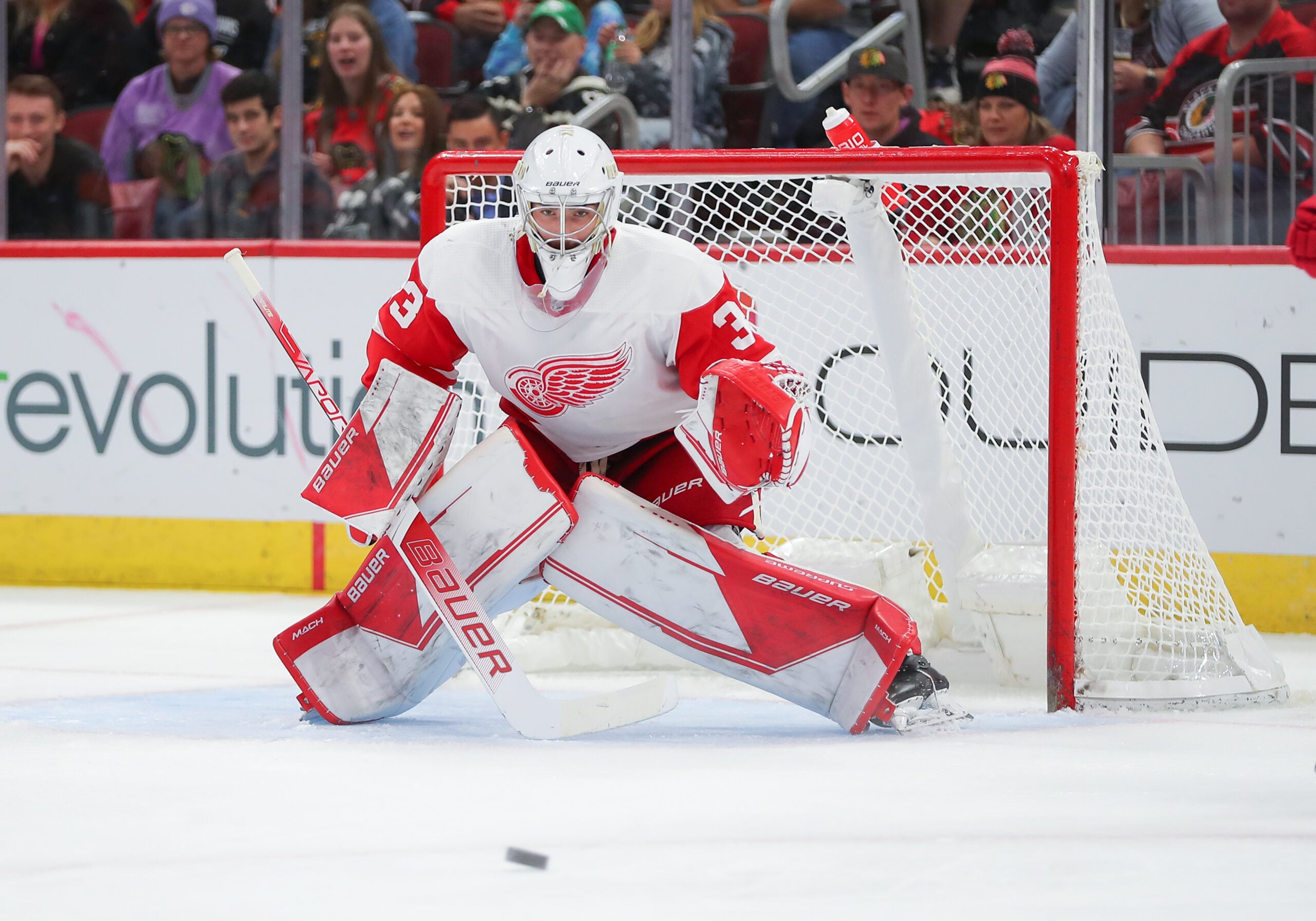
Team goaltending also appears to be in a good place ahead of the 2026-27 season. Like Faulk, John Gibson is entering a contract year, and Sebastian Cossa has more than proven himself at the AHL level.

Detroit’s forward group has some positives, too. Several players have positional/role flexibility, and can play in a variety of spots in the lineup. In addition, there should be lots of competition for roles. There are 13 NHL-caliber forwards on the roster now, and the Red Wings are expected to add more forwards to the group this summer. Sure, there may be some departures, but there will still be more than 12 NHL-caliber forwards on the team when training camp opens, and that volume breeds healthy competition.
Now the not-so-good news. There’s a lot of work to be done with this group.
Of all the forwards listed above, only three are bonafide top-sixers: Dylan Larkin, Alex DeBrincat, and Lucas Raymond. The rest are depth forwards.
Related, Steve Yzerman noted during his end-of-year press conference that the team needs more offense from the center position. Again, using NHL age curves as a proxy, it’s highly unlikely that Andrew Copp, J.T. Compher, and Michael Rasmussen elevate their offensive production enough in 2026-27 to sufficiently address that concern. Marco Kasper and/or Nate Danielson could step up, but there’s risk in expecting them to do so.
This is a clear gap. Detroit needs more top-six forwards, and at least one needs to be a center.
The Red Wings are also missing players who consistently get to the net/play well in the dirty areas. Most of their forwards are perimeter players, as indicated by the Red Wings finishing 25th in five-on-five high-danger chances-for per 60 in 2025-26.
Detroit could lean on younger players like Kasper, Carter Mazur, and Michael Brandsegg-Nygard to deliver around the net, but they shouldn’t rely on those three to do the heavy lifting. Consider this another focus area for the offseason.
Red Wings’ Prospect Pipeline Depth
Next up are Detroit’s 23-and-under professionals and prospects – the future of the Red Wings. Those 23 or younger are likely ascending in their overall trajectory, regardless of which junior or professional league they’re playing in.
| LW | C | RW |
| Carter Bear | Marco Kasper | Michael Brandsegg-Nygard |
| Emmitt Finnie | Nate Danielson | Jesse Kiiskinen |
| Max Plante | Amadeus Lombardi | Brent Solomon |
| Eddie Genborg | Ondrej Becher | |
| Dylan James | Noah Dower Nilsson | |
| Michael Milne | Michal Svrcek | |
| Charlie Forslund | Owen Mehlenbacher | |
| Kevin Bicker | Brennan Ali | |
| Grayden Robertson-Palmer | ||
| Austin Baker | ||
| Max Kilpinen |
| LD | RD | G |
| Simon Edvinsson | Axel Sandin Pellikka | Sebastian Cossa |
| William Wallinder | Anton Johansson | Trey Augustine |
| Shai Buium | Jack Phelan | Michal Pradel |
| Larry Keenan | Rudy Guimond | |
| Nikita Tyurin | Landon Miller | |
| Brady Cleveland | ||
| John Whipple | ||
| Fisher Scott | ||
| Will Murphy |
The Athletic rated the Red Wings as having the fourth-best prospect pool in the NHL for a reason. While their analysis didn’t factor in full-time NHLers Simon Edvinsson and Marco Kasper—who fit the criteria here—there is enough depth and talent in the system to warrant such a high ranking.
Up front, the Red Wings have eight or nine 23-and-under players with NHL upside. And, if a few things go right, that number could increase to double-digits.
Kasper, Brandsegg-Nygard, and Bear all have top-six potential. Nate Danielson could wind up there, too, but may be better off in a more conservative designation. They also have several chess pieces that could play throughout the lineup, including Emmitt Finnie, Max Plante, and Eddie Genborg. Again, depth and talent.
Defensively, you have to feel good about Detroit’s depth. Edvinsson is already a bonafide top-pairing blueliner and was stellar alongside Moritz Seider this season. Axel Sandin-Pellikka gives the Red Wings a third player with top-four upside. Beyond those three (and 24-year-old Albert Johansson), the Red Wings are in good shape – one or more of Anton Johansson, William Wallinder, and Shai Buium will develop into an NHLer, with Larry Keenan also progressing nicely.
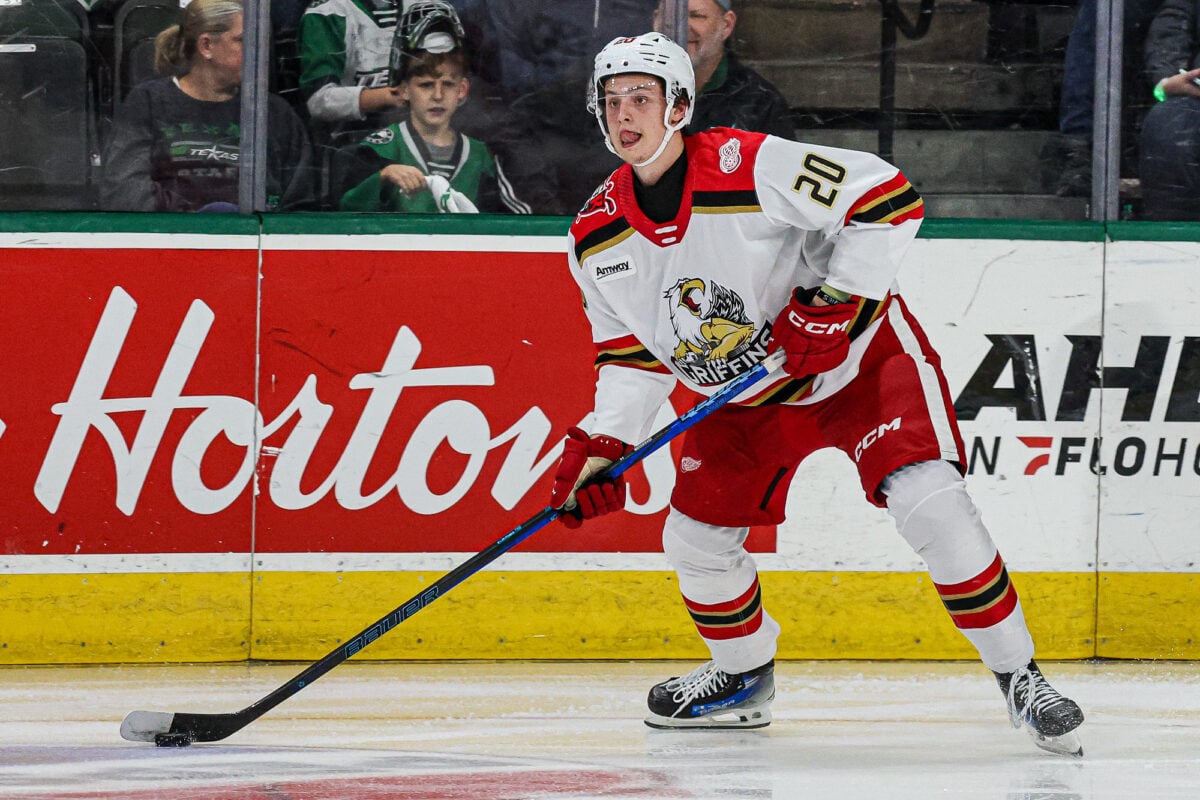
Finally, the Red Wings are positively loaded in net. Sebastian Cossa and Trey Augustine are the headliners, but Michal Pradel and Rudy Guimond have also made waves in the last year. Pradel has a great opportunity ahead of him at Colorado College where he’ll play under coach Kris Mayotte, who had a long track record of developing quality netminders – myself included.
In addition to the players listed above, Detroit also saw Brent Solomon, Nikita Tyurin, and Charlie Forslund progress nicely in 2025-26. These three are underrated prospects to watch next year as they advance to stronger leagues.
If there are any qualms about Detroit’s prospect pool, it’s that they are one game-breaker short. There’s not a lot that can be done about this from a drafting perspective given the fact that the Red Wings don’t own a first-round pick this year. Zero lottery luck in previous years also factors in. Given this, the Red Wings need to find an elite player elsewhere, which is a tall task, of course.
Final Word
A theme that encompasses the whole organization is supply. Both at the pro and amateur levels, the Red Wings have an abundance of players, and not all have a future in Detroit. Where possible, the organization needs to consolidate and use their supply to their advantage.
Do the Red Wings need all of their goalie prospects (plus Michal Postava)? Could a veteran or two be moved out to free up space for a prospect or external addition? And what about Detroit’s deep prospect pool at forward?
One other thing to consider is the ammunition the Red Wings have in the next two drafts. They don’t have a first- or fourth-round pick this year and already dealt their 2027 second rounder. Consolidation could also include dealing players for draft picks.
Regardless of the moves to be made, Detroit’s prospect depth is reason to believe in a brighter future – so long as their development paths continue along an upward trajectory.
Free Newsletter
Get Detroit Red Wings coverage delivered to your inbox
In-depth analysis, breaking news, and insider takes - free.
Subscribe Free →