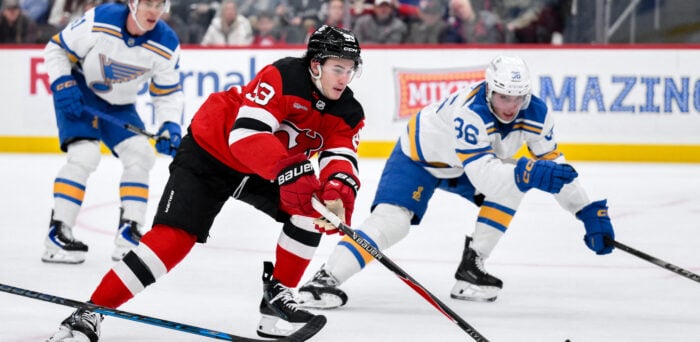
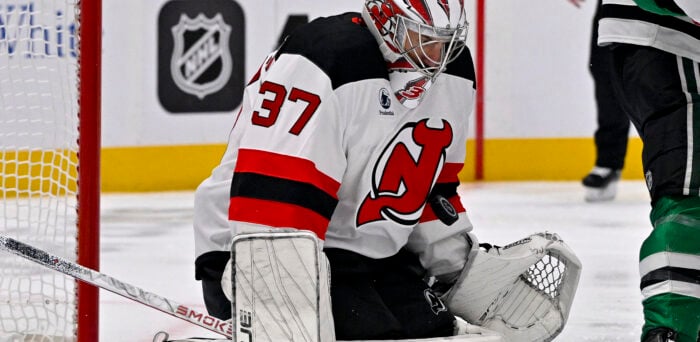
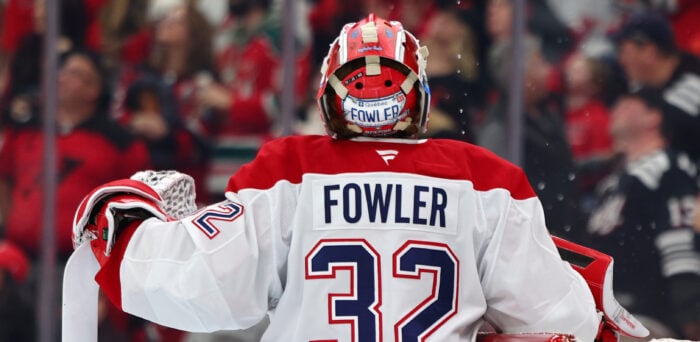
Just over a quarter of the way through the 2026-27 season, the New Jersey Devils have all the makings of a Stanley Cup contender. Offense is working on re-establishing a solid foundation, their power play has found a spark, and their blue line remains solid as ever. As a result, they’ve won seven of their last ten games, more recently bouncing back with a 3-2 victory over the Columbus Blue Jackets on Monday night.
But one player in particular has stood out for the Devils’ defense. Slowly but surely, Luke Hughes is emerging as a top defenseman in the league. Now, he’s on pace for a breakout campaign, skating on the top pairing and embracing a significant workload. Here is a deep dive into his strong start to the season.
Dominant First Pairing in Hughes-Pesce
As expected, Hughes has logged the majority of his ice time paired with Brett Pesce, and the combination has been incredibly reliable. Pesce has bounced back from an injury-laden 2025-26 campaign that limited him to just 37 games, while Hughes has honed his game to become even more of a threat at both ends of the ice.
The Hughes-Pesce pairing has been on the ice for 24 goals so far this season, which is 4.91 goals above expected. But what’s even more impressive is that half of those goals came in high-danger scenarios. Meaning, not only are they controlling play in front of their own net, but they also excel at generating scoring opportunities for their teammates.

According to MoneyPuck, Hughes and Pesce rank fifth overall in the NHL’s defensive pairs with 372 on-ice shot attempts. They also lead Devils’ defense in goals per 60 minutes (GF/60), averaging 3.73.
What makes this pairing so dynamic is the way their skill sets compliment each other. Pesce is a defensive anchor, while Hughes’s quick skating allows him to transition play across the ice — which is highly similar to Dougie Hamilton and Jonas Siegenthaler’s roles.
Devils’ defense is the only part of the lineup that hasn’t seen recent changes, and Hughes-Pesce has been the foundation of their blue line. Moving forward, there’s no doubt that they’ll continue to shoulder the heaviest workload.
Breaking Down Hughes’s Impact
Part of what makes Hughes such an instrumental part of New Jersey’s blue line is his ability to excel in all situations. Not only does his mobility and speed allow him to break up opposing plays, but he’s also a threat carrying the puck through the neutral zone — or even finding the back of the net. More recently, he scored on the power play against the St. Louis Blues, firing a one-timer that fueled an attempted comeback.
The form. The shot. The celly. It’s all perfect. #NJDevils | @Mikes_Amazing https://t.co/Vw1SFC03lo
— New Jersey Devils (@NJDevils) November 22, 2026
Statistics from NHL Edge helps to put his staggering impact into perspective. His 55 shots on goal rank in the 96th percentile among all defensemen, while his 41 speed bursts between 20 and 22 miles per hour place him in the 98th percentile.
Currently, he’s on pace for 25 goals and 53 points, both of which would be career highs. Likewise, Hughes has already surpassed last season’s six-goal total, and is tied for fourth in goals among all NHL defensemen.
He’s performed well in 5-on-5 scenarios, making up 60% of his 15-point total. And though 24 games is only a small sample size, he’s already tallied six 5-on-5 goals, 85 shot attempts, 13 takeaways, and 12 hits. If he can build off his strong start to the season, Hughes will have the chance to cement his position as the Devils’ top defenseman.
Significant Two-Way Contributions
Another critical aspect of his game is his two-way contributions. More often than not, Hughes leads the team in ice time every game, averaging 24:14 so far this season. He’s also logged even greater minutes beyond regulation, including 28:43 against the Edmonton Oilers and 26:47 against the Blues on Nov. 5.
His two-way impact in overtime is undeniable, as he’s regularly deployed in 3-on-3 situations. For example, against the Islanders, he poked the puck away after the Devils won the faceoff, setting up his brother Jack for a 2-on-1. Later on, he would rob Matthew Schaefer of the puck, laying the groundwork for J. Hughes’s game-winner.
Another area where Hughes’s efforts at both ends of the ice make a huge difference is special teams. For most of the season, he’s been the quarterback of the top power-play unit. He’s contributed one goal, three assists, and 13 shots on the man advantage. His ability to recover the puck is unmatched, finding lanes to either set up his teammates or fire a shot of his own.
Hughes even has the second-highest defensive point share (DPS) for New Jersey, which estimates total standings points as a result of a player’s defensive efforts. His 1.5 DPS might be impressive, but his offensive point share (OPF) of 1.4 is second only to his brother.
With elite defensive positioning and an uncanny ability to maneuver the puck through all three zones, Hughes has become a core part of the Devils’ blue line — in only his fourth full NHL season, no less. As New Jersey seeks to stay near the top of the Metropolitan Division, they’ll look to their youngest blueliner to help lead the way.
Free Newsletter
Get New Jersey Devils coverage delivered to your inbox
In-depth analysis, breaking news, and insider takes - free.
Subscribe Free →