


It’s been a crazy few days in the NHL. The Edmonton Oilers acquired Tristan Jarry, the Buffalo Sabres fired Kevyn Adams and named Jarmo Kekalainen their new general manager, and the Minnesota Wild acquired star defenseman Quinn Hughes from the Vancouver Canucks.
While Jarry and Adams are notable shakeups, the Wild’s acquisition of Hughes sent shockwaves around the NHL. The Colorado Avalanche and Dallas Stars are the cream of the crop in the West, but should the Wild be in the same tier as those two teams after trading for Hughes?
Hughes Makes a Good Wild Blue Line Even Better
The Wild had gotten off to a slow start this season, but they were trending in the right direction even before acquiring Hughes. They had an 18-9-5 record before adding Hughes to their roster, and they should only improve from here. There’s already a 10-point gap between them and the Avalanche, so they might not catch the Avs, but they’ve solidified their position as a playoff contender in the Central and Western Conference.
Even before acquiring Hughes, the Wild had one of the better blue lines in the NHL. Jared Spurgeon isn’t what he was in his prime, but he’s still a solid defender. Meanwhile, Jonas Brodin is still at the peak of his powers and is one of the better two-way defenders in the league.
Brock Faber is not what people think he is, but Hughes may help bring out the best in him. Though his defensive numbers were down this season with the Canucks, those were likely the product of being on the worst team in the NHL. Those should improve with the Wild, especially when they get a bit healthier. And Faber should benefit, similar to Filip Hronek, who had the best season of his career partnered alongside Hughes in 2023-24.
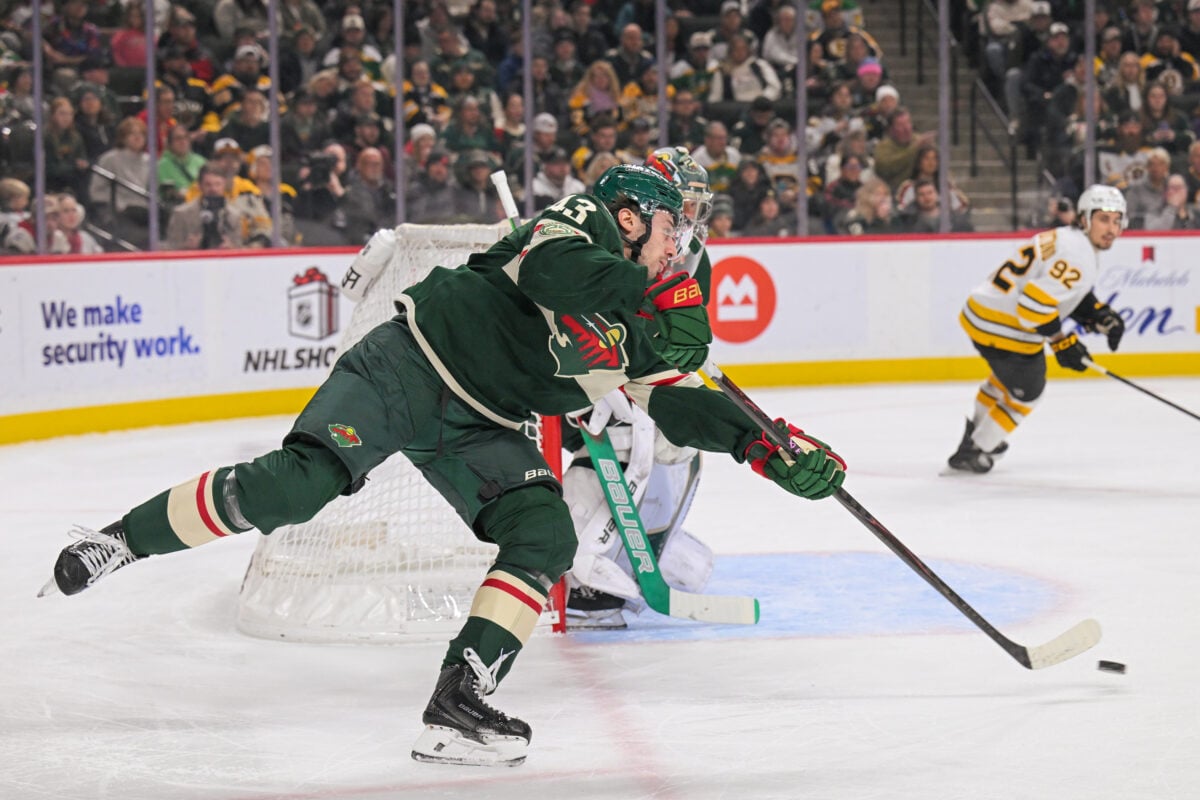
Offensively, only Cale Makar may have an edge over Hughes among NHL defensemen. He’s a dynamic playmaker from the back end and has elite skating ability. For as good as some of the Wild’s defensemen are, they did not have anyone close to Hughes’ ability offensively. He’ll add a different dimension at five-on-five, and the power play that they did not have before acquiring him.
Since the start of the 2023-24 season, the Canucks averaged 2.90 expected goals per 60 minutes at five-on-five when Hughes was on the ice, a top-20 rate among NHL defensemen. The Canucks were also a significantly worse team when Hughes was off the ice, as their xG% dipped from 54.09 to 47.61. He will be a game-changer for the Wild, just as he was for the Canucks, but there are still some concerns with the Wild’s roster.
Wild Have Questionable Center Depth
Hughes is a game-changer for the Wild’s blue line, but will he put them in the same tier as the Avalanche, Stars, and even the Vegas Golden Knights? The Wild gave up plenty to acquire Hughes. Zeev Buium has top-pair potential as a defenseman, but that’s moot since they acquired Hughes. Where the Wild may encounter some problems is giving up Marco Rossi to bring Hughes in.
To be clear, I’m not saying the Wild should have hung onto Rossi. If that’s what you needed to do to bring in Hughes, you do it, but center depth is a question mark for the Wild. Even before the Hughes trade, the Wild’s center depth was a concern. But without him, they’re far from the same level as the Avalanche, Golden Knights or Stars.
Related: 2 Takeaways From Quinn Hughes’ Debut Postgame Press Conference
As of today, the Wild have a center group of Danila Yurov, Joel Eriksson Ek, Ryan Hartman and Nico Sturm. Yurov is a promising prospect, but he’s not a top-six center yet. Eriksson Ek is one of the best two-way centers in the NHL, but he’s a second-liner on a Cup contender. Hartman and Sturm are good bottom-six forwards, but they’re just that. Bottom-six forwards.
Obviously, it’d be unfair to compare the Wild’s centers to Nathan MacKinnon. Only Connor McDavid is better than MacKinnon, but the Avalanche’s center depth is quite good. Brock Nelson has settled in nicely as the team’s second-line center, while Jack Drury is a capable third-line pivot.
The Stars have Roope Hintz, Wyatt Johnston, and Matt Duchene, the latter of whom can play center if needed since they lost Tyler Seguin to a torn ACL. The Wild’s center depth doesn’t compare to them, and it doesn’t even compare to the Vegas Golden Knights, who have Jack Eichel, Tomas Hertl and William Karlsson.
So what does this have to do with Hughes? For as great as he is, you need a legit first-line center to be a true Cup contender. The Wild, Stars and Golden Knights all have legit first-line centers, while the Wild do not. That’s why, even after acquiring Hughes, I wouldn’t put the Wild in the same tier as the Avalanche, Stars and the Golden Knights.

This might seem controversial, but I don’t think the Wild acquiring Hughes changes much in the Western Conference playoff picture. They’re a good team, maybe even a very good team, but they’re still not better than the previously mentioned teams because they lack a true first-line center.
Perhaps some of that concern is negated by having elite wingers such as Kirill Kaprizov and Matt Boldy, but getting another top-six center will be the next biggest task for GM Bill Guerin. If he doesn’t, it could come back to bite them in the playoffs if he doesn’t make an upgrade ahead of the trade deadline.
That will be crucial for the Wild and Guerin to do because they’re likely on a collision course with the Stars or Avalanche in Round 1 of the playoffs. Would I pick the Wild to win that series as of today? I wouldn’t, even with Hughes on the roster, because they don’t have the center depth to compete with the Stars or Avalanche.
Wild Still a Tier Below Other Top Teams in the West
Hughes ending up with the Wild and not the New Jersey Devils or Detroit Red Wings was a shock to almost everyone. They’ve gotten better by adding him to their roster, but Guerin still has work to do. They’re a center away from being in the same tier as some of the other top contenders in the West. If they acquire one, they could be a threat to make a run in the playoffs. But until then, they’re still a tier below the other top teams.
Advanced stats from Natural Stat Trick
