There is a deadline hanging over the San Jose Sharks this weekend, and it has nothing to do with a trade or a signing bonus. It is a calendar quirk written into the NHL’s new collective bargaining agreement, and it hands general manager Mike Grier a narrow, closing window to make a decision that could shape the franchise’s next decade. The player at the center of it is Will Smith.
Under the terms of the new collective bargaining agreement (CBA), Monday, Sept. 15 is the transition date. Until then, a team can extend a player under its control for as many as eight years. After it passes, the maximum term for a player re-signing with his own team drops to seven.
Smith’s entry-level deal runs through 2026-27, so he will be a restricted free agent next summer regardless, and San Jose holds his rights either way. The urgency is not about whether Smith stays. It is about how long the Sharks can secure him, and at what price.
That distinction matters more than it might appear. An eight-year extension signed before Monday could tie Smith to San Jose through his age-29 season, locking in his prime years at today’s rate before the salary cap climbs further.
A deal signed after the deadline caps out at seven years, one fewer season of guaranteed control over a top-five pick who is trending upward. For a player the organization has spent two years positioning as a franchise cornerstone, that extra year carries weight the raw numbers do not fully capture.
Why Smith Is Worth the Commitment
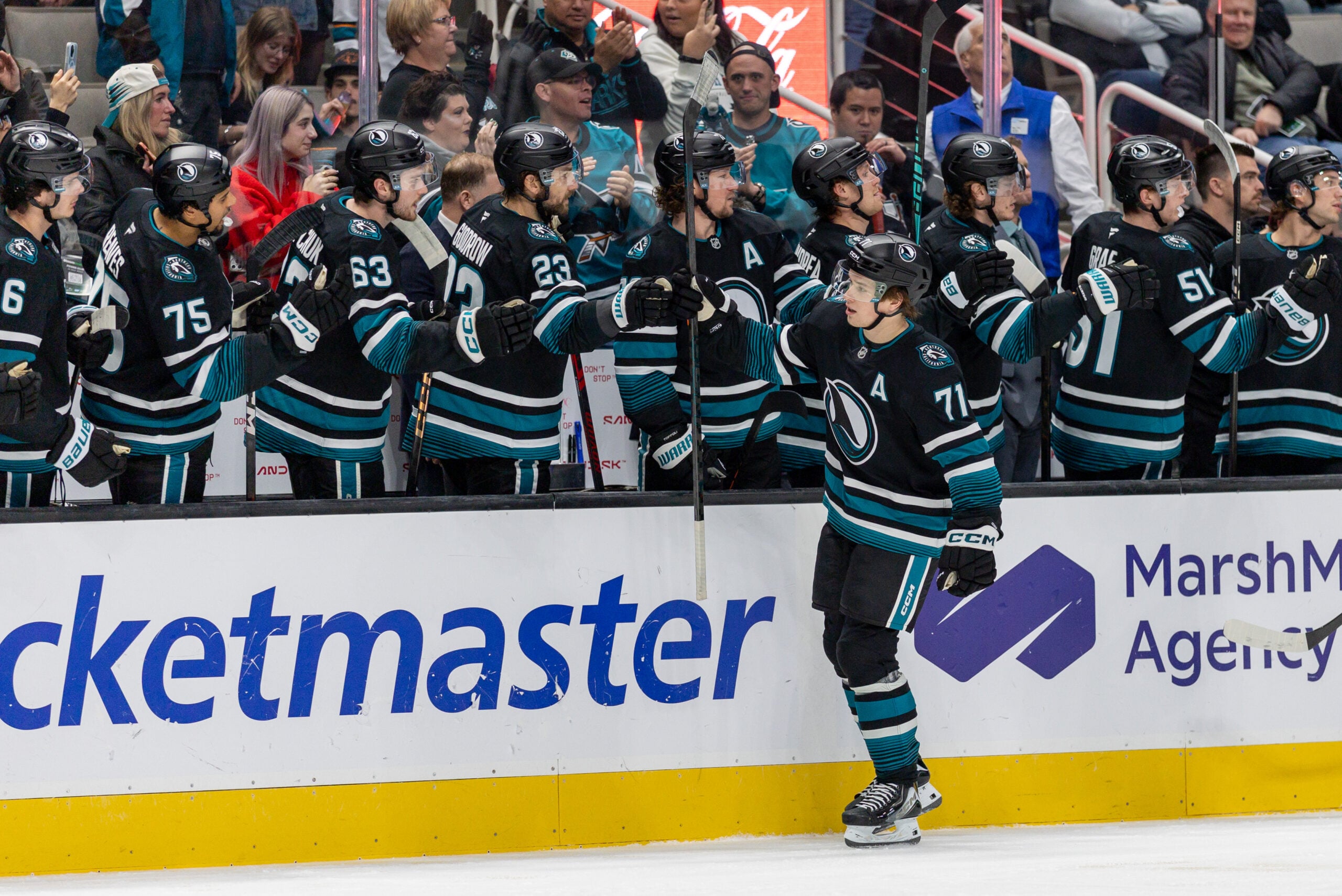
The case for moving quickly rests on how much Smith grew in year two. Selected fourth overall in 2023, a year before Macklin Celebrini, Smith improved from 45 points as a rookie to 24 goals and 35 assists for 59 points in 69 games last season. The 14-point jump is the headline, but the more meaningful shift was in how he generated offense.
As a rookie, Smith created almost entirely within the offensive zone. In his second season, he began driving play through the neutral zone, carrying the puck against set defenses, and winning the puck battles that precede those chances.

That kind of development is exactly what an organization hopes to see before committing long-term. Smith is a right-shot forward drafted as a center who has played mostly wing in the NHL, and there is a real possibility his value climbs further if he shifts back to the middle or continues his upward trajectory. Grier made the intention plain in August. “Smitty is definitely someone we’d like to lock up long-term as well,” he said, weeks after Celebrini’s record extension closed.
The Money and the Risk
The market context is where it gets complicated. Celebrini’s $18.8 million average annual value is not a Smith comparable. That figure reflects what a potentially generational center commands. Smith’s 59-point line places him in a different tier, one populated by talented young wingers in their extension windows. Analysts have floated a wide range, from a five-year deal around $10.5 million annually to an eight-year commitment approaching $12.5 million, or roughly 11 percent of the projected 2027-28 cap.
Herein lies the genuine tension. An eight-year deal benefits the Sharks by securing an extra prime season, but it may not benefit Smith, who could prefer a shorter term that lets him cash in again as the cap balloons and his game matures. A player betting on himself has every reason to sign for five years and revisit the market, especially if a return to center could boost his value. The eight-year structure that serves San Jose’s interests is not automatically the one Smith’s camp wants.
That is the needle Grier has to thread before Monday. San Jose is not in danger of losing Smith, but letting the eight-year window pass would quietly cost the franchise a year of cost-controlled prime production, and it would leave one of the two faces of the rebuild unsigned while the other is locked in through 2032.
Grier has said he is confident a deal can come together during the season if it does not happen now, which suggests the Sharks are comfortable with a seven-year fallback if the eight-year math does not work for both sides.
Still, the cleanest outcome is obvious. The Sharks spent two years building around Celebrini and Will Smith as the centerpieces of their next era (from ‘San Jose Sharks are No. 1 in NHL Pipeline Rankings for 2026,’ The Athletic, 8/18/2026). Getting Smith signed before the window narrows would remove any ambiguity from that plan. A few days remain to make it official, and the term on the table will never be this long again.
Free Newsletter
Get San Jose Sharks coverage delivered to your inbox
In-depth analysis, breaking news, and insider takes - free.
Subscribe Free →