The Montreal Canadiens have enjoyed a strong start to the 2026-27 season, but one of their biggest questions could soon become even more complicated. With Samuel Montembeault back practicing with the team and seemingly getting closer to returning from his injury, Montreal could soon find itself carrying three goaltenders.
While having too many options between the pipes might sound like a good problem, managing three NHL goaltenders is rarely an ideal situation. Jacob Fowler has been outstanding since being recalled, Jakub Dobes is still trying to find his rhythm, and Montembeault remains an experienced option. For head coach Martin St. Louis and the Canadiens’ management, the coming weeks could require some difficult decisions.
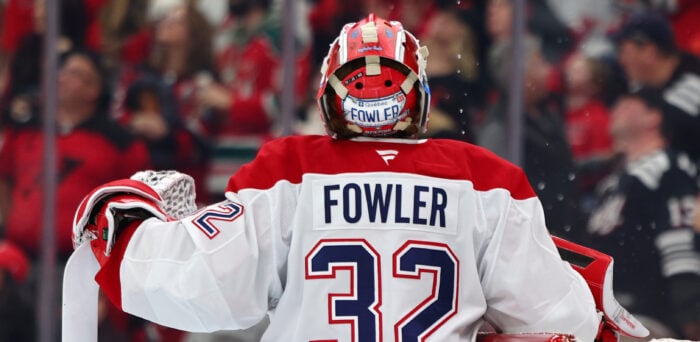
Fowler Has Earned His Spot
When Montembeault went down with an injury early in the season, the Canadiens turned to Jacob Fowler. At the time, the young goaltender was expected to provide temporary help while Montreal waited for its veteran to return.
Instead, Fowler has completely changed the conversation. The 21-year-old was arguably Montreal’s best player throughout October, finishing the month with a remarkable 7-1-0 record, a 1.84 goals-against average, and a .932 save percentage.

Those numbers are impressive for any NHL goaltender, let alone a rookie who was originally expected to spend considerable time developing with the Laval Rocket. Beyond the statistics, Fowler has looked incredibly comfortable at the NHL level. His positioning, composure, and ability to make timely saves have given the Canadiens something they desperately needed early in the season: stability between the pipes.
He has also played an important role in Montreal’s recent success. After beginning the campaign with a 1-2-1 record, the Canadiens responded with a remarkable 10-1-2 stretch, with Fowler providing much-needed consistency. At this point, sending Fowler back to Laval simply because Montembeault is healthy would be difficult to justify.
The Canadiens have repeatedly emphasized that young players need to earn their opportunities. Fowler has done exactly that, and taking away his NHL spot despite his performances would send a questionable message. He isn’t just Montreal’s goaltender of the future anymore. Right now, he has made a convincing argument that he deserves to be its number-one option.
What About Dobes and Montembeault?
While Fowler has been thriving, Jakub Dobes has experienced a much more difficult beginning to the season. Through his first seven starts, Dobes has recorded a 3-2-2 record while posting a 4.04 goals-against average and a disappointing .847 save percentage.
Those numbers are a significant step backward from what Canadiens fans witnessed during his impressive playoff performances last spring. Of course, it would be premature to give up on Dobes. The young goaltender has already demonstrated his potential, and Montreal recently committed to him with a three-year contract extension. However, his struggles have made Fowler’s emergence even more significant.
Then there is Montembeault. Before his injury, the veteran was expected to compete for playing time alongside Dobes. Now, he could return to a completely different situation, with Fowler having established himself as the team’s most reliable option. Montembeault also finds himself in the final year of his contract, making his long-term future with the organization uncertain.
With Fowler and Dobes both under team control beyond this season, it is difficult to envision Montembeault remaining part of Montreal’s long-term plans unless something changes considerably.
Still, that doesn’t mean the Canadiens should simply move on from him immediately. Montembeault has valuable NHL experience and could provide important insurance if either of the younger goaltenders struggles or suffers an injury. The question is whether Montreal can realistically provide enough playing time for all three.
Is a Three-Goalie System the Answer?
For the immediate future, carrying three goaltenders might actually be Montreal’s most reasonable solution. It would allow Fowler to continue playing in the NHL, give Dobes an opportunity to regain his confidence, and provide Montembeault with time to get comfortable following his injury.
However, such an arrangement should probably be considered temporary rather than a permanent solution. There are only so many starts available over an 84-game season, and splitting them between three goaltenders could become problematic.
Fowler needs regular playing time to continue developing. Dobes needs opportunities to bounce back, while Montembeault will undoubtedly want to prove he still belongs in the Canadiens’ plans.
One possibility would be to continue giving Fowler the majority of starts while rotating Dobes and Montembeault into the lineup when necessary. That approach would reward performance without forcing Montreal into an immediate roster decision.
Eventually, though, general manager Kent Hughes might have to explore the trade market. With Montembeault approaching unrestricted free agency, moving him before the trade deadline could make sense if Fowler continues to perform at this level and Dobes finds some stability.
Of course, finding a trade partner would depend on Montembeault’s performances, health, and the market for goaltenders. For now, the Canadiens shouldn’t rush into anything. They have a young goaltender playing outstanding hockey, another with considerable potential, and an experienced veteran nearing his return.
The situation might be complicated, but it also gives Montreal flexibility. The most important thing is that the Canadiens don’t sacrifice Fowler’s development simply to accommodate everyone else.
Montembeault’s return will undoubtedly create a difficult decision, but if Fowler continues playing the way he has, the answer to who deserves the majority of starts should be pretty obvious.
Free Newsletter
Get Montreal Canadiens coverage delivered to your inbox
In-depth analysis, breaking news, and insider takes - free.
Subscribe Free →