There is a very specific kind of silence that falls over an NHL player when that 25-year-old restricted free agent (RFA) signs a one-year contract in the middle of September.
It isn’t a silent celebration. It’s a silent acknowledgement of a challenge.
When Montreal Canadiens general manager (GM) Kent Hughes put a one-year, $1.5-million contract on the table for Arber Xhekaj on Sept. 15, just days before the opening of training camp, the subtext wasn’t particularly difficult to read. Good news for the club: it was without major risk, as he will remain a RFA at the end of the deal, but he will be eligible for arbitration per PuckPedia.
Coming off a two-year bridge deal at $1.3 million annually — a stretch that saw him average a career-low 11:25 of ice time during the 2025–26 regular season and sit in the press box for stretches before scratching out 8:06 a night during Montreal’s 13-game playoff run — Xhekaj wasn’t being handed security. He was being handed a proving ground.
Challenge Is a Seed for Opportunity
Xhekaj is a great story. Raised with a blue-collar upbringing by first-generation Canadians, going undrafted in the Ontario Hockey League (OHL) and NHL drafts all point to a true Cinderella story. Everyone loves an underdog unless they have to play against this particular one. No one gets to this level just to be an enforcer playing almost no shifts. While being able to fight is a bonus — and it doesn’t hurt that he does bring an intimidation factor — being a productive, engaged hockey player is far more important.
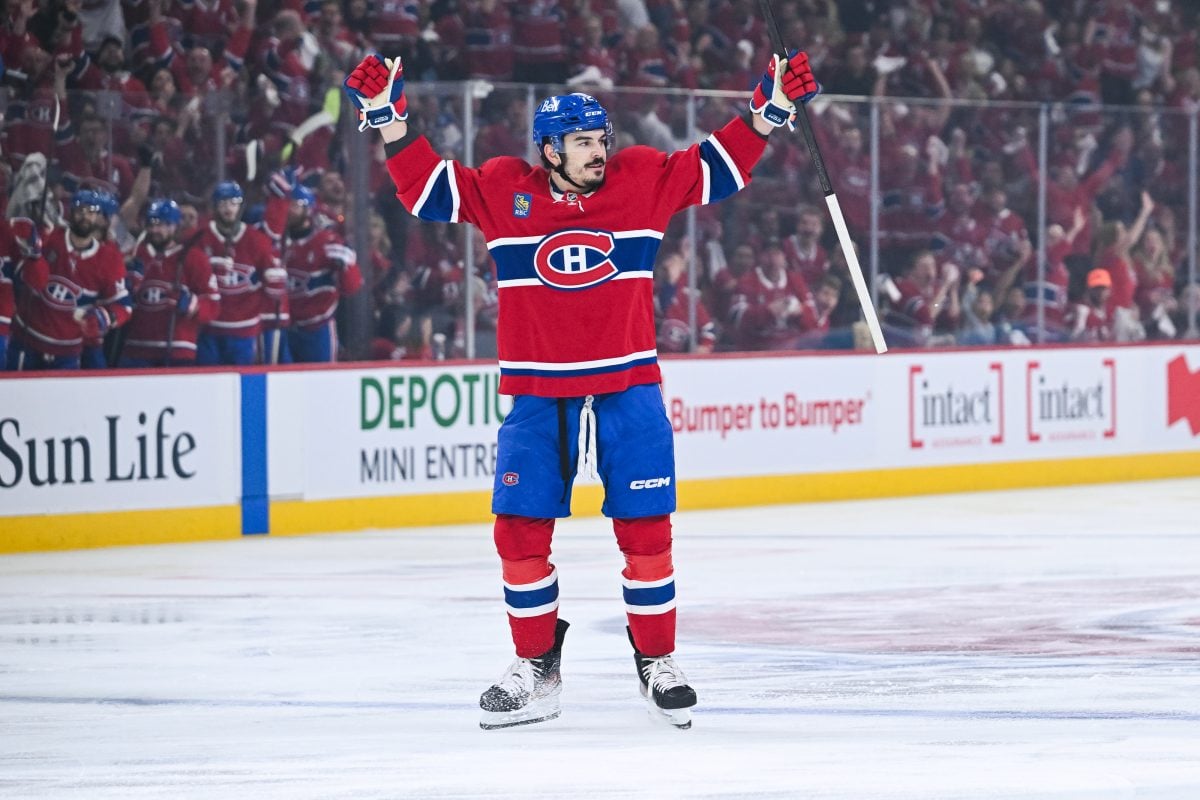
For an undrafted defenceman who built his reputation in this market by dropping the gloves with the league’s toughest heavyweights and firing 100-mile-per-hour slap shots from the point, the path forward wasn’t about becoming louder. It was about becoming consistently indispensable in a role.
Twenty-one games into the 2026–27 season, that is precisely what Xhekaj has done. He has taken every lesson over his career, and rather than sulking over the lack of term or chasing viral moments to justify his roster spot, Xhekaj has treated his “show-me” contract as daily fuel.
“You only get better with experience, and confidence comes with that”
He has stripped much of the volatility out of his game, earned head coach Martin St. Louis’ trust in critical situations, and quietly transformed himself from a situational seventh defenceman into an everyday staple on Montreal’s third pair, positioning himself for the multi-year commitment that eluded him this past summer.
Roster Construction Opened the Door
To understand why Xhekaj’s emergence matters so much to the Canadiens right now, you only have to look at the composition of their defence corps.
Montreal’s blue line is built on pace, puck retrieval, and offensive transition. Lane Hutson manipulates time and space like a fourth forward. Noah Dobson eats massive minutes moving the puck up the ice. Mike Matheson, when healthy, is one of the smoothest skating defencemen in the Eastern Conference, while Alexandre Carrier and Kaiden Guhle provide mobility and structured two-way play.
It is a modern, dynamic group capable of tilting the ice against anyone in the Atlantic Division. What that group doesn’t naturally possess in abundance, outside of Guhle, is sheer, unforgiving mass.
Over an 84-game grind, and especially in the claustrophobic, trench-warfare environment of the Stanley Cup Playoffs, a blue line made up exclusively of smooth-skating puck-movers can get worn down along the end boards and in front of its own crease. Xhekaj brings an element nobody else on Montreal’s back end can replicate.
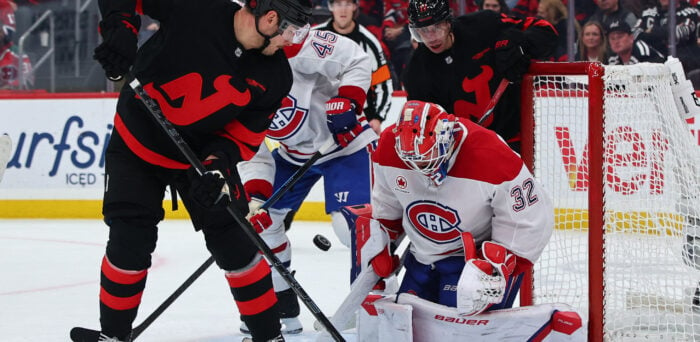
At 6-foot-4 and 240 pounds, he alters the physical geometry of the defensive zone. Opposing forecheckers think twice before finishing a check on Hutson or Dobson when Xhekaj is on the ice, and forwards looking to set up shop in front of Jacob Fowler or Jakub Dobes quickly discover that real estate around the Canadiens’ blue paint comes at a steep physical price. Even though his play puts him under surveillance for reputation calls, he gives Montreal’s defence the exact counterweight it needs to balance skill with deterrence. His shot can also be a weapon.
Of course, size and toughness alone don’t keep you in St. Louis’ lineup anymore. The standard in Montreal has risen dramatically since the early days of the rebuild, and the margin for error on a contender has shrunk accordingly.
Challenging Limits
Earlier in his career, Xhekaj’s biggest enemy was his own eagerness to make an impact. He would step up at the offensive blue line hunting for a highlight-reel collision, miss his target, and leave his partner stranded on a two-on-one going the other way. Or. he would take an instigator penalty at the wrong juncture of a tied game, forcing his teammates to kill off a momentum-sapping power play while he watched from the penalty box. This season, impulsiveness has been replaced by calculated restraint.
Through his first 21 appearances, Xhekaj has logged an average of 12:13 per night, registered four points (one goal, three assists), posted a plus-1 rating, and, most tellingly, begun to drive some offensive plays at five-on-five. With Xhekaj on the ice at even strength, the Canadiens are controlling 54.4% per cent of the shot attempts and have over 51% in expected goals. He also ranks first among Montreal’s defencemen in high-danger scoring chances (HDCF%), showing his offensive play (even due to playing against bottom-six lines) has greatly improved.
All of this is a stark turnaround for a player who spent last season underwater in possession and defensive metrics. Instead of chasing hits out of position, he is using his reach to steer play into the corners, winning his box-outs cleanly, and making the simple, five-foot outlet pass to allow his partner to exit the zone with speed.
“Boring” has become the highest compliment you can pay him. Against the Boston Bruins on Nov. 12, he logged 15:21, his highest workload of the campaign, picked up an assist, delivered four hits, blocked a shot, and finished plus-1 without taking a single minor penalty. Two nights later against a high-flying Colorado Avalanche attack, he played nearly 14 disciplined minutes, threw five hits, and didn’t surrender an inch of ice in front of his net.
Just as importantly, Xhekaj has expanded his utility beyond sheltered five-on-five shifts. In today’s NHL, a bottom-pair defenceman who cannot kill penalties is perpetually one bad week away from losing his job. St. Louis has increasingly trusted Xhekaj in short-handed rotations, leaning on his heavy stick in passing lanes and his ability to clear bodies out of the slot. That trust has kept him engaged throughout games rather than leaving him cold on the bench during special-teams stretches, a factor that has become even more vital with Matheson sidelined by a lower-body injury.
When Hughes signed Xhekaj to that one-year deal in September, the message from management was essentially: we know what you are when things get physical; now show us what you can be every single night.
By embracing the unglamorous details of third-pair defending, and by weaponizing his physicality selectively rather than recklessly, Xhekaj has, so far, answered that challenge emphatically. He hasn’t just secured his place in Montreal’s nightly lineup; he has made himself a critical piece of the Canadiens’ depth puzzle, and he is steadily building the exact kind of resume that turns a one-year bet into a long-term commitment.
Free Newsletter
Get Montreal Canadiens coverage delivered to your inbox
In-depth analysis, breaking news, and insider takes - free.
Subscribe Free →