


*This article was updated prior to the 2025-26 season
The world of NHL contracts is changing. With the news that the salary cap ceiling is on pace to spike around $25 million over the coming three seasons, the era of the flat cap is ending. That also means that the contracts signed over the last few seasons, which might look bad under a flat salary cap, will likely look much better going forward. A player making $6.5 million per season is currently making around seven percent of the salary cap. If the cap does indeed balloon to $113.5 million three seasons hence, those $6.5 million average annual values (AAVs) will drop to just 5.7% of the cap. The difference might seem small, but it compares to roughly a $5 million AAV in today’s numbers.
Chances are, the sharp increase in salary cap space will prompt a lot of reckless spending from NHL GMs. So this article might look very different in the coming seasons. But for now, we’ll look at the contracts that appear the worst by today’s standards. Most of these contracts were signed for a reason, given to players who have earned a great paycheck in the NHL.
Their inclusion is not meant as any disrespect to the players, who owe it to themselves and their families to get the best contract they can when it’s available. But injuries happen, performances decline, and circumstances change. In this article, we’ll pick the worst contract for each time right now, and look to e explain the circumstances that brought them to this point.
(The bolded text below each player name displays the term remaining on the contract entering the 2025-26 season, as well as the AAV and any no-trade clauses (NTC) or no-movement clauses (NMC) the deals contain.)
Anaheim Ducks: Jacob Trouba
(One year, $8 million, M-NTC)
The Anaheim Ducks are a team in transition, trying to claw towards a future that doesn’t seem eager to arrive. And moves like the trade they made for Jacob Trouba aren’t helping. Trouba had worn out his welcome in the Big Apple, and the New York Rangers were eager to get rid of their captain by any means necessary. For reasons that may only ever be known to general manager Pat Verbeek, the Ducks stepped up and took his full contract, with no compensation coming their way from New York. He’s a disaster on defense according to most metrics, and while he brings a physicality that often crosses the line of legality, it didn’t help the Ducks make a playoff push. Verbeek made another questionable move, signing Mikael Granlund to a three-year, $21 million contract this summer, but for now, Trouba’s deal takes the cake.
Boston Bruins: Jeremy Swayman
(Seven years, $8.25 million, NMC)
This is the stuff that contract nightmares are made of: a player sits out to demand better pay, finally gets a massive eight-year, $66 million contract extension with a no-movement clause (NMC), and then proceeds to have the worst season of his career, costing his team a postseason appearance for the first time since the 2015-16 season. And make no mistake: while the Boston Bruins are not the team they once were, had Jeremy Swayman put up anywhere near his normal career numbers, they would almost certainly have made the playoffs.
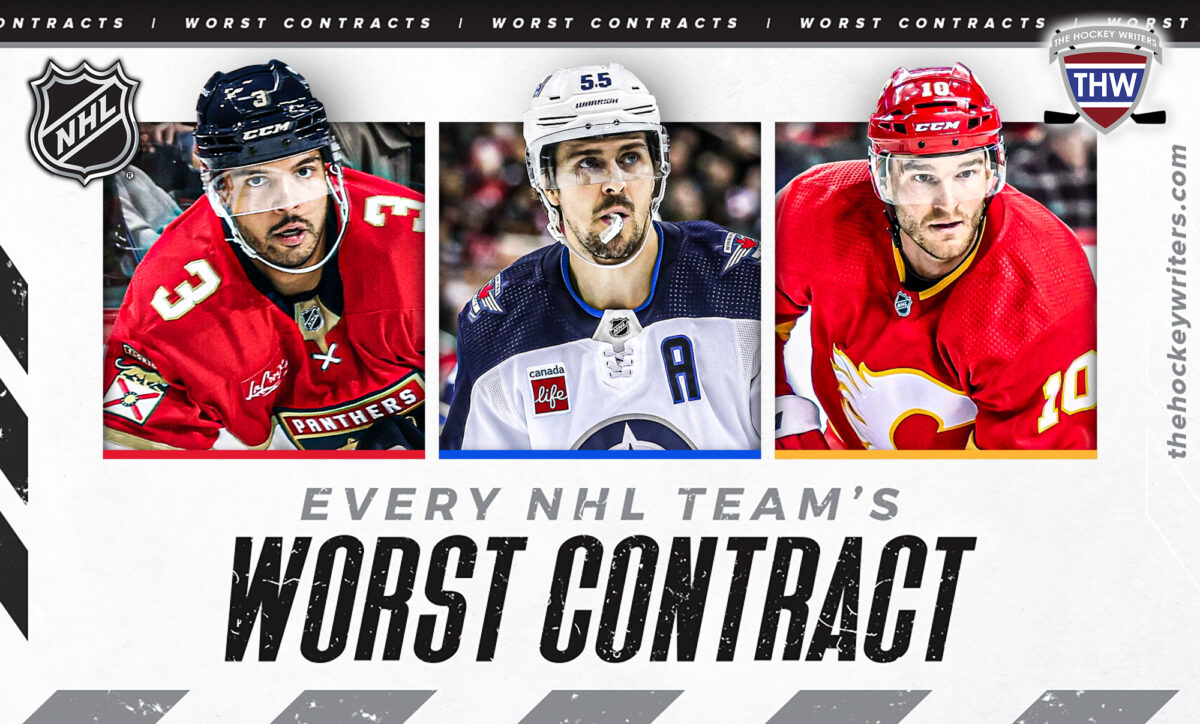
Unfortunately, Swayman fell off the face of the earth last season, allowing the most goals against in the league, and posting career lows in save percentage (SV%), goals against average (GAA), and goals saved above average (GSAA) — a mark in which he finished nearly 20 saves lower than any previous season. It was an awful season for the Anchorage, Alaska native, and one he’ll happily soon forget. Of course, his inclusion on this list comes with a big asterisk: if he returns to form, he’ll once again be one of the best goaltenders in the league, and his contract will be more than justified, especially with the cap going up. But entering the new season, fixing Swayman needs to be the Bruins’ top priority.
Buffalo Sabres: Ukko-Peka Luukonen
(Four years, $4.75 million, M-NTC in final three seasons)
Continuing a theme, Ukko-Pekka Luukonen is another goaltender who had a career-worst season after signing a long contract extension, which he did last summer, signing a five-year, $23.75 million contract to stay with the Buffalo Sabres. Luukonen posted career-worst marks in SV% and GSAA, and his 3.20 GAA is hardly admirable. The Sabres are a mess, and goaltending is far from their only problem. Last summer, Elliotte Friedman recently reported on his 32 Thoughts Podcast that teams believe Luukonen might be available. While that trade never materialized, it suggests that Buffalo already has buyer’s remorse about the extension they gave their 26-year-old netminder.
Calgary Flames: Jonathan Huberdeau
(Six years, $10.5 million, NMC)
Jonathan Huberdeau’s first three seasons with the Calgary Flames have been nothing short of a disaster. It would have been reasonable to expect some falloff after his career-best 115-point season in 2021-22 season, but then general manager Brad Treliving could not have anticipated this when he inked Huberdeau to the richest contract in franchise history, an eight-year, $84-million monster deal. Treliving proffered the contract before Huberdeau had played a single game in Alberta — shortly after acquiring him in the shocking Matthew Tkachuk trade. Everyone knew it was a huge swing at the time, but the Flames were desperate to keep some quality players around for the long haul.
It wasn’t supposed to be like this and Huberdeau’s immense drop-off remains mystifying. While his deal looked a little pricey at the time (his market value was $9.9 million) and there was a good chance he wouldn’t find the same success away from Florida, the degree to which he fell off was still hard to imagine.
Dom Luszczyszyn (From ‘NHL’s 10 worst contracts, 2025 edition: Jonathan Huberdeau, Ivan Provorov and more,” The Athletic NHL, July 31, 2025)
Huberdeau wouldn’t reach 115 total points in Calgary until early in his third season. Admittedly, it was his and the team’s best so far during his tenure in Alberta, but he’s still playing miles below a $10.5 million level of production. He’ll enter next season as a 32-year-old coming off a 28-goal season. And he recently generated controversy with comments about “not feeling” like skating during a preseason optional skate. He may indeed have been joking, but if so, it’s a tone-deaf remark to make after such a string of disappointing seasons in Cowtown.
Carolina Hurricanes: Jesperi Kotkaniemi
(Five years, $4.82 million)
The Carolina Hurricanes have developed a well-earned reputation for managing their salary cap well. But they might have made a mistake with Jesperi Kotkaniemi. The idea was simple enough: lock up a talented two-way forward long-term, keeping his salary cap hit low to buy the best seasons of his career. They locked him up on an eight-year, $38.5 million contract in 2022, after grabbing him via an offer sheet the offseason prior. Unfortunately, Kotkaniemi has not provided much offense, managing just 132 points in 305 games with Carolina. Though he is responsible in his own end, $4.82 is still a lot to pay a defense-first forward. It’s not a nightmare contract, but if he can’t score more, the Hurricanes might live to regret this one.
Chicago Blackhawks: Tyler Bertuzzi
(Three years, $5.5 million, M-NTC)
The Blackhawks are still rebuilding, and right now, they’re more worried about hitting the cap floor than the cap ceiling. One of the few longer-term moves they’ve made is to add Tyler Bertuzzi, a forward they hoped could come in and mentor their young players. But he did not cover himself in glory during his first season in the Windy City.

Bertuzzi’s final numbers were ok, but he’s a defensive liability and finished minus-39 on the season. And frankly, the Blackhawks don’t have many players on term, especially after sending Seth Jones, their previous worst contract, to the Florida Panthers. Bertuzzi is one of the few players who will be on the same contract when the Blackhawks are looking to really compete in a few seasons. If he can’t sharpen his all-around game by then, Chicago will probably hope to move on from his deal.
Colorado Avalanche: Valeri Nichushkin
(Five years, $6.125 million, NMC)
Valeri Nichushkin signed an eight-year, $49 million contract in July 2022. He was coming off a 25-goal season and was a major contributor to the Colorado Avalanche’s run to the Stanley Cup the previous season. He has been a great player with the Avalanche, and he still is when he’s on the ice. Unfortunately, he is on the ice less and less these days. Nichushkin entered Stage 3 of the NHL/NHL Players’ Association Player Assistance Program during the second round of the playoffs in 2024. He was thereafter required to miss a minimum of six months at this stage in the program.
Related: Avalanche’s Nichushkin Placed in Stage 3 of the Player Assistance Program
The reasons for any player’s admittance to the program are, appropriately, shrouded in mystery, and it’s inappropriate to speculate what might be going on. But Avalanche players at the time seemed disappointed in the circumstances. And, whether the distraction played a role or not, they would go on to lose that series to the Dallas Stars. When he plays, he’s still a good player. But if the team cannot rely on him, his contract will remain an eyesore and a point of frustration for the Colorado front office over the next five years, unless they can find another solution.
Columbus Blue Jackets: Elvis Merzlikins
(Two years, $5.4 million, M-NTC)
The Columbus Blue Jackets have had the most tumultuous and heart-wrenching stretch for any NHL team in recent memory, perhaps in league history. It is hard to imagine any player performing well, given everything members of this organization have had to go through over the past three seasons. But even as the team rallied this season to a near-playoff berth, Elvis Merzlikins remained a sore spot. Towards the end of the season, it looked as though Merzlikins was losing his starting job to incoming youngster Jet Greaves, but that won’t eliminate his contract from the books, unless the Blue Jackets force a trade or a buyout this summer.
Dallas Stars: Tyler Seguin
(Two years, $9.85 million, NMC)
It’s not often that a player is publicly called out by his team’s front office for poor performance, but Dallas Stars captain Jamie Benn and teammate Tyler Seguin have suffered that fate at least twice in their career. In 2018, CEO Jim Lites spoke to The Dallas News and said “what nobody says is what is completely obvious to me: We are getting terrible play from our top two players. If 14 (Benn) and 91 (Seguin) don’t lead we will not be successful.” Then, history repeated itself when owner Tom Gaglardi appeared on the Cam & Strick Podcast in 2022.
“When you sign contracts, you have to earn that,” Gaglardi told Andy Strickland. “The two guys are taking one-quarter of the cap space of the team, and both of them aren’t producing enough… I expect them to step up and get better.” Since then, Benn has re-entered the fan base’s good graces and re-signed a one-year, incentive-laden contract this summer after his bigger deal expired, but Seguin hasn’t eclipsed 52 points since the 2018-19 season. Injuries took their toll this season as well. And there are two seasons left on his contract, which carries a full NMC. The cap is going up, and the Stars still felt they had the flexibility to spend big on pending free agent Mikko Rantanen’s new contract, so they aren’t crippled by the Seguin deal. But they will probably be happy to see the back of them when the time comes.
Detroit Red Wings: Ben Chiarot
(One year, $4.75, M-NTC)
Do you still believe in the Yzerplan? There are a few too many bad contracts on the books of the Detroit Red Wings already for a team that has yet to find any success under his leadership. And it’s difficult to choose the worst of the bunch. But Ben Chiarot takes the cake by a hair. His performance has been disastrous, as many predicted it would be when he signed his four-year deal. Chiarot was not a significant enough difference-maker for a rebuilding team to make him a big part of their defense. And now, they’re reaping the consequences of impulsive free-agent spending. If there IS a Yzerplan — the nickname given to the rebuilds orchestrated by general manager Steve Yzerman — it needs to materialize, and fast.
Edmonton Oilers: Darnell Nurse
(Five years, $9.25 million, NMC)
It’s hardly a surprise that Darnell Nurse’s extensive and expensive contract ended up as an honorable mention near the 10 worst in the league by The Athletic’s Dom Luszczyszyn (cited above). Nurse is a fine defenseman, but he’s being paid like a franchise defenseman, and he hasn’t been playing like one. To compound issues, he has been particularly bad in the postseason, becoming a regular target of criticism during the 2024 run to the Stanley Cup. Nurse is still an ok defenseman and is respected in the room. But you need more than that for a $9-plus million contract to not become an albatross, and his has.
Florida Panthers: Seth Jones
(Five years, $7 million, NMC)
When the Florida Panthers decided to acquire Seth Jones at the trade deadline in 2025, they knew the contract they were taking on. Long considered one of the worst in the league, the Blackhawks signed Jones right before their team went into an extended rebuild. They gladly ate just over 25% of the annual salary cap hit to move on from him and send him to Florida, and Jones gladly waived his No-Movement Clause to move to a contender.
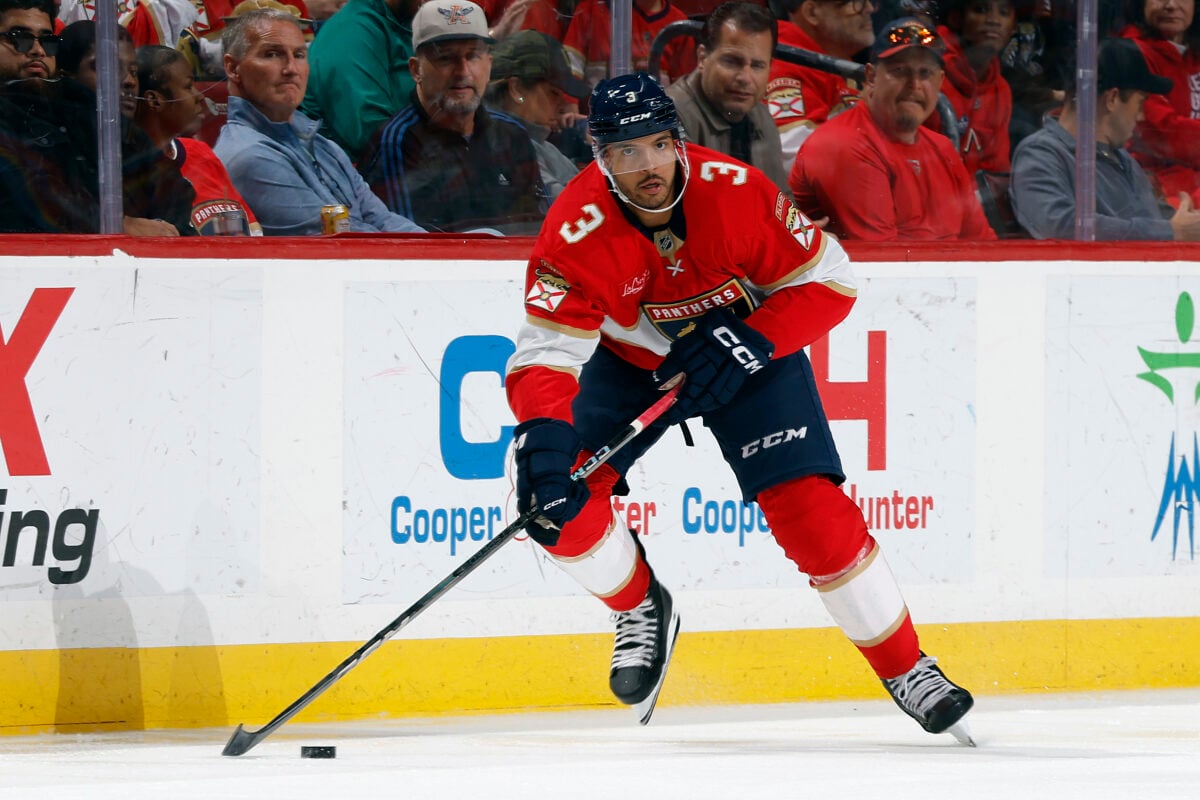
Jones shined in his new role and helped the Panthers become back-to-back champions, but even at a heavily reduced rate, his five remaining seasons are a lot to take on for a cap-conscious team like the Panthers. They believe the potential rewards outweigh the risks, and Jones should continue to be a huge asset playing a more suitable role with the Panthers. Still, on a team with few bad contracts, Jones’ is inarguably the worst one on the books.
Los Angeles Kings: Drew Doughty
(Two years, $11 million, M-NTC)
Much like Nurse, Drew Doughty is still a very solid defenseman for the Los Angeles Kings. But his AAV ties him for the second-highest-paid defenseman in the league (tied with Rasmus Dahlin, and behind one defenseman who will appear further down this list), and he clearly isn’t performing at that level heading towards the season when he’ll turn 36. Doughty is a legend for the Kings. When he retires, he’ll become a Hockey Hall of Famer and he is already immortalized as part of the Kings’ monument outside Crypto.com Arena. But $11 million is simply too much for anything but a truly elite defenseman. And considering that absolute superstars like Cale Makar, Roman Josi, and Adam Fox have all signed for significantly lower AAVs since Doughty’s extension in 2018, it’s clear that his contract was an overpay from the start.
Minnesota Wild: Frédérick Gaudreau
(Three years, $2.1 million, M-NTC)
The Wild are finally (mostly) free of the twin contracts given to Zach Parise and Ryan Suter in July 2012. A tiny fraction of both contracts will remain on the books until the conclusion of the 2028-29 season, but nothing near the massive albatross they’ve been over the last few seasons.But that doesn’t mean that the ghost of those contracts isn’t still weighing on the Wild’s salary cap. It forced them to make some bad decisions, such as the contract given to Frédérick Gaudreau, who signed a five-year, $10.5 million contract in April 2023.
It’s not that Gaudreau has been particularly bad for the Wild — he hasn’t. In fact, he reached a career-high 19-goal mark in 2022-23, shortly before signing the contract. The contract isn’t horrendous; it’s just a bit of a head-scratcher. A five-year commitment to a 30-year-old journeyman (32 now) really feels out of place. General manager Bill Guerin was probably trying to solve his cap dilemma by signing a longer-term contract to lower the cap hit; it’s just worth questioning whether Gaudreau was the right player for that commitment. Either way, the commitment was made, and Gaudreau will be a Wild player through the 2028-29 season.
Montreal Canadiens: Josh Anderson
(Two years, $5.5 million, M-NTC)
It hasn’t been a good few years for Josh Anderson, who is entering the sixth season of a seven-year, $38.5 million contract he signed with the Canadiens in 2020. Montreal signed him just days after acquiring him from the Blue Jackets, and they received criticism for giving such a long and expensive contract to a player with only one season of over 30 points in his career. After five seasons, the gamble clearly has not paid off. Anderson has continued to struggle to stay healthy and has managed only 135 points (with a minus-63 plus/minus) in his tenure with the team.
Nashville Predators: Steven Stamkos
(Three years, $8 million, NMC)
The new contract the Nashville Predators gave to Steven Stamkos last summer is one they’d already like to have back. Of course, Stamkos is still one of the best goal-scorers in NHL history. But there’s a reason why the cap-conscious and ruthless Tampa Bay Lightning opted to let Stamkos, a franchise legend, walk and replace him with the younger (and more expensive) Jake Guentzel. It simply isn’t wise to make long investments in 34-year-old players, especially with Stamkos’s injury history. His first season in Music City was a disaster, with the Predators finishing with just 68 points, miles outside the playoffs. Stamkos managed only 27 goals and was minus-36. Can he bounce back? Sure. But will he ever live up to a $32 million contract? Probably not. And now, the Predators have to weigh the need for a rebuild with him on the roster.
New Jersey Devils: Ondřej Palát
(Two Years, $6 million, M-NTC)
Back in 2022, the New Jersey Devils wanted to make another big splash in free agency after missing out on the postseason for the fourth season in a row, and they managed to grab Stanley Cup veteran Ondřej Palát on a five-year, $30 million contract.
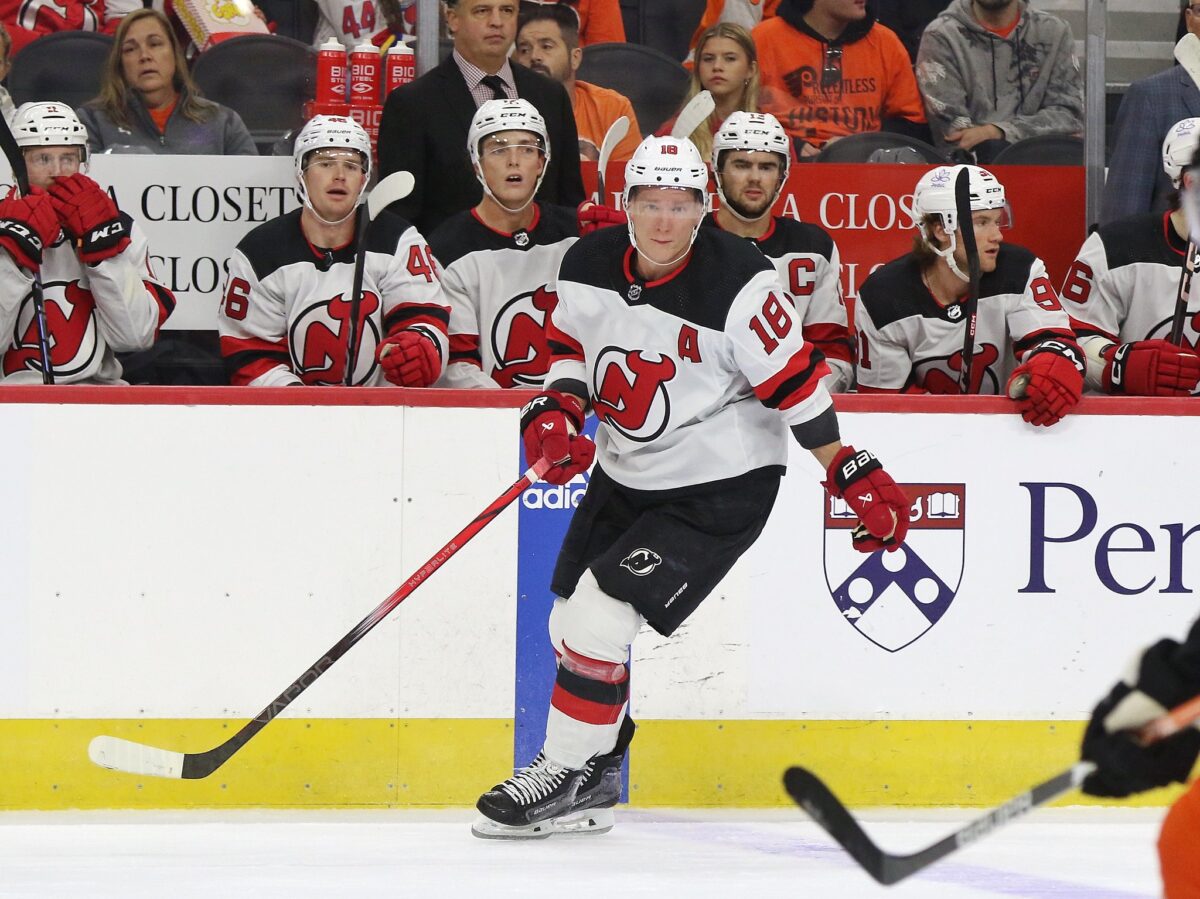
The good news is that the Devils returned to the playoffs, becoming one of the teams to watch of the season and finishing with 112 points, good for second in the Metropolitan Division. the bad news is that Palát was a non-factor, struggling with injuries and managing only 23 points in 49 games. Unfortunately, Palat has been a ghost ever since. He has not lived up to a $6 million cap hit in any season with New Jersey so far, and the Devils might wish to be rid of the two seasons left on the deal. That hypothetical trade will be made somewhat easier at least, as his NMC clause now drops to a 10-team no-trade list.
New York Islanders: Scott Mayfield
(Five years, $3.5 million, NTC)
A low AAV might make a contract more palatable, but it doesn’t make it good. And giving Scott Mayfield a seven-year extension in 2023 is one of the more perplexing moves in Lou Lamoriello’s career. Mayfield is a solid third-pairing defenseman. But he is already 32 and will turn 33 early in the 2025-26 season. He’s a fine stay-at-home defenseman, but a replaceable one, and giving him a seven-year extension is truly baffling. There are a few bad contracts on the Islanders, but this takes the cake.
New York Rangers: Mika Zibanejad
(Five years, $8.5 million, NMC)
Things are getting ugly at Madison Square Garden, and Mika Zibanejad is at the center of it. After a brutal season that saw him finish with his lowest full-season point total since 2017-18, talks of trading the Swedish center were quickly shot down — by none other than the player himself. When asked about a potential move on locker cleanout day, Zibanejad bluntly stated: “I know what my contract says. … Both parties agreed to it, and like I said, I think I’ve earned it. Until it’s time to adjust it, I have no plans of going [anywhere]. I’ve invested a lot of years here.” The Rangers have some other questionable contracts, but this one has become an emotional albatross and a lightning rod, two things no team wants on the books.
Ottawa Senators: Dylan Cozens
(Five years, $7.1 million)
Last trade deadline, the Ottawa Senators made a bold move, dealing Josh Norris and Jacob Bernard-Docker to the Buffalo Sabres in exchange for Dylan Cozens. They were betting that Cozens, now 24, could still turn into the type of top-six center that he was drafted seventh overall to become. And in 21 games in Ottawa, he showed some flashes of exactly that.

The problem is that Cozens is already being paid like an established second-line center, and he isn’t yet producing as one. When the Sabres gave him the contract, they doubtlessly hoped they would overpay in the first season or two, then have a bargain on their hands from that point forward. Clearly, that’s what the Senators hoped in acquiring him as well. But on a team with few really bad contracts, this one is certainly a risk at present.
Philadelphia Flyers: Rasmus Ristolainen
(Two years, $5.1 million)
Rasmus Ristolainen is the archetype of a player that NHL general managers see with completely different eyes than the rest of us. Almost universally panned by statisticians and fans alike, GMs seem to take one look at his 6-foot-4 frame and his physical play style and get glossy-eyed. So even though it was a mistake before the ink was dry, it is no surprise that a team as badly run as the Philadelphia Flyers signed Ristolainen to a five-year, $25.5 million contract extension, which has two seasons remaining entering the 2025-26 season.
Ristolainen’s isn’t the only questionable contract on the Flyers’ roster, and he had a decent season in 2023-24 as the team fought for and ultimately missed out on a playoff spot. But he just is not a good defenseman overall and is not worthy of such a costly contract. He’s currently rehabbing from a triceps tendon rupture and is expected to rejoin the Flyers in the first or second month of the season.
Pittsburgh Penguins: Erik Karlsson
(Two years, $10 million, NMC)
How can the 2022-23 Norris Trophy winner be the worst contract on his team? Despite the recent success, Karlsson has one of the worst contracts in the league. It might be controversial, and yes, he had 101 points in 2022-23. But he’s the highest-paid defenseman in the NHL, and he cannot play effective defense anymore.

Karlsson has had a great career, which includes three Norris Trophies. He’s a future inductee into the Hockey Hall of Fame without question. But he allowed the fourth-most expected goals against (xGA) and the fifth-most high-danger chances against (HDCA) at 5-on-5 even en route to a Norris Trophy season in 202-23. Despite scoring 101 points, he still managed to be a minus-26, an almost Herculean accomplishment of terrible defending. And the San Jose Sharks still finished 29th in the league despite his best efforts. Newly installed general manager Kyle Dubas clearly saw something he liked in Karlsson. But now, after two seasons in the Steel City, they might already be looking for an escape hatch.
San Jose Sharks: Barclay Goodrow
(Two years, $3.641 million, M-NTC)
The San Jose Sharks are nearing the end of one of the deepest rebuilds in the league, and they fully understand where they are as a franchise. So there’s no reason to spill a lot of ink here: they knew Barclay Goodrow was on a terrible contract when they claimed him off waivers from the Rangers in 2024. But he’s a veteran player and a former Shark rookie (signed as a free agent), and the team knows him. They wanted him in their room, and they got him. They don’t plan to be serious competitors in the next two seasons, and by the time they are, Goodrow will be long gone.
Seattle Kraken: Chandler Stephenson
(Six years, $6.25 million, NMC)
The aforementioned Luszczyszyn ranked the new, massive Chandler Stephenson contract as one of the 10 worst in the league as soon as it was signed, and it’s understandable. He was already declining, he was already 30, and it was a massive amount of money and term to give to a player who had never really been a star on his team. A year into the deal, and nothing has changed. Stephenson was second on the team in points, but he was a minus-9 on a team that didn’t sniff the playoffs. He doesn’t make the Kraken better now, and it’s unlikely that will change as he grows older on this contract.
St. Louis Blues: Justin Faulk
(Two Years, $6.5 million, M-NTC)
Ask almost any Blues fan, and they won’t have a very high opinion of Justin Faulk. It’s not entirely his fault. Many view general manager Doug Armstrong’s decision to trade for and extend Faulk as insurance in case captain Alex Pietrangelo left as the very mistake that ensured that outcome. And while many years have past and Pietrangelo’s career appears at a premature end, Faulk hasn’t eased tensions because he hasn’t been particularly good. He’s had a few strong stretches in St. Louis, but the defense has been a sore spot since Pietrangelo’s departure. In recent seasons, Colton Parayko’s play has dramatically improved, even earning a spot on Team Canada’s 4 Nations Face-Off roster and an Olympics Orientation Camp invite. But Faulk is still an obstacle, and one the Blues would probably like to be rid of.
Tampa Bay Lightning: Nick Paul
(Four years, $3.15 million, NTC)
The Tampa Bay Lightning are ruthless with their salary cap — as evidenced by letting franchise legends like Stamkos walk away in free agency. And that makes it even more difficult to explain the seven-year contract given to Nick Paul after the 2021-22 season. Yes, the then-deadline acquisition played an important role for the Lightning in their deep run to the Stanley Cup Final. But the Lightning had seen rentals come and go before. Why was it so important to keep Paul that they would sign him for seven seasons?
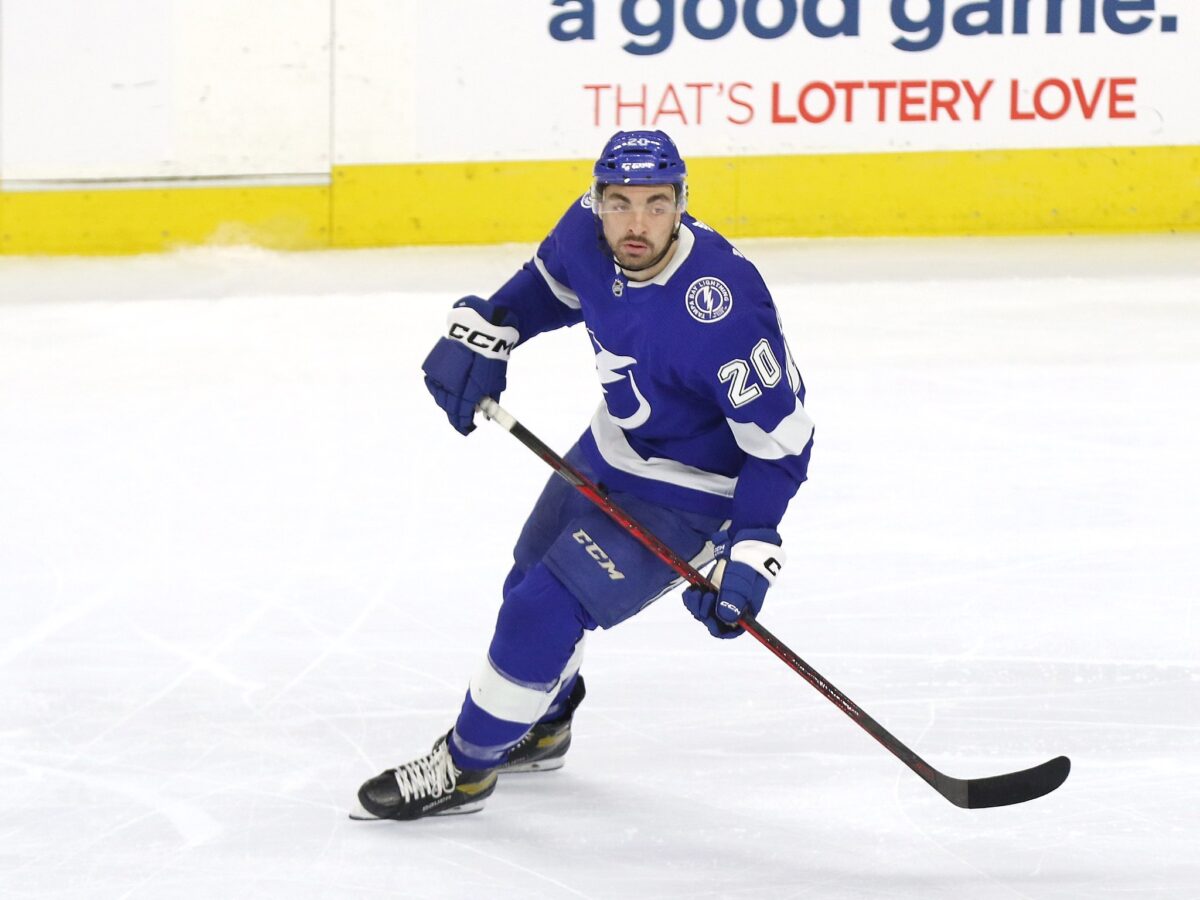
Obviously, the argument for a longer deal is a smaller AAV. And at $3.15 million, Paul is a valuable piece who scored 22 goals last season. But the 30-year-old is leaving his prime with four more seasons left to play. Some will argue that the re-acquired Ryan McDonagh contract beats out Paul’s for worst on the Lightning. But McDonagh is still a solid player and only has one season left on his deal. The risk on four more seasons of Paul seems to be the most potentially problematic, especially now that he’ll be missing till November after shoulder surgery. The Lightning are still a well-run team with very few bad contracts, and Paul’s is nowhere near as problematic as others on this list — but it’s just a few seasons longer than it needs to be.
Toronto Maple Leafs: Chris Tanev
(Five years, $4.5 million, NMC)
It’s not going to be popular in the Greater Toronto Area, but there really is no justification for the six-year contract Toronto Maple Leafs general manager Brad Treliving gave to 34-year-old Chris Tanev last summer. Yes, he is still a solid defenseman who helped the Stars reach the Western Conference Final as a deadline acquisition. He’s still a good player in the NHL. But there are clearly more good seasons behind him than in front of him. And a six-year extension for a player in his mid-30s is always going to raise eyebrows.
Some will argue that in Free Agency, you have to stretch your budget to get the player you need, but that’s a logical fallacy: if a player isn’t worth a contract, he simply isn’t worth the contract, whether he’s a free agent or not. And some might say that the four-year, $14 million extension given to Oliver Ekman-Larsson is worse than Tanev’s. They are both bad deals, but Tanev’s is more expensive and longer. If Ekman-Larsson and Tanev end up being the backbone pieces that help the Maple Leafs secure their first Stanley Cup since 1967, no one is going to care about the last few seasons on these deals. But if they don’t deliver fast, Toronto will regret these for a long time.
Utah Mammoth: Lawson Crouse
(Two years, $4.3 million)
The Utah Mammoth are inheriting the misdeeds of the Arizona Coyotes, but the general manager has been consistent for several seasons. Bill Armstrong inked Lawson Crouse to a five-year extension back in 2022, and while it’s hardly the worst contract in the world, the $4.3 million AAV is really high for a defense-first player. Crouse had an especially poor 2024-25 season: just 18 points in 81 games. Yes, he’s very responsible in his own end, and he’s a valuable player at the right price. But $4.3 million simply isn’t the right price.
Vancouver Canucks: Elias Pettersson
(Seven years, $11.5 million, NMC)
This entry comes with a huge asterisk: for now, Elias Pettersson’s $11.5 million AAV is at the top of the list for Vancouver after an awful season. Yes, Pettersson has played at a superstar level before, and the Canucks will use everything they can to get him back to that level. But they missed their opportunity to trade him before his NMC kicked in, which means they’re now stuck with whatever version of Pettersson remains until or unless he decides to try a fresh start.
The 2024-25 season was an utter disaster that immediately puts this contract in the “terrifying” category. 15 goals and 45 points isn’t a great result for someone making half as much money per season as Pettersson. And the pernicious controversy between him and J.T. Miller last season was an embarrassment to the entire franchise. Now with a new head coach and Miller gone, there are no more excuses for Pettersson. Either he delivers, or his contract immediately joins Huberdeau’s as among the very worst in the league.
Vegas Golden Knights: Ivan Barbashev
(Three years, $5 million, M-NTC)
Ivan Barbashev became a fan favorite in Vegas with a fantastic performance during the 2023 playoffs — which culminated in his capturing his second Stanley Cup. But for a team that has been ruthless in moving on from players, no matter how beloved, the five-year, $25 million contract extension the Golden Knights gave Barbashev the following offseason was certainly surprising. Barbashev is a useful player and has been fine with Vegas. But for a cap-strapped team like Vegas, every dollar counts. And, frankly, Vegas could find rentals that do what Barbashev does most seasons at the deadline. There aren’t many bad contracts in Vegas, but this is at least one to scratch your head about.
Washington Capitals: Tom Wilson
(Six years, $8.5 million, NMC)
It’s a tale as old as time: never give a long and expensive extension to a power forward in his 30s. The Capitals did that with Tom Wilson in 2023, giving him a seven-year, $45.5 million extension that officially kicked off last season. To be fair, he had a fantastic first campaign as the Capitals shocked everyone to be one of the top seeds in the Eastern Conference. But history suggests he is not going to be worth anywhere near that over the life of this contract. At $8.5 million per season, the Capitals are clearly paying Wilson like a top-liner. But if he’s already slipped behind that pace at age 30, what’s his deal going to look like in two, three, or four seasons, let alone six?
Winnipeg Jets: Mark Scheifele
(Six years, $8.5 million, NMC)
It’s easy to understand the seven-year extension the Winnipeg Jets gave Mark Scheifele back in 2023. After months, even years of speculation that they would lose one or both of their superstars, Scheifele and goaltender Connor Hellebuyck, the Jets shocked the hockey world by signing both in one fell swoop, defeating in the process the accusation that the franchise couldn’t keep top talent. And Scheifele has been the Jets’ best forward for many years. He’s still a very good player. He’s just not going to be an $8.5 million for much longer if he even is one now.

Scheifele is an elite offensive producer and creator. But as good as he is in the offensive zone, he is horrendous in his own end. Evolving-Hockey ranks him in the second percentile in that category, near the very bottom of the league. A true number-one center has to be an all-around performer, and Scheifele already isn’t that at age 32. He won’t likely improve in that respect over the seven seasons of this contract, and meanwhile, history indicates that his offense will start to drop off. If that happens, this contract will be very rough for the Jets in due course. But for now, it’s worth it for them to keep a very good core intact.
Spending Never Stops
If there is one constant in the NHL, it’s general managers offering contracts that their fans (and often their successors) wish they hadn’t. And that’s probably only going to accelerate with the salary cap increasing over the coming years.
Some are worse than others, but every team has a bad deal on the books. The important thing to remember is that a bad contract does not necessarily mean a bad player. But we’re curious: which contract would you like to see YOUR team get rid of? And how would you like them to deal with it? Let us know what you think!

