After 57 games last season, the Vancouver Canucks were riding high at the top of the league with 80 points thanks to a 37-14-6 record. This season, they are woefully behind that mark with 63 points (26-20-11) and 11 fewer wins, and subsequently on the precipice of missing the playoffs. As of this writing, they are one point behind the Calgary Flames for the final wild card spot in the Western Conference after losing their last two games since the 4 Nations Face-Off break.
As the trade deadline approached last season, the Canucks were firmly in the category of buyers and a contender for the Stanley Cup – some would even say they were one of the favourites. This season, not so much, and as such, there are a lot of burning questions surrounding the team heading up to the 3 pm ET deadline on March 7. Let’s discuss three of the biggest ones.
Will Brock Boeser Get Traded?
Over the last month, the Canucks have re-signed three of their upcoming unrestricted free agents in Marcus Pettersson, Drew O’Connor, and Kevin Lankinen. However, the big one still remains, Brock Boeser. With those extensions, general manager Patrik Allvin used up $12.5 million of his available cap space for next season. According to PuckPedia, he now only has $11.75 million to sign Boeser and three other players to fill out his roster for 2025-26. That’s not a lot of cap space to do that, especially considering Boeser will command at the very least $9 million average annual value (AAV) on his next contract.

Recent reports suggest things are not good on that front, as it appears the Canucks aren’t willing to shell out the money on a long-term contract for a guy that scored 40 goals last season and is on track to hit 30 again this season. As a result, all roads seem to lead to a trade unless a deal can be struck in the next week or so, or they decide to use him as an “own rental” and risk losing him in the offseason for nothing just to have a better chance of making the playoffs. Considering their place in the standings and struggles to score goals right now, I think the latter is more likely. If they do trade him, they won’t be getting the same caliber of player in return, as a package will probably consist of futures (first-round pick, high-end prospect, etc.) rather than someone that will help the Canucks now.
Having said that, if the Canucks and Boeser don’t see a path to an extension, the best thing is to trade him, regardless of their place in the playoff race. They can’t afford to lose yet another UFA for nothing, especially one as valuable as him.
Should the Canucks Sell Low on Elias Pettersson?
Elias Pettersson has been in the media’s crosshairs ever since he signed the $11.6 million AAV extension last season. And for good reason, as he’s struggled to live up to even half that salary so far. It’s surprising how far he’s fallen since the day that contract was inked. We’re nearly at the one-year anniversary and Pettersson has scored only 16 goals and 49 points in 71 games and is in the midst of his worst season in the NHL. He is on pace for only 16 goals and 52 points, the lowest totals across the board he has seen in his career and the worst since his days in junior. I wouldn’t blame fans if they were having nightmares of Loui Eriksson at this point, as Pettersson is looking more and more like his Swedish counterpart by the day. He has been great defensively, but his goalscoring and production have dried up and as a result, he’s been dragging down the team and his linemates.

Everyone in the NHL, no matter if you’re a fan of the Canucks, has probably heard of the feud between J.T. Miller and Pettersson that eventually led to Miller being shipped out of town. Well, removing Miller has not changed anything, as Pettersson somehow looks worse than he did when Miller was on the team. He has only four shots on goal since the trade and has even created drama for himself after his controversial comments on Monday when he said, “It’s more annoying dealing with the media,” when asked whether a lack of confidence is a reason why he’s not shooting the puck. It seems to be going from bad to worse for the Canucks’ supposed top-line center and could lead to him being put back on the market before the deadline.
The big question, though, is, should the Canucks entertain that idea right now considering he’s probably at his lowest value-wise? They would essentially be selling low on a player who has looked like a shell of his former self and now has questions about his character after failing to show any sort of accountability for his struggles lately. I’m not sure if there are any teams out there that would feel comfortable bringing this type of player into their locker room for another seven years at $11.6 million AAV while giving up substantial assets to do so. Unfortunately, for that to happen, the Canucks will likely have to retain some salary and take a lesser return to entice a team to take a risk on acquiring him.
Whatever happens, this question will loom large over the team, not only before the deadline but potentially into the offseason if they decide it’s better to give Pettersson even more time to turn things around – something they have done for almost a year now with no results.
Could Thatcher Demko Be on the Move Too?
By the end of the season, the Canucks might have four pieces of their core wearing other jerseys. When Miller and Pettersson signed their long-term extensions, the core was believed to be Miller, Pettersson and Boeser anchoring the forward group, Quinn Hughes leading the defence, and Thatcher Demko in goal. Now, that picture is a lot less clear. Miller has already been dealt, Pettersson and Boeser are seemingly on the cusp, and now even Demko’s future is murky. Essentially, the core is in flux right now, with just Hughes at the center of it all.
Before Demko suffered his first injury last season, he was playing at a Vezina Trophy level and did enough to garner enough votes to become a finalist. He had the starting role locked down and was the Canucks’ franchise goaltender. Now, not so much, as Lankinen has appeared to take it from him, parlaying his one-year “show-me” contract into a long-term deal worth $4.5 million AAV. He also got a no-movement clause in the first two years and a modified no-trade in the last three.
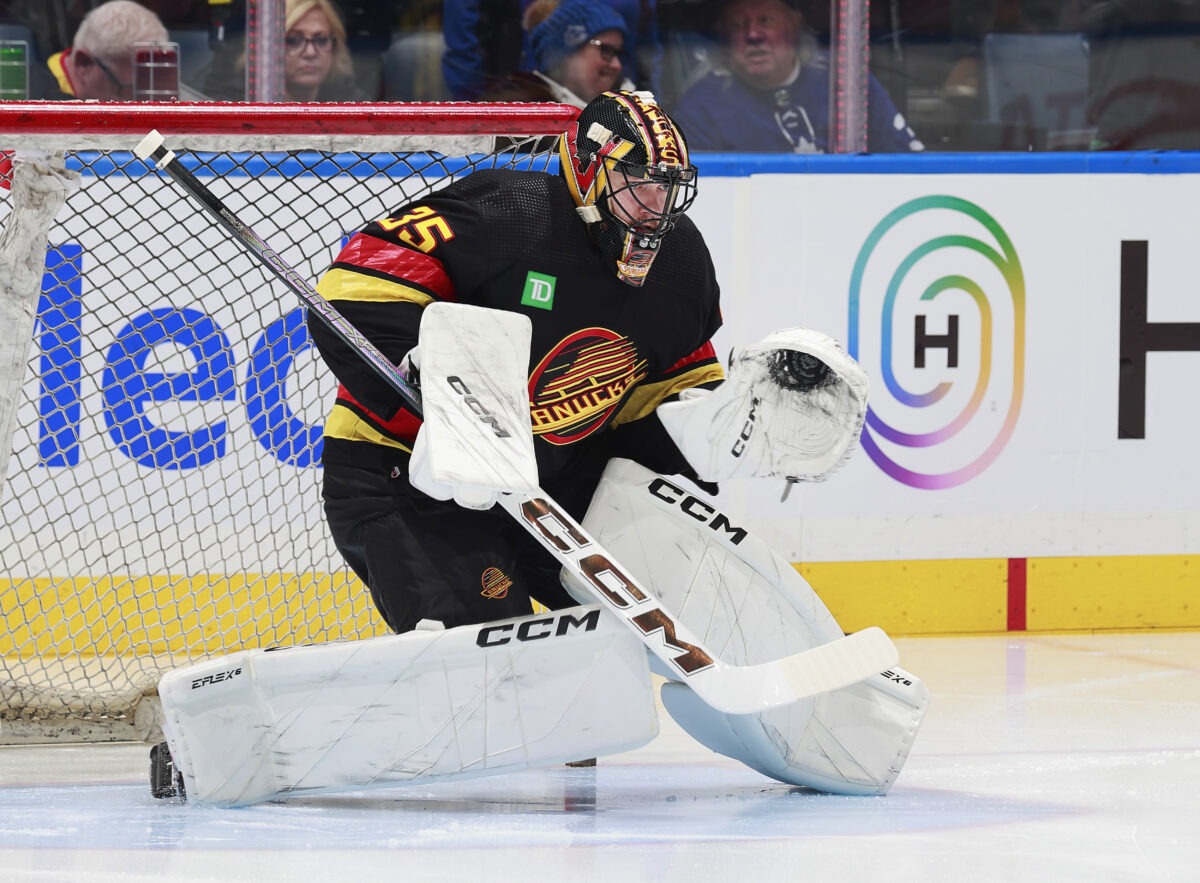
What this means for Demko’s future remains to be seen, but it begs the question, could Allvin pull the trigger on a trade before the deadline? Given his lengthy injury history, from the popliteus muscle to back spasms to his current ailment, teams will probably hesitate to give up a lot. As such, I think they should hold onto him for now and hope that his latest injury is the last of it for a while. In this day and age, teams need a solid 1A/1B tandem, and a healthy Lankinen and Demko give the Canucks that. They can always trade him next season, and possibly get a return closer to what he’s worth, assuming, of course, he returns to form, and the injury bug stays away.
Canucks Will Be an Interesting Team to Watch Before March 7
The next four games will determine what Allvin does at the trade deadline. Right now, they are just outside the playoff picture but could be well out of it by March 7 if they continue losing. Whether they are buyers, sellers, or somewhere in between will be up to the front office and whether they believe they are only a move or two away from being a contender. For the record, I don’t think they are, and should not mortgage any significant assets just to be swept in the first round or worse yet, miss the playoffs by just one or two points.
Free Newsletter
Get Vancouver Canucks coverage delivered to your inbox
In-depth analysis, breaking news, and insider takes - free.
Subscribe Free →