The 2024-25 season is officially over for the Philadelphia Flyers. They took the ice for the final time on Thursday night, falling 5-4 to the Buffalo Sabres to secure the fourth-best odds in the NHL Draft Lottery. All loose ends were tied up on Friday and Saturday as most players, interim head coach Brad Shaw, and general manager Daniel Brière held exit interviews at the team’s training facility in Voorhees, New Jersey.
After a 2023-24 season that was mostly steady until a disastrous conclusion, this season of Flyers hockey was back to the standard fare, which is to say, nothing was standard. That was evident months in advance when news broke that Matvei Michkov would join the team two years earlier than expected. Despite his emergence, it was still a wonky ride full of scoring droughts, goaltending struggles, and the general streakiness of a young team still trying to find its way.
Doing just that ultimately eluded the Flyers. Despite management exercising patience and being well aware that the team could take a step back record-wise, it was still a tough season to follow. There’s always darkness before dawn, though, and maybe the peaks that emerged between the valleys, or even in the valleys themselves, can set the Flyers up for a brighter tomorrow. Until that day arrives, here’s what to remember from the 58th season of Flyers hockey.
Matvei Mania
The main character for this Flyers season was obvious before it even began: Matvei Michkov. The then 19-year-old’s arrival from Russia cemented his status as the most hyped Flyers prospect since Eric Lindros, a Hart Trophy winner who led the Flyers to a Stanley Cup Final in the prime years of his Hall of Fame career. Michkov had one of the best seasons in Kontinental Hockey League (KHL) history for a teenager in 2023-24 after the Flyers took him No. 7 overall the year prior.
Michkov got off to a strong start, scoring two goals in his third career game and earning NHL Rookie of the Month honors in October with a line of four goals and five assists in 11 games. Shortly thereafter, he became one of the first to draw the ire of John Tortorella (but certainly not the last) and spent a pair of games in mid-November in the press box. That was the only time Michkov was in the press box all season, although there were a handful of mid-game benchings and one particular animated shouting sequence between the pair.
Though his scoring numbers initially held steady, Michkov hit a speed bump shortly after his 20th birthday on Dec. 9, entering the 4 Nations Face-Off break in a scoring dry spell. But he came out of the break strong, earning a second Rookie of the Month nomination in February with 10 points in seven games. He rode that wave to the end of the season, finishing with a rookie-best 26 goals and tied for second in the points race among first-year players.
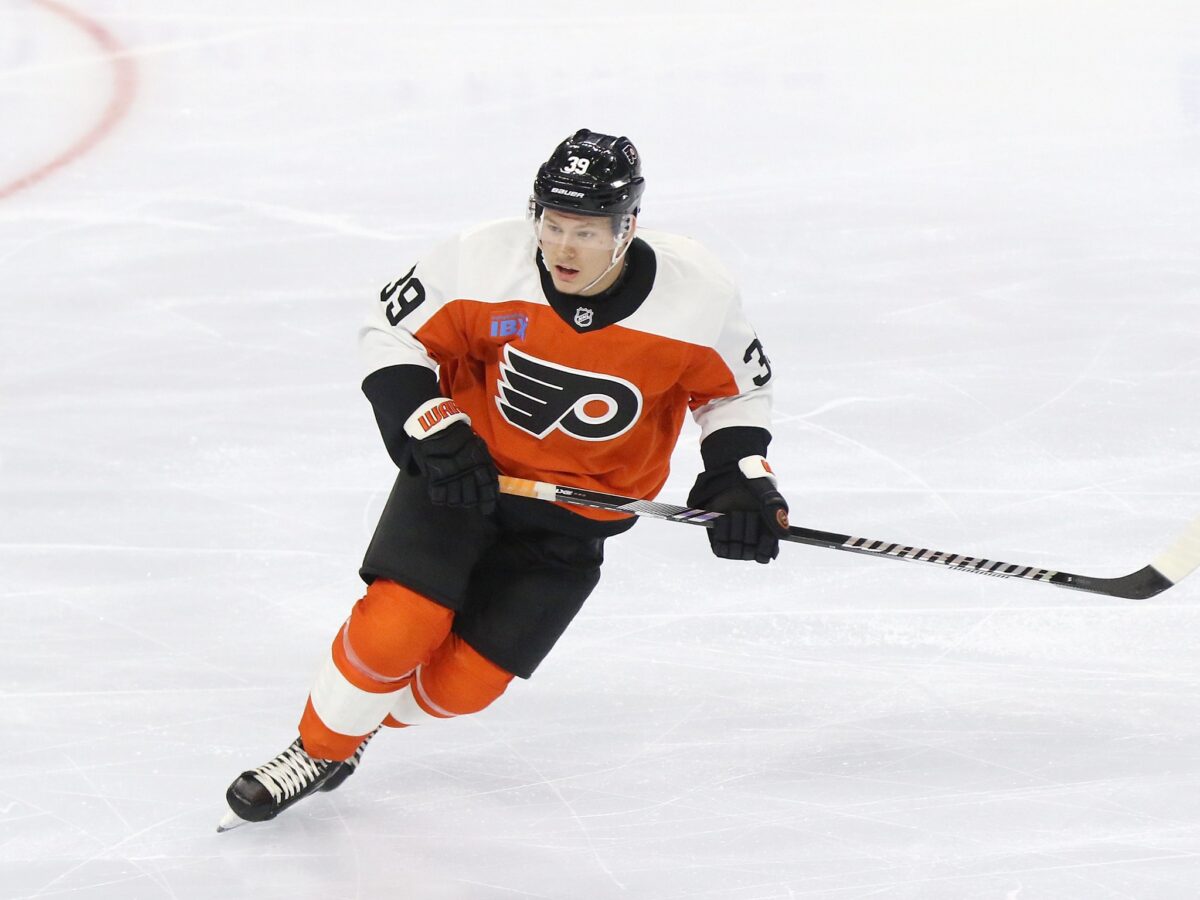
It’s unlikely that Michkov will be the first Flyer to win the Calder Trophy as the league’s top rookie, as he lost the scoring race to Lane Hutson, a defenseman on the playoff-bound Montréal Canadiens, and was tied with Macklin Celebrini, who played in 10 fewer games due to injury. Dustin Wolf only had three points, all assists, but that’s because he’s a goaltender who nearly carried the Calgary Flames into the playoffs single-handedly. Wolf was 22nd in the NHL with 11.9 goals saved above expected (per Moneypuck.com), just ahead of Jake Oettinger. That trio could box Michkov out of a nomination, leaving him in fourth place, the same spot Lindros finished in Calder voting in his rookie season.
Overall, it was a good, maybe even great, first season for Michkov. He set a Flyers record for rookie scoring and wasn’t a one-dimensional player, finishing ninth on the Flyers in expected goals share and on-ice goals for percentage at 5-on-5. At times, he did cheat a bit too much, but the risks were worth the overall rewards. According to The Athletic‘s Dom Luszczyszyn’s model, Michkov was a $6.1 million player in his rookie campaign. The 2024-25 season gave Michkov a nice base to build off, and he appears eager to keep improving.
“The one thing I can tell you is it’s impressive how minded he is,” Brière said. “I’ve been around a few superstars and he’s got that mindset. He came in and he has a detailed plan of all the things he wants to do. I was actually shocked with how prepared he was for his meeting. He knew exactly what he needed to do and how he wants to conduct himself.”
Three’s a Crowd
One thing Tortorella openly discussed before the start of the season was how scared the team’s goaltending situation made him. Though Sam Ersson looked good for much of his first regular NHL run the season before, his struggles down the stretch combined with Ivan Fedotov’s lack of NHL experience led to a lack of certainty at the sport’s most important position. But the odds of being worse than 2023-24, when the Flyers brought up the league’s rear with a .895 save percentage, weren’t high.
Alas, they turned out to be high enough. The state of the Flyers’ crease turned into a Simpsons scene as they not only repeated as cellar dwellers in save percentage but saw their team mark fall to .890. The next worst team was over five percent better, roughly the same gap between them and the 24th-best team. Any hope for stability washed away when Fedotov allowed 3.88 goals above expected in his first two starts and was pulled during the second.
That led to a desperate recall of Aleksei Kolosov less than a month into his first full season in North America. This followed months of drama about Kolosov’s willingness to play in the American Hockey League after reportedly feeling uncomfortable during a trial run with the Lehigh Valley Phantoms at the end of last season. Kolosov did flash some potential, but a wretched stretch around the turn of the calendar year (minus-6.75 goals saved above expected in five appearances from Dec. 14 to Jan. 2) showed he couldn’t be trusted. Yet Kolosov barely played down the stretch, riding the bench other than a few starts for the Phantoms and two last NHL games in April.
Ersson looked the best of the three, but he wasn’t without warts. A four-week-long injury raised questions about his durability, especially when he played his worst hockey of the season upon returning, allowing at least 1.2 goals above expected in his first six starts back. Then, after a strong performance for Team Sweden at 4 Nations, Ersson had another brutal run, allowing at least one goal above expected in five of seven starts from Feb. 27 to March 20, a stretch that marked the death knell for the team’s playoff hopes.
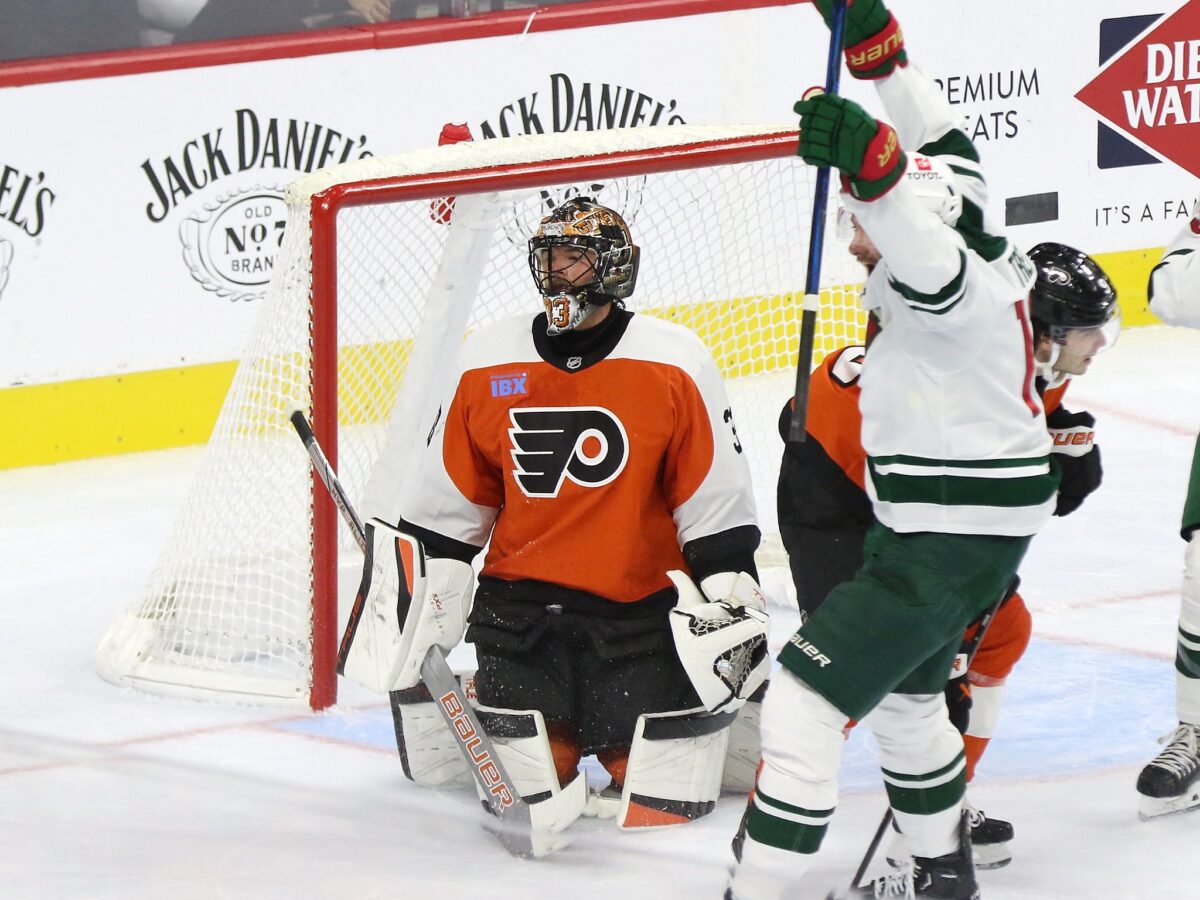
He will at least have another chance next season to improve things, but the other two goaltenders are on much thinner ice. Both are under contract for next season, Fedotov at a pricey $3.75 million. But that shouldn’t stop Brière from finding a better option to pair with Ersson to ensure the team’s netminding gives them a puncher’s chance next season.
Man Up, Men Down
The Flyers’ special teams in 2023-24 were a mixed bag. On one hand, their penalty kill was dynamite by almost every metric. Their success rate (83.4%) was fourth best, and their net penalty kill (90%) was second on the strength of a league-leading 16 shorthanded goals, four more than any other team. The underlying numbers supported that success as the Flyers ranked sixth in expected goals against per 60 minutes and first in expected goals for per 60 on the PK, according to Natural Stat Trick.
However, Brad Shaw’s unit took a step back in his third season with the team. The Flyers fell toward the middle of the pack in expected goals against per 60 prevention and barely cracked the top 10 in expected goals for per 60. Only three teams scored fewer short-handed goals than the Flyers’ total of four, and Travis Konecny had a league-leading six the season prior. To round it out, the Flyers were an underwhelming 20th in success rate, much closer to their first season under Shaw and Tortorella when they were 24th (although that at least came with 11 shorthanded goals, tied for fourth most).
But that unit received little criticism because all special teams vitriol was directed toward the power play. That unit has been consistent under Rocky Thompson’s watch, but that isn’t good. Escaping the 32nd-place cone of shame doesn’t mean much when you only climb to 30th. There was a brief flash to start the season, as the Flyers were a respectable 14th in goals per 60 through Halloween, but only 27th in expected goals for per 60 during that span. The underlying numbers held steady throughout the season, and the production numbers eventually matched.
Several high-profile Flyers endured significant slumps this season. Konecny scored two goals after the 4 Nations break. Travis Sanheim had a 40-game gap between tallies. Owen Tippett’s 20 goals were the fewest of his three seasons in Philadelphia. There was also Michkov’s scoring lull in January. A functional power play would have gone a long way toward bridging the gaps in production for these players, not to mention helping the team win several more games.
Like goaltending, the Flyers cannot let this issue fester for a third consecutive season. While Thompson experimented with different groupings and strategies, including a five-forward set-up late in the season, it felt like Charlie Day from It’s Always Sunny in Philadelphia throwing random things up on a corkboard rather than an actual, coherent plan. The Flyers don’t have the current talent to be an elite man advantage. However, three straight seasons of abysmal results, especially with the addition of a dynamic scorer like Michkov, make it easy to figure out what the first move should be.
Last Retorts
Flyers fans will likely always think of the 2024-25 season first and foremost as Michkov’s first season. But the second thing on their minds will likely be that it became Tortorella’s farewell season.
One of the biggest differences between the beginning of this season and last season was the lack of roster turnover. That meant anyone who Tortorella miffed or didn’t have a great relationship with was still around. Two of those players, Joel Farabee and Morgan Frost, were traded mid-season, more subtractions in this step-back season. Scott Laughton was also traded, and although he may have been the most universally liked player in the room, that was exactly why his departure mattered so much.
Shortly after Laughton left, it felt like everything became unglued. The benching and further incident with Cam York that contributed to Tortorella’s dismissal was the obvious breaking point, but there were other developments. It was particularly telling that Sean Couturier, who, as captain, one would expect would be close with the head coach, said he felt Tortorella was not just pushing him out of the picture but was ready to quit on Fedotov during the season.
Whether or not Tortorella’s time with the Flyers was a success or a failure is undecided, but the turning point of his tenure was undoubtedly the two-game scratching of Couturier last March. Though the team continued playing hard and driving play through the end, that decision seemed to create a ceiling of trust and comfort that the players could have around Tortorella. While pushing players can sometimes be the best way to maximize their talent, having a boss who always keeps you on edge is tough for almost everybody. That included Brière, except he was Tortorella’s boss, and ultimately decided to go in a different direction.
“Anybody that comes in will seem milder than Torts,” Brière said when asked about his approach to finding the right fit to be the team’s next coach.
What’s Ahead
For starters, expect a busy offseason. While we’ll save an in-depth breakout on the Flyers’ summer plans for another day, Brière confirmed that he is looking to move the needle and bring in some help for the current roster this offseason. The rebuild isn’t over, as he quickly mentioned how important phasing in the team’s prospect plethora will be. Oh, and there will also be a new coach to lead them.
Those new players, whoever they may be, will have lots of attention on them to see if they can guide the Flyers to a better place. Of course, Michkov will be one of the lead conductors on that train, and whether he continues to ascend or suffers a sophomore slump will reveal more of what his ultimate ceiling will be. With such a young team, there’s no one who’s really on set-it-and-forget-it mode, especially with veterans like Konecny and Sanheim close to earning that status only to struggle in the second half of the season.
The Flyers haven’t exactly had a lot of fun over the last half-decade. Since their excellent 2019-20 campaign, only last season qualified as anything close to enjoyable. Becoming a true contender is still a bit away (at least), but there’s a base for a more fun season ahead next fall if the right pieces are put in place alongside the current foundation.
Free Newsletter
Get Philadelphia Flyers coverage delivered to your inbox
In-depth analysis, breaking news, and insider takes - free.
Subscribe Free →