If you’ve been watching the Ottawa Senators through the first quarter of this 2025-26 campaign, you’ve likely felt that familiar, sinking sensation in the pit of your stomach. It’s the feeling of high expectations colliding violently with reality. Right now, the epicenter of that collision is located squarely in the blue paint.
Linus Ullmark was supposed to be the savior. When he arrived, boasting a Vezina Trophy and a sparkling pedigree from the Boston Bruins, the narrative was clear: the Senators finally had their elite stopper. But as we sit here in early December, the numbers tell a different, far more anxiety-inducing story. The question on every Sens fan’s mind isn’t just “What’s wrong?”—it’s “Can this actually be fixed?”
Let’s cut through the noise and look at what’s really happening between the pipes.
Digging Into the Wreckage
There is no sugarcoating the start of this season. It has been, by almost every metric, a disaster. Through his first 11 appearances, Ullmark posted a .861 save percentage. That isn’t just “bad”—it’s sub-replacement level.

But the stat that should really keep you up at night is goals saved above expected (GSAx). For the uninitiated, GSAx measures how many goals a goalie prevents compared to what an average goalie would allow, given the shot quality. Through those first 11 games, Ullmark sat at a staggering minus-9.41 GSAx. At that specific snapshot in time, he wasn’t just struggling; he ranked dead last among every goaltender who had stepped onto NHL ice this season.
Related – Senators’ Tkachuk Becoming One of Top Captains in the Atlantic
Here is the frustrating kicker: the team in front of him hasn’t actually been terrible. The Senators’ defensive metrics are surprisingly respectable. We are talking about a unit that ranks in the top 10 league-wide for suppressing shots and expected goals against. The system is doing its job. The breakdowns haven’t been constant, but when they have happened, the last line of defense hasn’t been there to bail them out.
The “Heater” Horizon
Before we collectively hit the panic button, let’s take a breath and look at the history books. If this script feels familiar, it’s because we have seen this movie before—literally just last season.
Ullmark has a history of slow starts followed by scorching stretches of dominance. In the 2024-25 season, he stumbled out of the gate in a remarkably similar fashion. The narrative then was identical: “He can’t handle the workload,” “He misses the Boston defense.” Then, the calendar flipped to late November.

Ullmark went on an absolute heater, posting an 8-0-1 record with a .954 save percentage and a microscopic 1.43 goals-against average. That stretch didn’t just pad his stats; it single-handedly vaulted Ottawa into playoff contention.
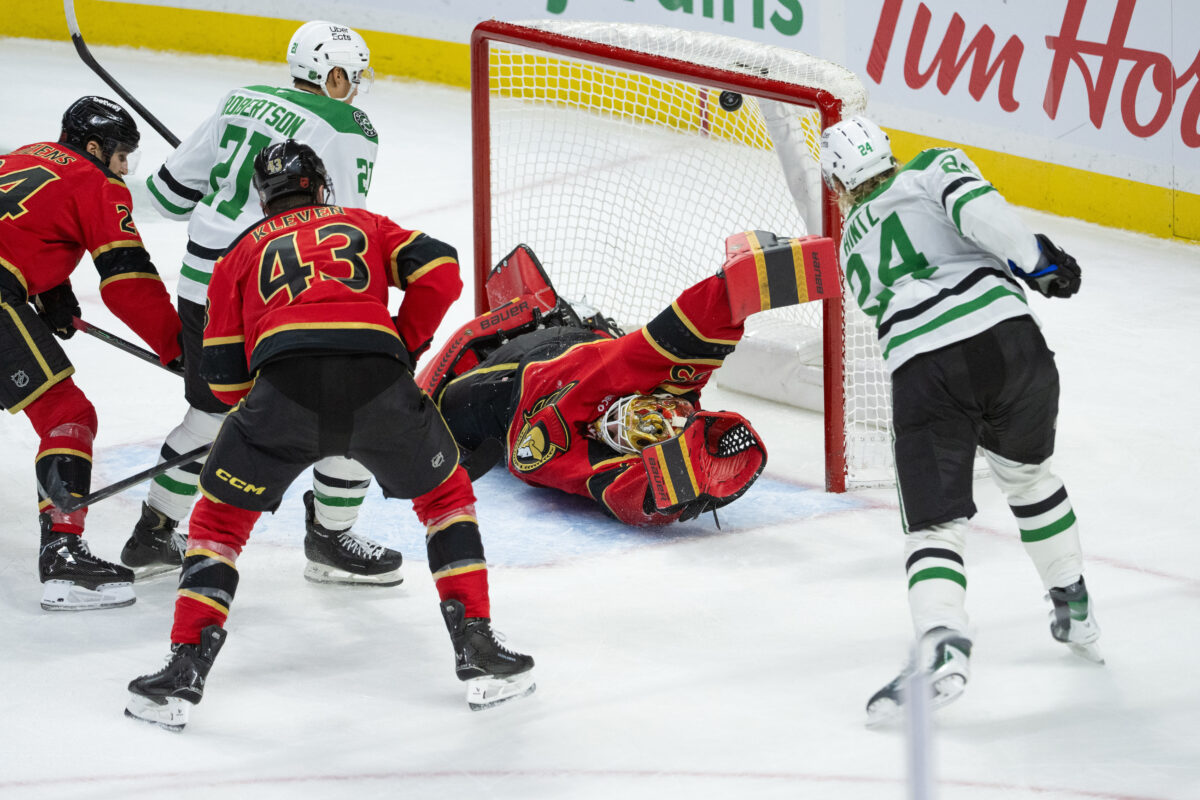
We are already seeing the first sparks of that ignition again. Ullmark has won four of his last five starts. That 5-2 win over the Montreal Canadiens? He made 19 saves, but more importantly, he looked settled. Even with the blowout loss to the Dallas Stars prior, he was coming off three straight victories. The talent hasn’t evaporated; it’s just been dormant.
The “Dog on a Bone” Dilemma
However, relying on a “heater” to save your season is a dangerous strategy, and valid concerns remain about his consistency. This is where the analysis gets a bit more uncomfortable.
Related – Ottawa Senators Have Become Canada’s Top Team
Former NHL netminder and analyst Steve Valiquette recently dropped a critique that likely stung because it rang true. He questioned Ullmark’s intensity, contrasting him with “dog on a bone” competitors like Juuse Saros or Igor Shesterkin. Valiquette’s point was that Ullmark relies heavily on his massive frame and natural technical ability, sometimes at the expense of that desperate, second-effort battle level required when structure breaks down.
Ullmark, to his credit, hasn’t dodged this. He candidly admitted that his offseason preparation wasn’t where it needed to be and has already flagged changes for next summer. It’s rare to hear a pro athlete admit to a prep failure mid-season, and while the honesty is refreshing, it’s also alarming for a player carrying an $8.25 million cap hit. You don’t pay that kind of premium for a goalie who needs two months to ramp up his intensity.
The Boston Hangover
We also need to address the structural reality. Ullmark thrived in Boston’s system, which is historically one of the most goalie-friendly environments in hockey. Ottawa’s system, while improved, is still “leakier.”
In Boston, high-danger chances were rare events. In Ottawa, even with better defensive metrics this season, the breakdowns tend to be more catastrophic when they occur—odd-man rushes, backdoor tap-ins, the kind of plays that leave a goalie exposed. Ullmark is facing a different caliber of workload here. He’s no longer the luxury piece in a well-oiled machine; he is the engine that needs to pull the car up the hill.
The Verdict: A Tune-Up, Not a Trade
So, can he turn it around? The short answer is yes. The talent that won a Vezina Trophy in 2023 doesn’t just disappear at age 32.
Think of Ullmark right now like a high-end Formula 1 car running on the wrong fuel mixture. The engine—his elite technical pedigree—is proven and powerful. But the calibration—his offseason prep, his battle level, his adjustment to a new defensive environment—has been slightly off. He is stalling at the starting line, but the machinery is capable of winning the race if he can just get the revs up.
The recent string of wins suggests another late-November turn-around is in the works. But for Ottawa to make a real push, they don’t just need “Good Linus.” They need “Consistent Linus.” They need the guy who doesn’t rely on a two-month hot streak to mask four months of mediocrity. The pedigree is there. Now, he just needs to find his way to becoming a dependable piece of the Senators’ already impressive backbone.
AI tools were used to support the creation or distribution of this content, however, it has been carefully edited and fact-checked by a member of The Hockey Writers editorial team. For more information on our use of AI, please visit our Editorial Standards page.
