By traditional goaltending standards, Connor Hellebuyck should not be one of the best goalies in the NHL. He’s not an elite skater, he doesn’t have elite reflexes or flexibility, he doesn’t even really have great save selection.
Other than his size, there’s not a lot about his game that catches the eye, like some of the athletically-gifted monsters in the league like Sergei Bobrovsky, Andrei Vasilevskiy and Igor Shesterkin, who combine size with superhuman flexibility and explosiveness. But, he is currently the best goalie in the NHL, in spite of, and maybe even because of these limitations.
Hellebuyck’s Simplified Game
Because Hellebuyck doesn’t have the athleticism to bail himself out if he gets into trouble like the aforementioned goalies, he’s had to find a different solution to this problem. That solution? Play in a way that you never need to bail yourself out. Hellebuyck starts deeper in the net than most NHL goalies, which means he doesn’t have to move as far on rebounds and cross ice plays or as much on angle changes as his counterparts.
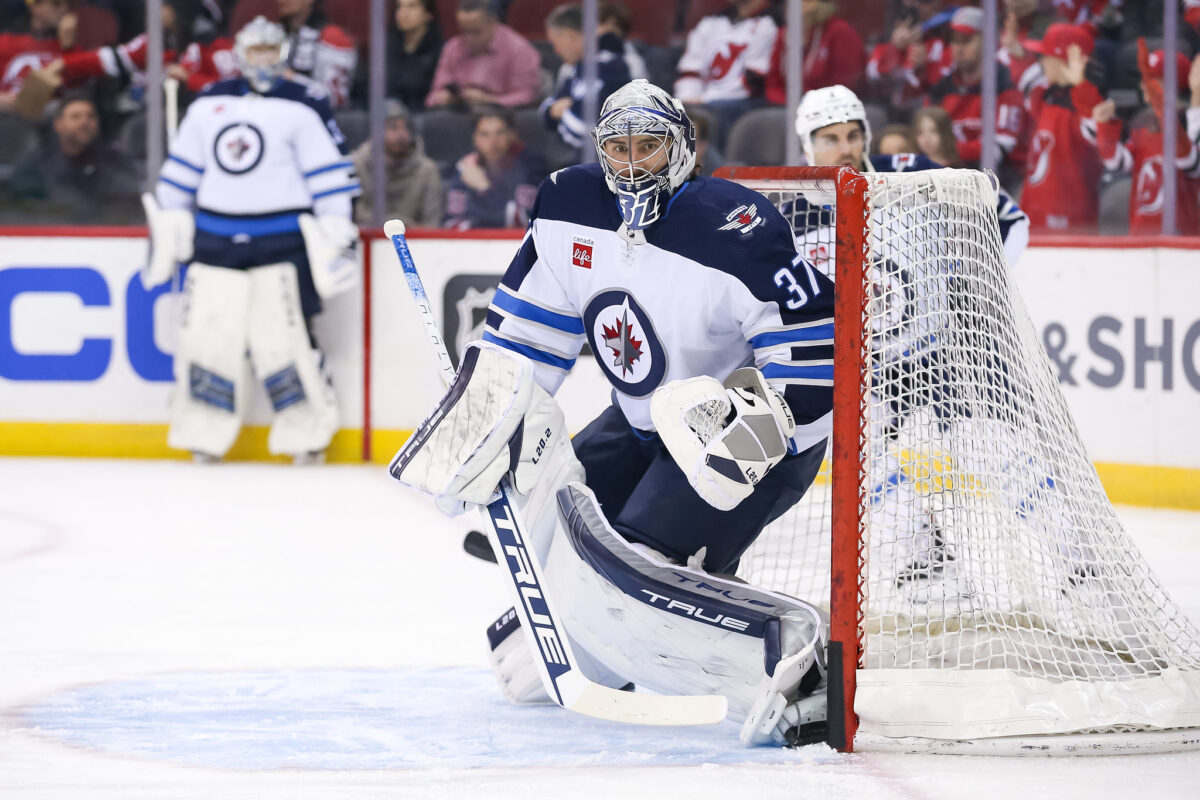
That lack of movement is what sets him apart from the rest of the league. A casual fan watching Hellebuyck would be forgiven for thinking that he doesn’t do much in the net and his opponents make his job easy by hitting him with the puck a lot. This is both true and reductive. It doesn’t give Hellebuyck enough credit for how he causes these things to happen.
Intimidation Through Positioning
What Hellebuyck does to his opponents is similar to what Dominik Hasek, Patrick Roy, and Vasilevskiy did to shooters in their primes. He beats you mentally as much as physically. Like Nicklas Lidstrom, who routinely blew up rushes before they even started with excellent positioning, against Hellebuyck, you’re beaten before you even get the puck.
Because of his positioning, Hellebuyck has to move a lot less than he would if he was out in the white ice. This means he can find ways to stop backdoor rebounds and broken plays without moving as well. The look on Juraj Slafkovsky’s face, after Hellebuyck found a way to keep this puck out in the last minute, says it all. If Hellebuyck had been out at the top of the crease with more traditional depth, this puck likely bounces in and it’s a tie game.
Still On Rushes
On rushes, instead of starting out in the white ice and backing up, Hellebuyck starts mid crease where most other goalies finish. When he stands his ground instead of retreating back, all he has to do is make small lateral adjustments, allowing him to set his feet earlier. This gives him more time to be still, calm, and ready when compared to other goalies, and results in better balance because his feet remain underneath him and not moving. It also means he creates an imposing image for shooters to look at in the net.
Related: Jets’ Connor Hellebuyck Deserves to Be a Hart Trophy Finalist
Conventional wisdom has always dictated that goalies should come out and challenge the shooter to take away the net. But, the tradeoff to that is that a goalie has to move backwards to avoid a shooter changing the angle and going around them. It also creates larger distances to cover on passes and rebounds and lateral moves by shooters.
What Hellebuyck’s positioning shows the shooter is more net as they’re crossing the blue line and nearing the top of the circles, but, according to Hudl InStat, Hellebuyck has a .982 save percentage having only allowed 27 goals from above the circles over the last three seasons. It’s essentially pointless to shoot from out there. Hellebuyck is happy to give up a bit of extra net in those situations, for the trade off of being set earlier. What happens to shooters because of this trade off is that, compared to other goalies, the net is getting significantly smaller behind Hellebuyck as they get closer to him. This is how Hellebuyck extinguishes hope. NHL shooters are finely-tuned machines. If they see net, they’ll hit it, but, if you change the pattern on them, and they don’t see the things they usually look for, they short circuit somewhat. This manifests in shooters overhandling the puck, forcing passes, and missing the net because they start to think they need to make perfect plays to score.
This shot by Clayton Keller is a good example of how little shooters see when they approach Hellebuyck and the perplexed look on his face afterwards shows the grim reality they face.
In-Zone Play
On plays in his zone, Hellebuyck beats passes because of his positioning. He lays in wait for the shot as other goalies would be desperately trying to make their way across the crease. For every inch above the top of the crease a goalie starts, they have to make that up and then some in distance across the ice. The same goes the other way. By being deeper in the crease, Hellebuyck only has to travel a few feet to get across the zone.
On this save against the Nashville Predators, Hellebuyck beats the pass by a comical amount and literally just waits in his butterfly for the shooter to present him with the puck right in the chest.
On rebounds, he often only has to reach out a leg or an arm (see the save on Slafkovsky above) where others might need to push their entire body across the ice. Playing deeper means he can get to longer passes and rebounds quicker, without incredible skating ability. On shorter angle changes, like a toe drag before a shot, it means he doesn’t have to open up as many holes as he moves to cover the net.
What Happens When Hellebuyck Challenges
Aggressively challenging doesn’t work as well for Hellebuyck. On the few occasions he does get into trouble, it’s often because he’s trying to play at more traditional depth. Charging out or trying to challenge a shooter in a good scoring position, instead of setting his feet and waiting.
The goal below is a bad bounce and the odds of it landing right back on Nathan MacKinnon’s stick are infinitesimal, but, because Hellebuyck is so far out (for him) and also moving forward at the time of the original shot, trying to make himself big and block while MacKinnon comes up the gut with a head of steam, he ends up having no chance on a rebound that he often saves with his usual depth and the short push needed to get there from that position.
Here’s another example of Hellebuyck playing with more traditional depth on a player attacking up the middle with time and space. On the initial pass, Hellebuyck is set and ready well before the shooter has the puck. Most of the time, that’s all the movement he’ll do unless there’s an angle change. Here he creeps out and tries to take away more net, but, doing so means he doesn’t get as good a read on the shot and the puck finds a way through his blocker arm as he makes an awkward save attempt.
Less Movement, More Consistent
Because less movement means fewer things to coordinate in a complex system like the human body covered in full goalie gear, it means Hellebuyck is less prone to slumps as well, as there are fewer things that can go wrong in his game. Hellebuyck has been remarkably consistent since his breakout season in 2017-18 when he finished second in Vezina Trophy voting. According to Hockey Reference he has led the league in quality starts in four of the last eight seasons since then and finished in the top four in that category in every season but 2018-19. He won the award in 2020 and last season.
Not only has he been consistently good, while being remarkably durable, he’s practically lapped the league in terms of Goals Saved Above Average. According to Evolving Hockey, he’s played 40 games (543) more than the next-closest goalie (Bobrovsky, 503) since his NHL career began in 2015 and he has amassed more than 28 Goals Saved Above Average (GSAA, 139.38) more than the next-closest goalie, Vasilevskiy (111.29.) That number is even more remarkable when you understand that last season Hellebuyck led the league in GSAA with 31.8. So, the distance between him and the next-closest goalie is almost a full-league-leading-season of GSAA.
He is off to the best start of his career in 2024-25, putting up the best save percentage (SV%, .926) and goals against average (2.02) of his career and having already matched his career high in shutouts (6). These numbers are even more impressive given that the league average SV% is the lowest it’s been in 10 years having followed a downward trend (.901) over that period.
Less Wear And Tear
Hellebuyck isn’t unique in the NHL in his positioning. There’s now a long line of goalies playing that style tracing back to goalie coach Benoit Allaire’s time in Phoenix with Nikolai Khabibulin and Sean Burke through his time in New York with Henrik Lundqvist. Playing deeper has brought a resurgence in a new role for Jonathan Quick as well. In fact, most of the league’s goalies play deeper now than they used to, because the offensive game has become more dynamic with players constantly moving on offence and an emphasis on passes across the middle of the slot.
What has come with this trend is that goalies who used to rely more on their athleticism are playing deeper, simpler games now. Marc-Andre Fleury plays deeper than he did when he came into the league, same with Quick. In baseball, scouts call power and the ability to take walks “old player skills,” because they are more repeatable as a player ages and they lose some of their athleticism. In goaltending, positioning is one of those “old player skills” and because Hellebuyck has built his game around it, it stands to reason he should be able to continue to be among the league’s best for a long time to come.
