When things are going badly for a team with serious playoff aspirations, as is the case with the Toronto Maple Leafs at the moment, fingers tend to be pointed at deeper, core issues. Is the system working? Is the coaching effective? Has the right roster been constructed?
For the Maple Leafs, this is most notable on the back end, where a reliable group of veterans comprised entirely of carryovers from last season was supposed to be a trusted strength for the club. Now, with Toronto ranked dead-last in the NHL in goals allowed per game (3.82), it’s fair to wonder if the blue line is too old, too slow and can no longer keep up with the rest of the league.
If that’s the case, then it’s also hard to ignore flaws in the construction of a unit that was built to win now. Morgan Rielly gets a pass here as the longest-tenured Maple Leaf and the player with the most games played from the 2012 NHL Entry Draft. Beyond Rielly, however, it’s worth looking back at the construction of the top-six and where the Maple Leafs may have gone wrong.
Tanev, Ekman-Larsson Signings
Toronto wasted little time in addressing their blue line in summer 2024. Even before free agency opened on July 1, the club was positioning itself for a run at the hard-nosed, homegrown rearguard by acquiring Chris Tanev’s negotiating rights from the Dallas Stars. While the two sides failed to strike a deal in the exclusive negotiating window, they quickly came to terms on a six-year, $27 million contract.
Later in the same day, the Maple Leafs further bolstered their blue line, stealing Oliver Ekman-Larsson away from the defending champion Florida Panthers on a four-year, $14 million contract.

Tanev was 34 at the time of the signing while Ekman-Larsson was about to turn 33, so both long-term deals were signed with the understanding that the incoming players may experience age-related decline while under contract. That hasn’t yet been the case for Tanev, although upper-body injuries have limited the now 35-year-old to eight games this season and he still has four more seasons left at $4.5 million per year.
Ekman-Larsson, meanwhile, has largely been a disappointment in Toronto. While his 2024-25 season was perfectly adequate (four goals and 29 points in 79 games), turnover issues and inconsistent play ultimately prompted head coach Craig Berube to lose faith in the Swede. Come playoff time, he averaged two minutes less than his regular season ice time (from 21:04 to 19:03), ranking fifth amongst Maple Leafs defencemen.
Jake McCabe Trade
Outside of Rielly, the longest-serving member of the Maple Leafs’ current blue line is Jake McCabe. Acquired at the 2023 Trade Deadline from the Chicago Blackhawks alongside Sam Lafferty and conditional draft picks, he brought defensive accountability and physicality to a defensive group sorely in need. Though the cost was steep (a conditional 2025 first-round pick, a conditional 2026 second-rounder, Joey Anderson and Pavel Gogolev), the reliability he brought carried value, as did the remaining year on his contract.
Over what has now been parts of four seasons in Toronto, McCabe has served as a respected, trusted, shutdown presence on the back end, leading the team in average ice time last season (21:30). However, he hasn’t been perfect. Last season saw him cough up a career-worst 83 giveaways and he’s already on pace for more with 21 already this season. Though still only 31, he has looked old and slow at times while struggling to chase down opposing breakout chances.
The McCabe trade, itself, is a win for the Maple Leafs. In exchange for a dependable top-four mainstay, they parted ways with a veteran player bouncing between the NHL and American Hockey League (Anderson), a flopped prospect struggling in the Kontinental Hockey League (Gogolev) and two draft picks. It’s still possible that current NCAA standout Vaclav Nestrasil (taken with the 25th pick of the 2025 Entry Draft) develops into a star or that Chicago strikes gold with Toronto’s 2026 second-round pick, but it’s most likely that this trade continues to look good.
What remains up for debate, however, is the Maple Leafs’ decision to extend McCabe in the early stages of last season to a five-year, $22.55 million extension. The deal, which just kicked in this year, will pay the Eau Claire, Wisconsin native $4.51 million each season until 2030, at which point he’ll be approaching 37 years old. Who knows what situation he or the team will find themselves in by then.
You Might Also Like
- Bill Barilko, the Tragically Hip & the Most Famous Goal in Maple Leafs History
- Matthew Knies Is the Perfect Trade Target for the Blackhawks
- 3 Takeaways From Maple Leafs’ 4-2 Win Over Bruins
- Maple Leafs News & Rumours: Knies, Stolarz, Nylander & Logical Priorities
- NHL Rumors: Goalie Trades, Karlsson Staying, Kucherov Controversy
Brandon Carlo Trade
The past decade of success in Toronto has been driven by the drafting and development of a talented core of superstar forwards (Auston Matthews, William Nylander, and Mitch Marner), but it has been further buoyed by a strong track record of front office decision-making. Sure, there’s been an ill-fated Nazem Kadri trade here or a Patrick Marleau signing there, but few moves with negative long-term repercussions.
Perhaps until now. General manager Brad Treliving’s trade deadline deal for Brandon Carlo was supposed to bolster the organization with one more big, tough-minded defensive force for a deep playoff run in 2025 and beyond. It wasn’t cheap either, with the team shipping top prospect Fraser Minten, a 2026 conditional (top-five protected) first round pick and a 2025 fourth-rounder to the Boston Bruins.
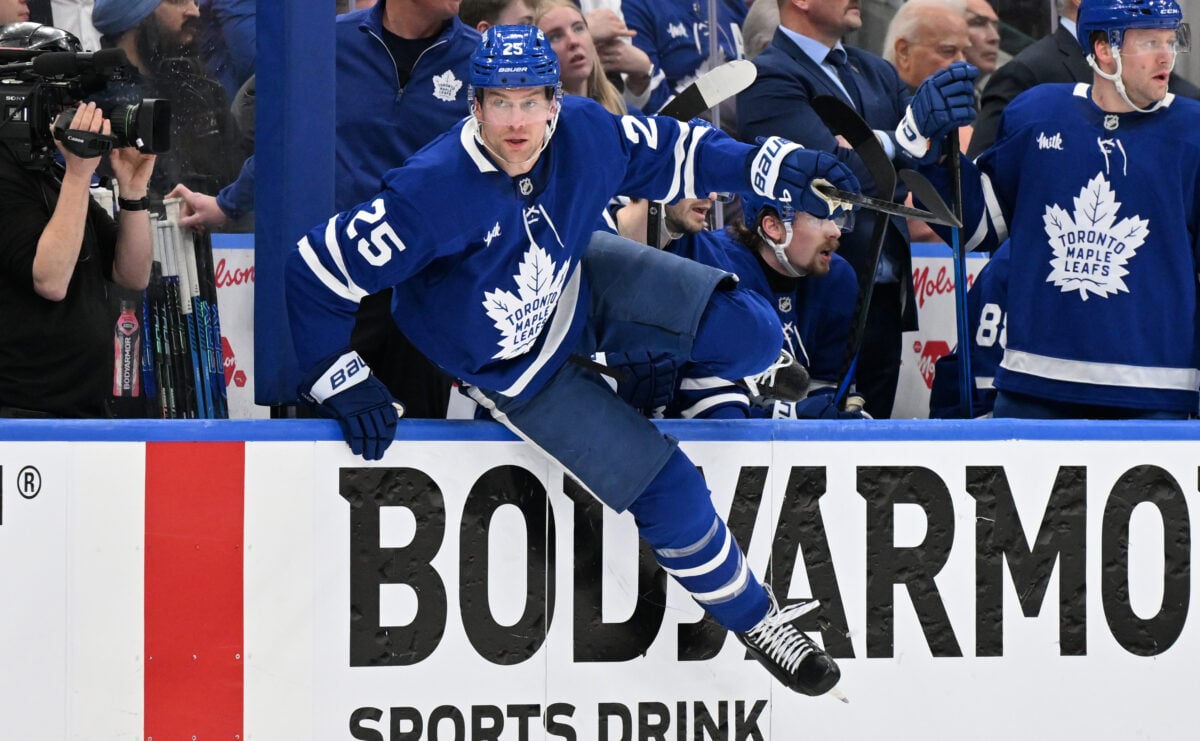
Carlo is now 37 games into his Maple Leafs tenure, and the results look disastrous. The 28-year-old has appeared sluggish and slow, often serving as the poster boy for some of the defensive lapses that has plagued the club. He and Rielly have failed to develop the type of chemistry that the organization had hoped would enable the long-time Maple Leaf to freelance more in the offensive zone. There have been widespread reports by credible sources that the club was open to dealing him this past summer.
On the other end of the deal, the 21-year-old Minten has already forced his way into the emerging Bruins’ everyday lineup, recording three goals and three assists in 18 games thus far. He joined a long list of ex-Leafs to haunt their old club in their return, delivering the game-sealing fifth goal in a 5-3 victory last Saturday. Beyond Minten, the 2026 first-rounder also has the potential to be a coveted asset if Toronto continues to struggle this season.
Heading into a 2025-26 campaign without Marner, the blue line was supposed to be one of the few certainties that the Maple Leafs could rely on. There’s still plenty of time for things to change this season, but the early returns on Toronto’s play have called that certainty into question. The hope is that this veteran unit can figure it out and return to form. If they can’t, however, it calls into question the very construction of the group.
