Ahead of the 2025-26 season, Fabian Zetterlund was set to fill in on the top line with Tim Stutzle and Brady Tkachuk. He had the experience and, maybe more importantly, the speed to keep up with the team’s best young forwards. Given his breakout 17-goal, 36-point breakout with the San Jose Sharks, the 26-year-old seemed to be on the doorstep of hitting the next level of production.
However, that’s not what’s happened this season. 16 games into the season, Zetterlund has just a goal and two assists, and it hasn’t been for a lack of trying. He’s spent time with almost every forward on the Senators roster and on every line. Ottawa is trying everything to help him out, and it’s just not working.
Something isn’t clicking with Zetterlund in Ottawa. No matter where he plays, he can’t seem to find his scoring touch that he had a year ago. Although the season is still early, the Senators are running out of options for helping their young sniper find his place on the team.
Zetterlund Doesn’t Work on the Top Line
The theory behind starting Zetterlund with Stutzle was solid; few players are faster than the 26-year-old Swede, but Stutzle is one. Having someone who can keep up with him and his lightning-quick decision-making seemed to be a recipe for success. Add in Tkachuk on the other side, and there was the potential he could emerge as a 24-goal scorer and help unlock the Senators’ underwhelming 5-on-5 offence.
Early trials at the end of 2024-25 seemed promising. Even though Zetterlund finished with just two goals in 20 games, the line of Stutzle and Claude Giroux scored a goal, averaged 22 shots per 60 minutes, and had a positive Corsi For percentage. The trio were also strong defensively, averaging 1.71 goals against per 60 minutes (GA/60). With Stutzle and Tkachuk, it was even more encouraging, with the line averaging four goals per 60 minutes and, in the 30 minutes they played together, didn’t allow a single goal against.
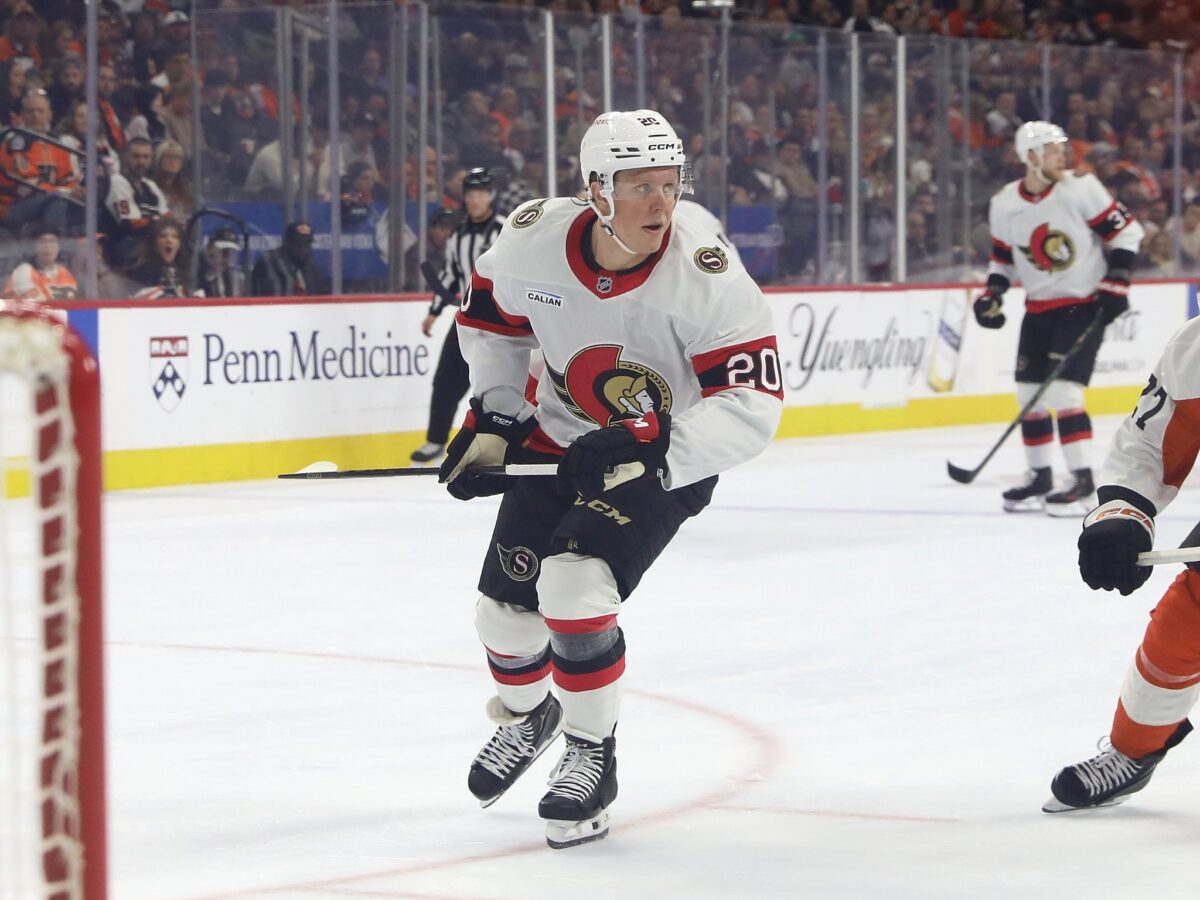
“I thought he created a lot of chances last year,” Senators coach Travis Green told reporters in September. “I think he was good last year. He’s still improving. (He) looks a little lighter and looks a little quicker this year…I think goal-scorers kind of figure out how to score, and they do it in different ways. But you’ve got to get to the net to score, that’s for sure.”
But the goals haven’t come in 2025-26. The top line with Zetterlund produced one goal and 18 shots over 25 minutes for a shooting percentage of 6%, or an average of just 2.6 goals per 60 minutes (GF/60). The Senators tried to give him and Stutzle time to figure it out, and Tkachuk’s injury hasn’t helped, but Zetterlund still has an expected goals scored of just 1.78 (xGF) at five-on-five. Meanwhile, Ottawa has the eighth-most goals in the NHL this season, averaging 3.35 goals per game, and the fourth-most at five-on-five. The Senators were producing in spite of Zetterlund’s struggles, and he was getting left behind.
Zetterlund Can’t Stay on the Fourth Line
If Zetterlund can’t play on the top line, then maybe he can find some success on the fourth. Although he’s a strong goal scorer, he’s also a reliable defensive presence, and if he wasn’t scoring, maybe he could stop the puck and get his confidence back doing what he does best.
So far, the results have been positive. After 17 games, Zetterlund has an expected goals against of 9.81 (xGA) over 219 minutes played, or about a 2.7 expected goals against per 60 minutes (xGA/60). At even strength, he averages around 13 minutes of ice time, which means he’s averaging a goal against every other game. In practice, he’s been even better than that, averaging just 2.5 goals against per 60 minutes (GA/60), which is better than Lars Eller, David Perron, and Drake Batherson.
Related: Can Tim Stutzle Still Become a Superstar for the Senators?
The biggest problem, though, is that Zetterlund still isn’t scoring and hardly creating scoring chances. While the third line of Giroux, Michael Amadio, and Shane Pinto has been one of the Senators’ best lines this season, despite limited ice time, Zetterlund’s lines haven’t been able to score on the few chances they’ve generated. The Senators’ three most commonly used fourth lines with Zetterlund have produced 16 shots and no goals over 58 minutes. If Ottawa wants to help Zetterlund rediscover his scoring touch, he can’t stay on the fourth line, as it’s clearly not helping.
Where Does Zetterlund Fit?
Recently, Zetterlund has been back up on the second line with Dylan Cozens and Ridly Greig. The trio have had some success throughout the season with one goal on six shots over 18 minutes together. But it’s also one of the Senators’ least productive right now, probably because they’re the least familiar with each other. Aside from the recent call-up of Hayden Hodgson, who slotted into the fourth line, every other line was creating more scoring chances. A sniper can’t succeed without plenty of opportunities to score.
And that’s the problem. As long as Zetterlund struggles to produce individually, he will continue to be the odd-man-out, preventing him from developing better chemistry with his linemates and limiting his scoring opportunities. It’s a self-fulfilling prophecy: Zetterlund struggles to score, so he’s moved to a new line, where he continues to struggle because he’s less familiar with his linemates than everyone else in the top nine.
It’s only a matter of time before he’s on the move again. Even if Zetterlund rediscovers his scoring touch with Cozens and Greig, that will change when Tkachuk returns. Batherson now looks like a fixture on the first line, meaning Perron will return to the second line, where he has the most experience this season. The Senators won’t break up the third line, so Zetterlund will likely return to the fourth line, where his production is likely to remain stagnant.
That’s not the way a $4.275 million player should be treated, and yet the Senators don’t have a better option right now. It’s not that Zetterlund doesn’t fit in Ottawa; he’s been a solid addition to the team since he was acquired last season. He’s a speedy winger with the potential to play top-six minutes, which is exactly what the Senators wanted, and along with his defensive skills, he’s helped make Ottawa better.
But Ottawa can’t afford to be patient forever. The Senators need to make the playoffs, so they need to work with players who are producing, which makes it difficult for Zetterlund to snap out of this slump. Yet it might end up costing them in the long run, as Zetterlund surely won’t want to waste his time playing low-event hockey for the next three years.
All stats and metrics taken from Natural Stat Trick, Hockey-Reference, and Dobber’s Frozen Tools
