The Carolina Hurricanes have long had an issue at the second-line center slot. Interest in players like Elias Pettersson has been widely reported, but the Hurricanes may have found a more viable solution. Seth Jarvis has been talked about as an internal fit for a long time. He’s a sensational two-way forward who played center for the Portland Winterhawks in the Western Hockey League. He’s a right-handed player, which the Hurricanes lack down the middle, and he’s already earned the trust of his coach. With a new-look top line succeeding without Jarvis, the door has opened to deploy him in the center position once again.
Fans have long been skeptical of the organization making that move because of the lack of depth around him. Carolina’s star forward, Sebastian Aho, needs players around him who can help carry the weight of expectation. On New Year’s Day, the Hurricanes put Nikolaj Ehlers and Andrei Svechnikov on the wings of the Finnish Olympian, and the results have been staggering. Each of them has at least eight points in the first seven games together, and they’ve dominated games as a trio. Aho’s five-point night in their first game together highlights this perfectly. However, the depth below them couldn’t perform. This is where Jarvis shifting to center gains weight.
First Line Dominance
This idea is only possible because of the domination of the Ehlers – Aho – Svechnikov line. With the Hurricanes looking for a solution without the Winnipeg native in the lineup, they put together their three best healthy players, and something just clicked. The combination of the speedy Dane, the Russian power forward, and the Finnish star just worked. Since New Year’s Day, when this trio was united, they have offered something the Hurricanes have never had under head coach Rod Brind’Amour: game-winning scoring. In a back-and-forth affair, this line could be the difference in winning a shootout.
At 5-on-5, this line has scored six goals and allowed five in the seven games since they were united. However, the benefits exceed that because these guys play together on Carolina’s power play. So, when you look at the “all strengths” numbers, you see this trio has 12 goals for and just six against. It’s helped the power play go from struggling to mediocre. Not great, but much better than where it was.
Rightfully, there will be some concerns about a limited sample size for this trio. According to Moneypuck, they have an expected goals for per 60 (xGF/60) of 4.62, by far the highest of any line that has played at least 50 minutes for the Hurricanes so far this season. The concern is that the expected goals against per 60 (xGA/60) is 3.35. It’s one of only two Hurricanes lines that have played 50 minutes or more above 2.5 xGA/60. It means they have some defensive growth to do, but they’re capable of outscoring their problems. If they can be a net positive for the Hurricanes, there is suddenly an extra star player on this team in Jarvis, which makes the conversation around the second-line center slot extremely interesting.
The Current 2C Situation
Logan Stankoven has performed admirably as the Hurricanes’ right-handed second-line center. He’s given everything for the hockey club, and he’s recently begun finding the back of the net again. His line with Taylor Hall and Jackson Blake has looked reinvigorated with the reintegration of Jarvis after his injury against the Florida Panthers. Stankoven has scored in his last four games, highlighting the recent success.
However, Stankoven hadn’t scored in 17 games before that first goal in New Jersey, assisted by Devils goaltender Jake Allen’s miscue behind the net. He’s trying to do the right things, but it’s been Blake who’s done the goal scoring for that line. With this line rediscovering their scoring touch, this change should not be made immediately. Still, the long-term outlook of this roster improves when you consider a center duo of Jarvis and Aho looks vastly better in the long term.
Jarvis’ Shoulder Issue
It’s an open secret that Jarvis is dealing with some shoulder issues. He tore his rotator cuff and labrum two seasons ago and opted for rehab instead of surgery. He aggravated his injuries during the 2024-25 season. Again, he opted for rehab rather than surgery, this time citing his 2026 Olympic hopes and his bid to make Team Canada. We know now that it was unsuccessful, but Jarvis’s effort to make Team Canada was strong, and he remains an injury call-up option.
Related: Hurricanes’ Jackson Blake Living Up to Expectations in Sophomore Season
So, how do the Hurricanes accommodate that? The simple answer is to keep Stankoven on his wing for the purposes of taking draws. If Jarvis’s shoulder is in a bad way, let Stankoven slot into the faceoff dot, and revert to the wing like a winger when the center gets kicked out of the dot by the linesman. Allowing that rotation in the dot could save Jarvis some pain and allow the Hurricanes to continue developing Stankoven’s faceoff usage in case he is needed down the middle in the future. It also allows Jarvis to rest his shoulder in the most strenuous part of being a center if he has to.
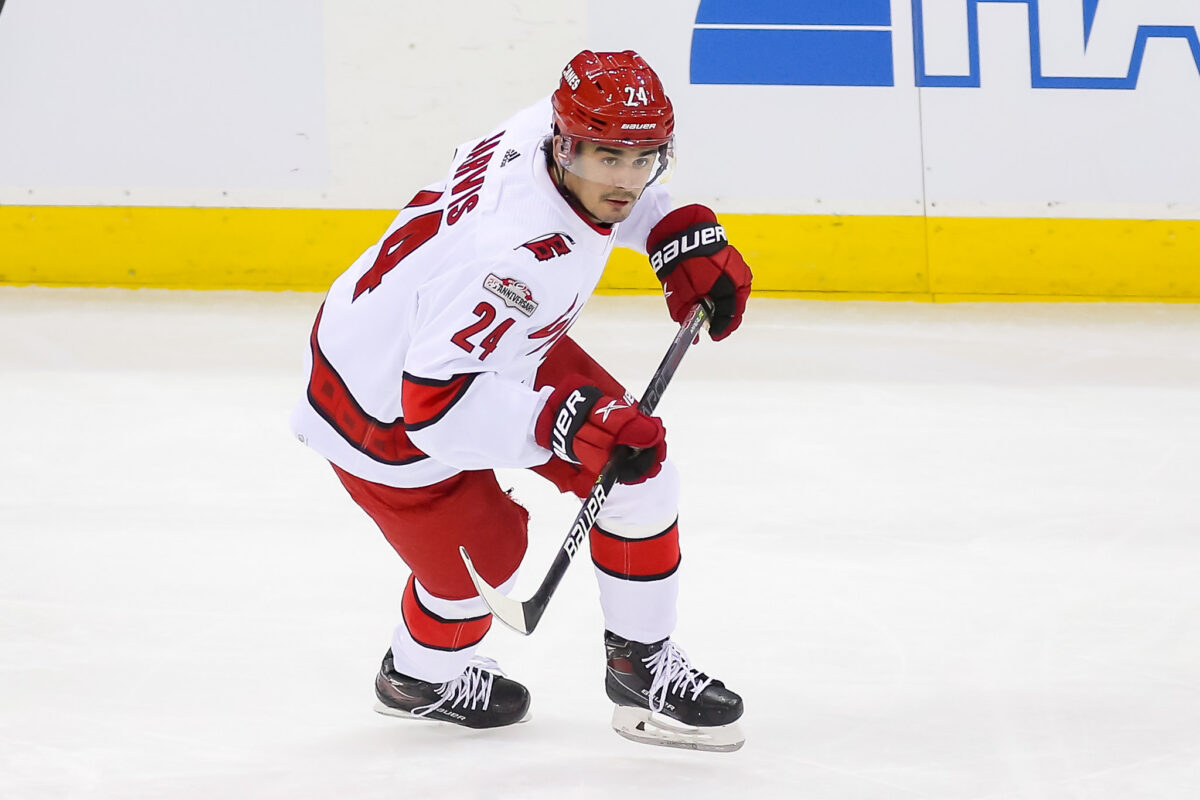
It’s important to note that Jarvis himself said he was open to playing center this season if he was needed. The Hurricanes came into the season with some question marks down the middle, so Jarvis offered himself as a center because he does everything. Rehab went well enough in the 2025 summer to have Jarvis feeling significantly better about returning to the middle of the ice. It’s not a situation where they are shoehorning him into a position he does not wish to play.
Jarvis 2C Upside
Jarvis anchoring the second line from the middle of the ice lets Carolina put their 24-year-old star in a more prominent position to gain better control of the game. He would allow the Hurricanes to begin to build a stronger second line than this organization has had since 2005-06. It would enable them to shift their attention away from the desolate top-six center market and toward general top-six players. Those are easier, though still not easy, to come across.
It also allows the Hurricanes more flexibility. The Pittsburgh Penguins of the 2010s could put Evgeni Malkin next to Sidney Crosby when they needed a goal. Those two are significantly better than Aho and Jarvis, but the same logic could apply here. If Carolina needed a goal in the final minutes, putting them together could be the straw to break the back of the opponent, especially if the Hurricanes’ third-line center is good enough to hold the role of a top-six center momentarily.
Since returning from his injury sustained from an awkward collision with the goalpost, Jarvis has been playing primarily with Jordan Martinook and Jordan Staal. Having a player who’s scored 20 goals and 12 assists for 32 points in 37 games in the bottom six is a waste of talent. He gets top power-play unit ice time, but playing on a line that is primarily used to shut down the opponent is going to limit the even-strength scoring of the Hurricanes’ forward. While he can play that role, his production is more valuable than his defensive game. Playing him at center opens the door to that.
In an ideal world, the Hurricanes go and find a solution at the second-line center position. A trade for a star who has proven they can play at the highest level as a center would be the ideal scenario for this Carolina roster. However, the center market is bare. With the lack of players available because of the log-jam in the Eastern Conference standings, it’s an option a creative Hurricanes organization may turn to in order to get the most out of their roster.
