Sometimes history is doomed to repeat itself, and in the case of the Buffalo Sabres, it feels like the doomed histories continue popping up on them. When it comes to former players who are the poster children for “wasted potential” or who never lived up to expectations, Drew Stafford would be one of the highest picks for that list. As a player who burst into his NHL career with some good numbers and some of the best effort anyone had seen, he, unfortunately, suffered from being a bit of a head case and did not live up to the potential that he had.
With history being inclined to repeat itself, the Sabres find themselves with another forward following a very similar career path. As current Sabres forward Dylan Cozens trots along this season, struggling to find consistency once again, the comparison is starting to look eerily similar between the two of them. The real question is, how similar are their numbers, how similar is their play, and is Cozens doomed to the same fate that Stafford was?
Comparing Cozens and Stafford’s Style of Play
Stafford was always a smooth winger with some brains to him. He had some decent size, standing at 6-foot-2 and 215 pounds, but he never really used it like a power forward. Instead, he took mentorship from a fellow Sabres forward from his time, Thomas Vanek, and learned how to be a slot presence and a crease crasher. He never had the hardest shot, nor was he the fastest skater, but Stafford did have a knack for being in the right place at the right time when it came to scoring a lot of his goals.
Dylan Cozens, on the other hand, stands at 6-foot-3 and weighs in at 207 pounds. He has learned to play a similar game to what Stafford did, but as the NHL has evolved over the years, being a pest to goaltenders in their crease is not as allowed, so instead, that style of play has been adapted to being more of a slot shooter. Cozens can score goals in a lot of different ways since he has the hand skills to do so, but most of his goals are scored from the dirty areas around the net, grinding away for rebounds, and playing the “bumper” shooter spot in the slot.
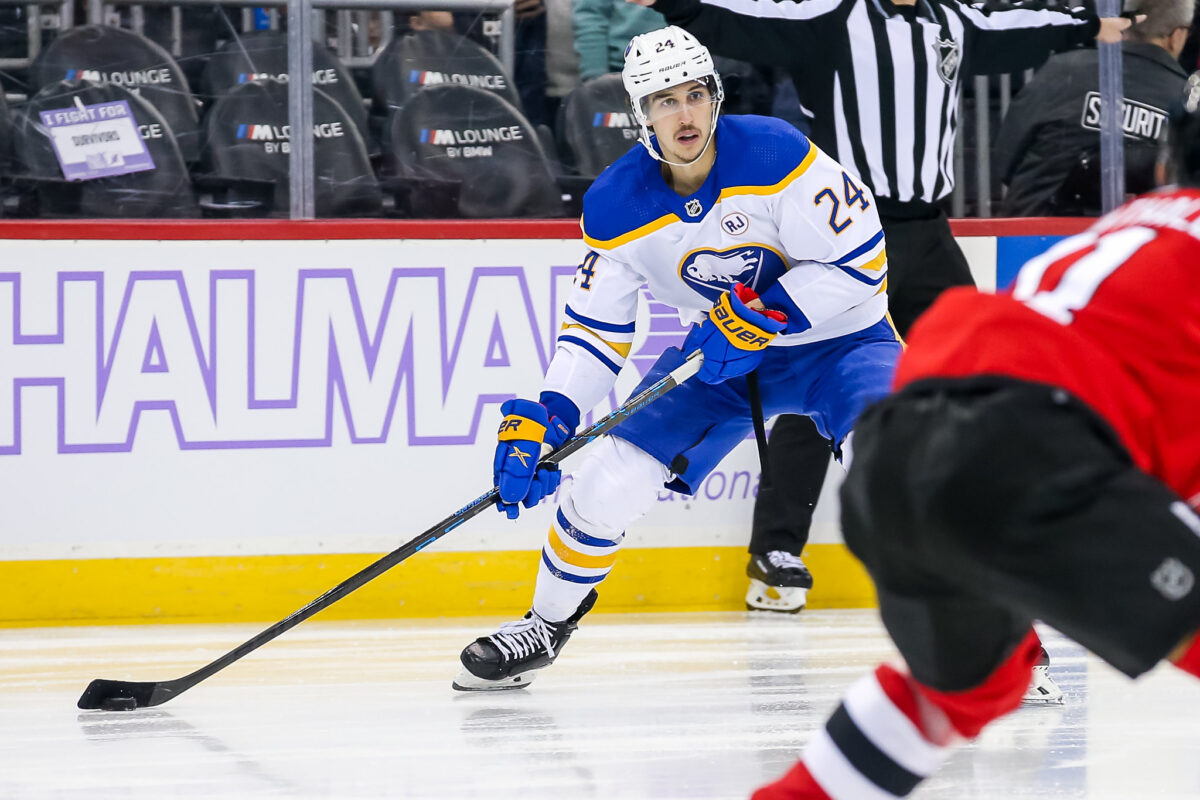
Another key aspect that now connects them is their head coach, Lindy Ruff. Both of these players have played for Ruff and struggled under his leadership. While some assumed a player like Cozens would thrive under Ruff, it appears that the opposite is happening, as he is on pace to have his lowest point total in a full season since he was a sophomore. Stafford also found struggles under Ruff, as the two did not seem to mix well. As their play styles look so similar, it leaves one wondering if there is something about that kind of player that Ruff does not coach well.
Comparing Cozens and Stafford’s Numbers
When comparing Stafford and Cozens, there are a few key elements that need to be looked at. First is the circumstances that brought them into the NHL. Stafford was the 13th overall in the 2004 NHL Draft and Cozens seventh overall in 2019. After having high expectations, both took a fairly quick path to the NHL as Stafford received his full-time call-up in 2006-07, a mere two seasons after he was drafted, and Cozens played as one of the Sabres’ “COVID call-up” players in 2020-21, also two seasons after he was drafted. When each of them played in their debut seasons, they both played 41 games in their respective campaigns, with Stafford having the edge in points as he put up 27 to Cozens’ 13. In this regard, Stafford will get a little less credit, as the team he was a part of was a Presidents’ Trophy-winning team, and Cozens’ group went on to be last in the NHL.
Comparing the rest of their major numbers across seasons is where it gets interesting and eerily similar. Stafford had a breakout season in 2010-11, where he managed to put up 31 goals and 52 points; a career high that he would only come close to one more time. Then, for Cozens, in 2022-23, just his third NHL season, he had his breakout when he put up a rock-solid 31 goals and 68 points. In the two seasons since then, he has struggled to find the form that brought him that success.
Another stat that is close between them is their shooting percentage. By the end of his career, Stafford had a shooting percentage of 10.5%, and as it stands today, Cozens is at 10.2%. During their breakout seasons, Stafford was at a staggering 17.3%, and Cozens was at 14.7%. Both of them were efficient and lethal shooters during those seasons, but something fell off that held Stafford back, and it seems to be holding Cozens back too. The real question is, can he recover from it, to save his career?
What Does Cozens’ Future Look Like?
Stafford steadily had his career trail off after his career season, and he never looked like the same player. He went from potentially scoring a hat trick each night and being a scoring threat to any goaltender, to just another third-line forward who happened to be playing that night. This is why he was ultimately traded to the Winnipeg Jets as part of the blockbuster deal for Evander Kane in 2015. As Cozens now has his name swirling in trade rumors constantly, what will his fate end up being? Will he turn things around and find his way back to form as the 25-30-goal top-six forward that the Sabres are paying him to be? Or will he be moved out as part of a major deal that restructures the Sabres yet again as his career takes a drastic turn in a different direction?
Related: 3 Goals the Buffalo Sabres Need to Achieve Before the Offseason
The signs are currently pointing towards the latter as Cozens continues to show more and more signs of regression in Buffalo. It is not a knock on his potential or skill as a young forward in the NHL, but it looks like he has stalled in his development in a Sabres uniform. Getting him on another team sooner than later may save him from the downward spiral fate that Stafford suffered from, and getting this kid back to looking like he loves the game of hockey will make a world of difference.
When he burst into the NHL, Cozens could always be seen with a smile on his face regardless of the score or scenario, and now, he looks like he sees nothing but the ghosts of the losses haunting him daily when he is on that bench. Hopefully, there will be action regarding him soon, and he does not end up being the next Drew Stafford who gets tucked away in the “wasted potential” history books.
